False Consensus Effect
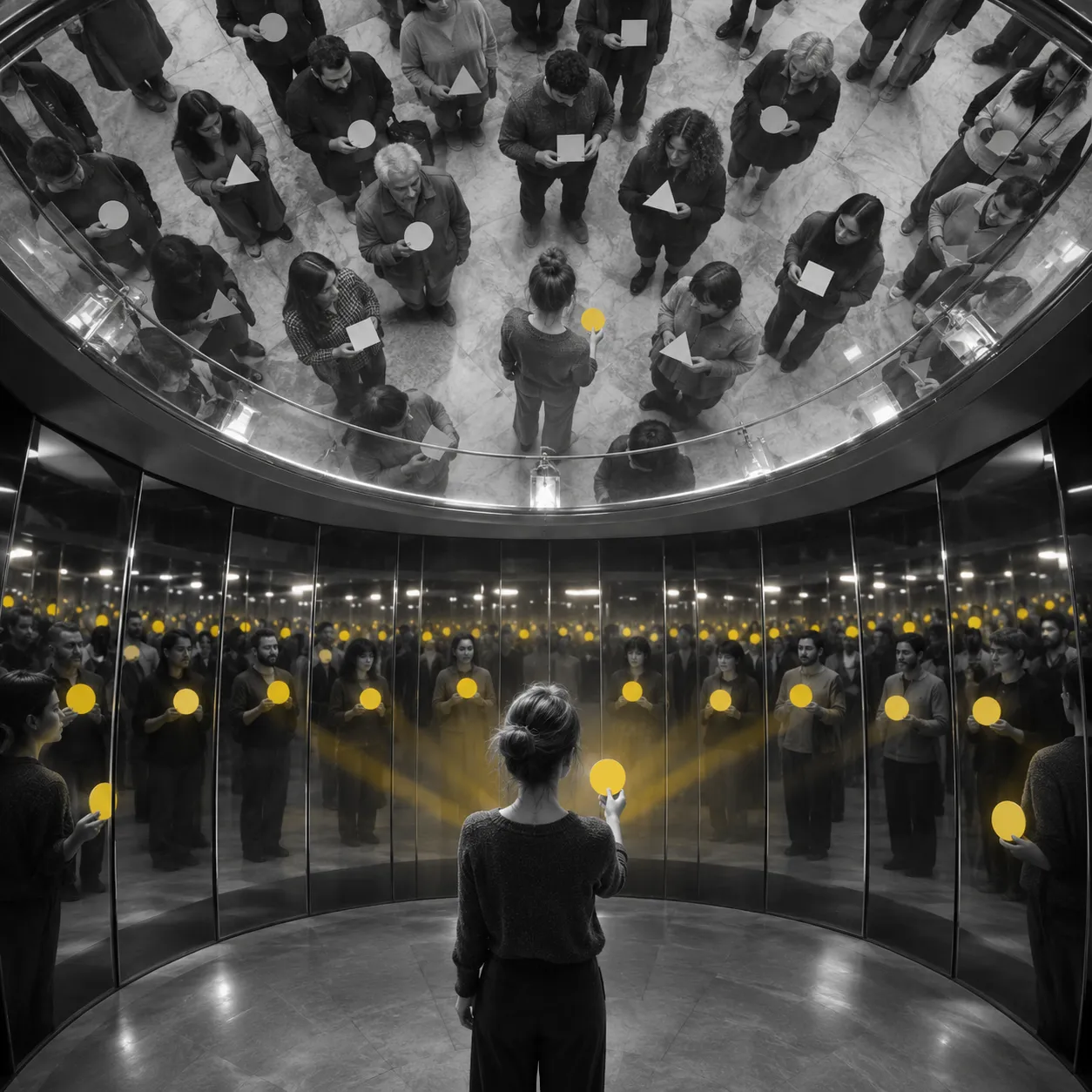
The false consensus effect is the tendency to see one's own choices, beliefs and habits as more common than they are, and other people's as rarer. People who do one thing estimate that more others do it than people who do the opposite. The pattern was named in a 1977 paper by Lee Ross and colleagues and has been tested across many studies since, including a 1985 meta-analysis that combined 115 hypothesis tests and a large replication project in 2018. A 1994 set of experiments found that the tilt remained among participants who had been taught about it.
What it is
The false consensus effect describes how people estimate prevalence. Asked what share of other people would make a given choice, hold a given view or own a given thing, people who themselves made the choice, hold the view or own the thing give higher answers than people who did not. The word false refers to the estimate, which leans towards the estimator's own position, and not to any claim that people know nothing about others.
Lee Ross and colleagues named the effect in a 1977 paper in the Journal of Experimental Social Psychology, titled around an egocentric bias in social perception and attribution. Two later syntheses show how quickly it became a research field. A 1985 meta-analysis in the same journal combined 115 hypothesis tests of the effect, and a 1987 review in Psychological Bulletin looked back over ten years of research, covering both the findings and the theories offered to explain them. This page does not rank those explanations.
One account of the mechanism is an inference. A person's own view is an observation from the group, and weighting it can look reasonable. In a 1994 paper in the Journal of Personality and Social Psychology, Joachim Krueger and a co-author argued that the pattern reflects egocentrism rather than sound statistical reasoning, and they tested the argument in three experiments, described below.
The standard way of measuring the effect compares two groups, such as people who agreed to a request and people who refused it, and checks whether each group's estimate favours its own choice. Krueger has pointed out that in this design each respondent gives one judgement, so a gap between the groups could come from how either group judges others or from how either group is judged, and the design cannot separate these. He has proposed designs with several groups of judges and several groups being judged.
In effect
The best-known demonstration is the sandwich board request. Students were asked whether they would walk around campus wearing a sandwich board that advertised a restaurant, and then what share of their fellow students would agree. In Krueger's account of the study, students who agreed estimated that roughly 60 per cent of others would also wear the board, and students who refused estimated that roughly 30 per cent would. Each group placed its own choice in the majority. The Many Labs 2 project, which re-ran published findings across many samples and settings, included this comparison between what people chose and what they estimated others would choose, and recorded it as replicating.
The 1994 experiments asked whether the tilt can be removed. In the first, participants estimated how many people in the population would agree with each of 40 personality statements. The tilt towards their own answers remained among participants who had been taught about the bias, among those given feedback on the real level of agreement, and among those given both. In the second, participants judged another person to show the bias, yet their own estimates stayed closer to their own answers than to that person's. In the third, the tilt remained even when participants had been shown unanimous answers from 20 randomly chosen others.
An everyday version appears in Richard Shotton's The Choice Factory. Shotton heard colleagues say they did not project their own habits onto their audience, so he asked colleagues and clients what share of the population owns an iPhone and whether they owned one. Owners guessed about half, and non-owners guessed about a third. The book does not give the number of people asked, so the figures show a direction and not a measured size.
For anyone who plans for an audience, the practical reading is an interpretation and not a finding of these studies. A planner's own habits are a poor guide to how common those habits are, and a comparison between the guesses of people who differ in the habit in question shows whether the tilt is present. A count from the real audience replaces the guess.
What it does not say
It does not say that people know nothing about others. The research concerns a tilt in estimates, and the studies above report that estimates differ by the estimator's own position, not that they are uniformly wrong.
It does not say that teaching is pointless. The 1994 experiments report that the tilt remained in their designs after participants were taught about the bias, given feedback or both. They do not test every form of training or every setting.
It does not say why any one person gave any one estimate. Krueger's point about the standard two-group design is that the same gap can have several sources.
It is not the curse of knowledge. That idea concerns misjudging what other people know, and the false consensus effect concerns misjudging what they do, choose or believe. Shotton places the iPhone question in his chapter on the curse of knowledge, and the two are best kept apart.
It is not pluralistic ignorance, which runs the other way. There, people privately reject a norm and assume nearly everyone else accepts it, so a widely held private view feels rare. Todd Rose's Collective Illusions addresses that reverse misreading of the crowd.
It does not supply a forecast. The 60 and 30 per cent figures describe students' estimates in one set of studies and say nothing about how many people would respond to a request in another setting.
Sources
- Ross, L., Greene, D., & House, P. (1977). The "false consensus effect": An egocentric bias in social perception and attribution processes. Journal of Experimental Social Psychology, 13(3), 279-301. https://doi.org/10.1016/0022-1031(77)90049-X
- Krueger, J., & Clement, R. W. (1994). The truly false consensus effect: An ineradicable and egocentric bias in social perception. Journal of Personality and Social Psychology, 67(4), 596-610. https://doi.org/10.1037/0022-3514.67.4.596
- Mullen, B., Atkins, J. L., Champion, D. S., Edwards, C., Hardy, D., Story, J. E., & Vanderklok, M. (1985). The false consensus effect: A meta-analysis of 115 hypothesis tests. Journal of Experimental Social Psychology, 21(3), 262-283. https://doi.org/10.1016/0022-1031(85)90020-4
- Marks, G., & Miller, N. (1987). Ten years of research on the false-consensus effect: An empirical and theoretical review. Psychological Bulletin, 102(1), 72-90. https://doi.org/10.1037/0033-2909.102.1.72
- Klein, R. A., et al. (2018). Many Labs 2: Investigating variation in replicability across samples and settings. Advances in Methods and Practices in Psychological Science, 1(4), 443-490. https://doi.org/10.1177/2515245918810225
- Krueger, J. I. (2018, 19 December). People are like me. Psychology Today, One Among Many. https://www.psychologytoday.com/us/blog/one-among-many/201812/people-are-me
- Shotton, R. The Choice Factory.
- Rose, T. Collective Illusions.
In these themes
- Biases and Heuristics
The mental shortcuts we rely on, and how well the evidence for each holds up.