Fertile Green
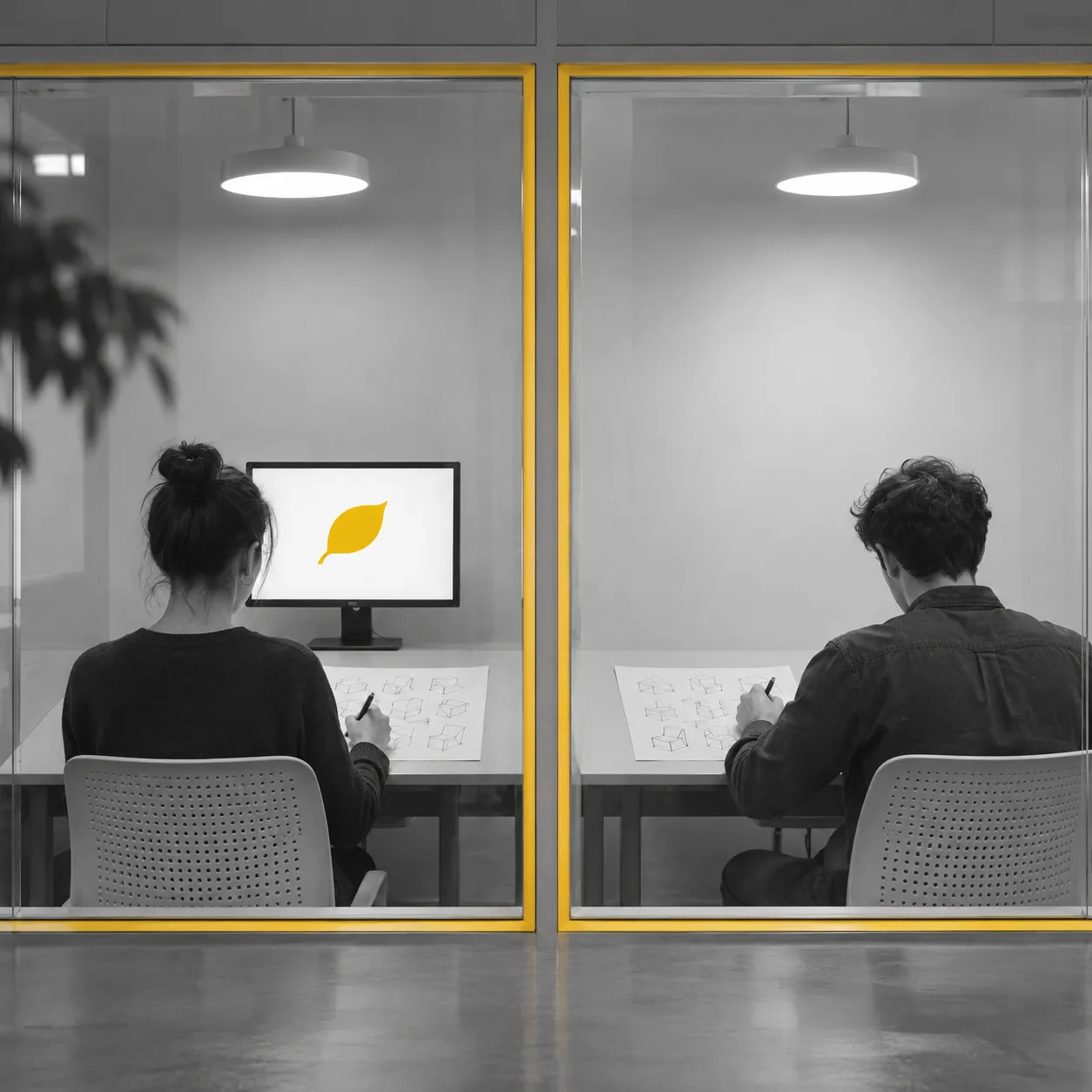
Fertile green is the finding that a brief glimpse of green before a creativity task improved creative performance. Stephanie Lichtenfeld, Andrew Elliot, Markus Maier and Reinhard Pekrun reported it in 2012 across four experiments. A 2018 experiment by Lichtenfeld and three co-authors, with green on a workspace wall, found no influence on creativity. The pair shows how a colour result can change with the set-up.
What it is
The name comes from the title of the 2012 paper, Fertile green: Green facilitates creative performance. The idea is that green, as a colour with a functional meaning, can change how people perform on tasks of a certain kind. The paper extends earlier work on colour and psychological functioning, much of which concerned red and blue, to green.
It is a laboratory finding about creativity. It is not a finding about trust, about shopping or about brands, and the Why We Project uses it only as the best-known set of experiments on green alone.
In effect
In the four experiments reported in 2012, a brief glimpse of green before a creativity task improved creative performance. The effect appeared against contrast colours that were achromatic and against contrast colours that were chromatic, matched with green on properties other than hue, and with picture-based and word-based measures of creativity. Participants were unaware of the purpose of the study. The glimpse of green changed neither self-reported mood nor positive activation. The authors argued that the findings have implications beyond aesthetics and called for sustained empirical work on the functional meaning of green.
In 2018, Lichtenfeld, Maier, Buechner and Elliot asked whether ambient green on a workspace wall, compared with red, would enhance creativity. A methodologically sound experiment found no influence. The authors cautioned that null results require careful interpretation, said the data do not support a link between ambient green and creativity, and warned against real-world recommendations before a firm empirical base exists.
The two studies used different set-ups, a brief glimpse in one and an ambient wall colour in the other, so neither overturns the other. Read together, they fit the colour-in-context view that a colour's effect depends on the setting in which it appears.
What it does not say
Fertile green does not show that green walls, green packaging or green logos make people more creative or more trusting. It does not identify the mechanism. The summary on this page rests on the abstracts of both papers, with bibliographic details checked against Crossref. The 2012 work remains a result from one research group, and the 2018 null is a reminder that the effect has not been shown to carry from the brief-glimpse set-up to every setting.
Sources
- Lichtenfeld, S., Elliot, A. J., Maier, M. A., & Pekrun, R. (2012). Fertile green: Green facilitates creative performance. Personality and Social Psychology Bulletin, 38(6). https://doi.org/10.1177/0146167212436611
- Lichtenfeld, S., Maier, M. A., Buechner, V. L., & Elliot, A. J. (2018). Ambient green and creativity. Creativity Research Journal, 30(3). https://doi.org/10.1080/10400419.2018.1488197