Fiction as a Safe Frame
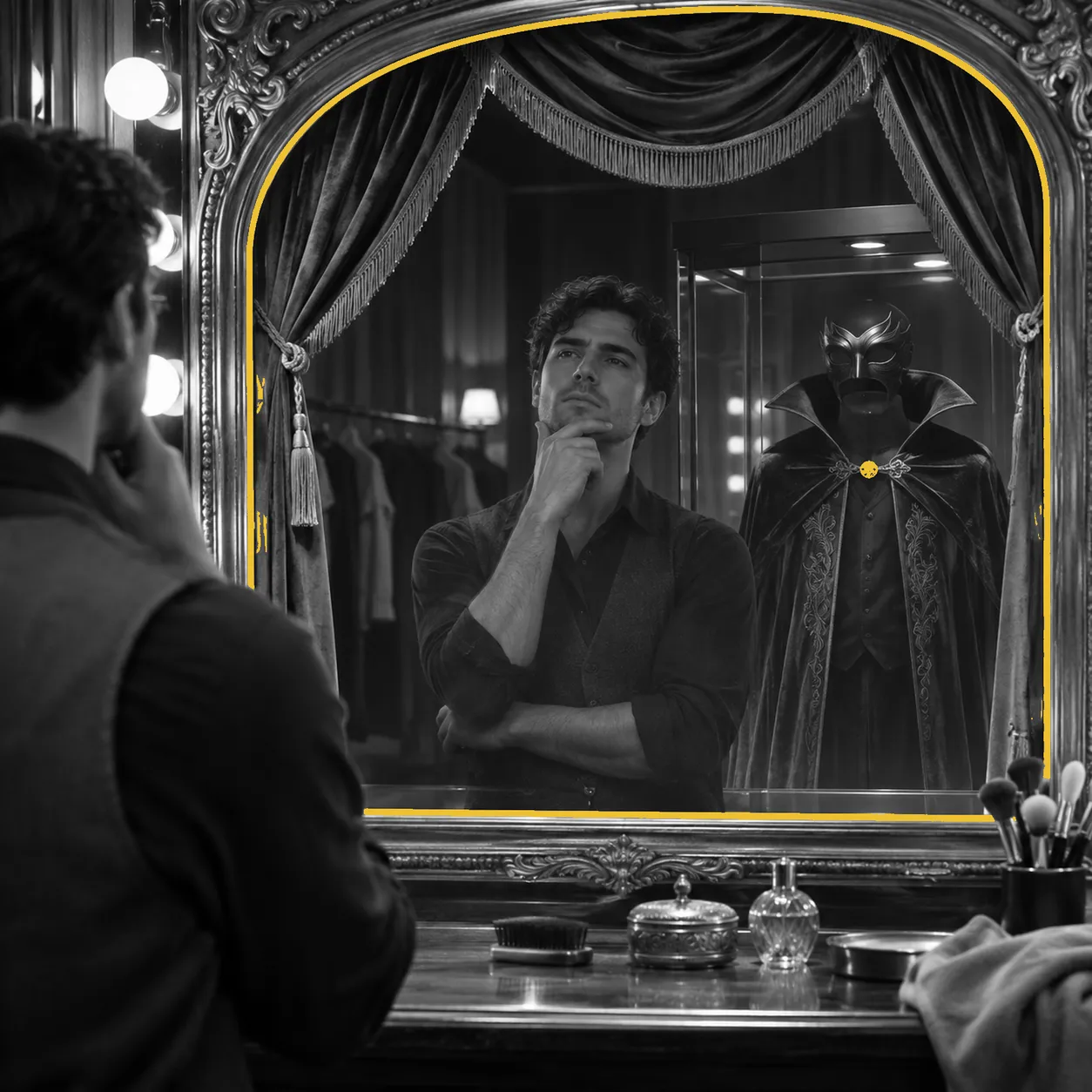
Fiction as a safe frame is the proposal that a story lets a person notice a resemblance to a negative character without a cost to their self-image.
What it is
In the work by Krause and Rucker, an online study of 100 university students found that a match to a fictional villain was rated as less uncomfortable than a match to a real villain. In an experiment with 397 participants, people led to believe that stories offer no shield from social judgement lost interest in a film when told they resembled its villain. Both findings are reported in a university research magazine and a society news release, and the authors raised the safe-exploration idea for further research.
The frame is the boundary between a story and life: what happens in fiction stays in fiction, so the resemblance can be examined without consequence.
In effect
In the article on why we love villains, the frame explains why resemblance is attractive in a character and uncomfortable in a person. A viewer can look at a darker version of themselves from a safe distance.
What it does not say
It does not say that every viewer uses fiction this way. The authors presented the idea as a direction for further research, not a settled result. It does not suggest that resembling a villain says anything about a person's character.
Where it comes from
The idea comes from Krause and Rucker's 2020 study in Psychological Science, volume 31, issue 5. They analysed records from an online character-quiz site with about 232,000 registered users and found that people preferred villains who resembled them. They then ran five laboratory experiments with 1,685 participants. The safe-exploration idea was raised by the authors as an explanation worth further research.
What the research found
Two experiments were reported in public summaries of the work. In one, 100 students rated matches to fictional villains as less uncomfortable than matches to real villains. In the other, with 397 participants, removing the sense that stories are socially safe lowered interest in a film for viewers who resembled its villain. The news release from the Association for Psychological Science adds that the pull toward similar characters was strongest for villains, that the data did not show which traits drew people in, and that the authors raised the safe-exploration idea for further research.
Busselle and Bilandzic's 2008 mental models framework in Communication Theory offers a compatible point: knowing a story is fictional does not disrupt absorption, while clashes with the real world or with the story's own rules do. That paper is a theoretical synthesis with no new experiment.
Where opinion differs
The authors present safe exploration as a possible explanation and not a settled result. Other accounts of why people like villains stress identification with a character's goals, discussed under antihero enjoyment and wishful identification, or the thrill of departing from rules. The studies do not set these against each other. This site presents the safe frame as one reading among several.
How this site uses it
The Why We Project uses fiction as a safe frame in the article Why We Love Villains, to explain why resemblance is attractive in a character and uncomfortable in a person. The explanation is the researchers' proposal, held here as such.
Sources
- Krause, R. J., & Rucker, D. D. (2020). Psychological Science, 31(5), 518-530.
- Busselle, R., & Bilandzic, H. (2008). Communication Theory, 18(2), 255-280.