Fitts's Law
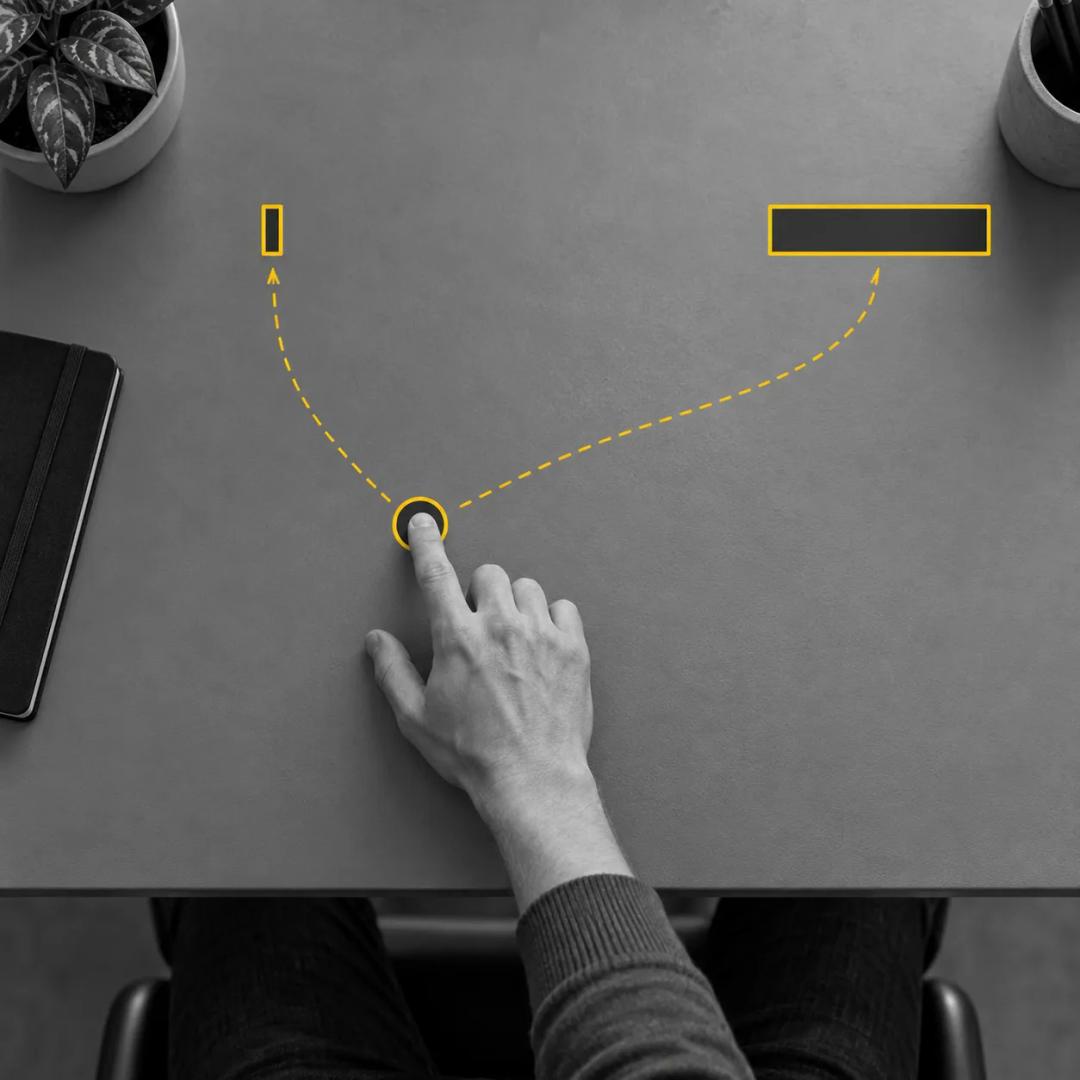
Fitts's law is the finding that the time needed to move to a target depends on the ratio of the target's distance to its width. Paul Fitts reported the relationship in 1954, from tapping and transfer tasks that used the arm and hand. Researchers in human-computer interaction later fitted it to pointing devices, and designers draw on it when they decide how large to make a control and where to put it.
What it is
Fitts's 1954 paper in the Journal of Experimental Psychology asked whether the human motor system has a roughly fixed capacity for handling information when it controls the amplitude of a movement. He borrowed a measure from communication engineering and treated a movement as a message worth a number of bits. The difficulty of a movement, in bits per response, came from the ratio of its amplitude to the tolerance, which is the width of the target. Dividing that difficulty by the average movement time gave a rate in bits per second.
Three tasks supplied the data. In reciprocal tapping, sixteen right-handed college men struck two target plates alternately with a stylus, at amplitudes from two to sixteen inches and target widths from a quarter of an inch to two inches. A second group of sixteen men did a disc transfer task, moving washers from one pin to another. Twenty students, ten men and ten women, did a pin transfer task, moving pins between sets of holes. In the two transfer tasks errors were not permitted. Performance rate stayed roughly constant across a central range of amplitudes and tolerances and fell off outside that range, and the best rate across the three tasks was about ten to twelve bits per second.
A constant rate means that movement time grows in step with difficulty. The modern statement of the law expresses this as movement time equal to one constant plus a second constant multiplied by the logarithm of a distance-to-width ratio, with the two constants fitted separately for each device and task. The logarithm gives the law its shape: doubling the width of a target removes the same amount of difficulty at any distance, and doubling the distance adds the same amount at any width.
I. Scott MacKenzie's 1992 paper in Human-Computer Interaction set out how the law was adapted for computing. Fitts's own index of difficulty used the logarithm of twice the amplitude over the tolerance. MacKenzie argued that a revised index, the logarithm of the distance-to-width ratio plus one, is more soundly based in information theory, and noted that it cannot return a negative difficulty when targets overlap, which the original form can.
In effect
The law moved from laboratory motor tasks to computing in 1978, when Stuart Card, William English and Betty Burr compared four ways of selecting text on a display in the journal Ergonomics. The devices were a mouse, a rate-controlled isometric joystick, step keys and text keys. According to the abstract, the mouse was fastest on all measures and had the lowest error rates. Positioning times for the mouse and the joystick fitted Fitts's law. The slope for the mouse was close to values found in other eye-hand tasks, which the authors took as a suggestion that its positioning time was near the minimum achievable. For the key-based devices, positioning time was proportional to the number of keystrokes required, so those devices sat outside the distance-and-width scale.
MacKenzie's 1992 paper reviewed six studies that used the law to predict cursor-positioning and selection times with mice, trackballs, joysticks, touchpads, helmet-mounted sights and eye trackers. The performance measures in those studies varied enormously, which made comparison between studies difficult, and the paper identifies sources of experimental variation that might account for the differences. A 2004 review by R. William Soukoreff and MacKenzie in the International Journal of Human-Computer Studies carries the title Towards a standard for pointing device evaluation, with the subtitle perspectives on 27 years of Fitts's law research in HCI.
In design practice the law appears as a rule about layout. Jon Yablonski's Laws of UX lists it among ten design heuristics and presents it as guidance for making touch targets large, well spaced and within easy reach. The book gives examples such as placing a submit button near the last field of a form, and treating the edge of a screen as a target the pointer cannot overshoot. Within the terms of the law there are two levers, a wider target and a shorter path, and each acts on the same ratio.
What it does not say
The 1954 experiments measured movements of the arm and hand to targets of fixed distance and width. Layout advice for forms, menus and touch screens is built on the law and is a design extension of those experiments, not a result they reported. The screen-edge example, for instance, depends on the pointer stopping at the display boundary, which is a property of the interface and not of the original tasks.
The law does not give a single throughput figure for a device. MacKenzie's review found that reported performance measures varied enormously across studies, and he lists differences in experimental procedure among the reasons, so a number quoted for a device depends on how the test was run. The law also describes movement time, and says nothing on its own about which control a person should be asked to reach for.
The Why We Project treats the law as a well-supported relationship for pointing and aiming movements, and as a source of design heuristics whose application to a particular interface is a matter for testing in that interface.
Sources
- Yablonski, J. Laws of UX. Seed book for the article What is Fitts's law?
- Fitts, P. M. (1954). “The information capacity of the human motor system in controlling the amplitude of movement.” Journal of Experimental Psychology, 47(6), 381-391. doi:10.1037/h0055392
- Card, S. K., English, W. K., & Burr, B. J. (1978). “Evaluation of mouse, rate-controlled isometric joystick, step keys, and text keys for text selection on a CRT.” Ergonomics, 21(8), 601-613. doi:10.1080/00140137808931762
- MacKenzie, I. S. (1992). “Fitts' law as a research and design tool in human-computer interaction.” Human-Computer Interaction, 7(1), 91-139. doi:10.1207/s15327051hci0701_3
- Soukoreff, R. W., & MacKenzie, I. S. (2004). “Towards a standard for pointing device evaluation, perspectives on 27 years of Fitts' law research in HCI.” International Journal of Human-Computer Studies, 61(6), 751-789. doi:10.1016/j.ijhcs.2004.09.001