Free-Choice Persistence
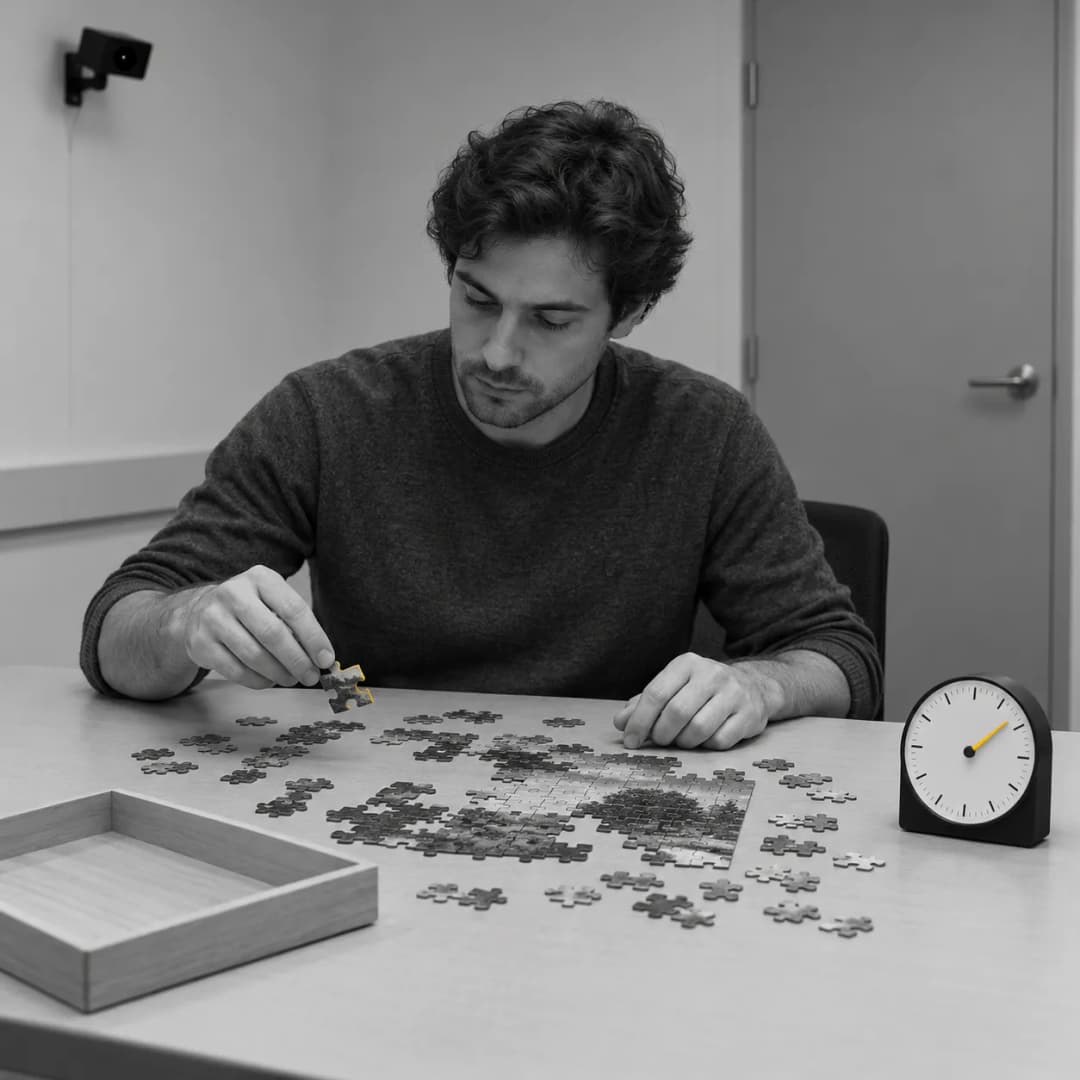
Free-choice persistence is the outcome measure the whole reward-and-motivation literature inherited from its first experiment. The participant is left alone with the puzzle, the drawing materials or the game still available, and the clock runs. Deci, Koestner and Ryan's 1999 meta-analysis defines it as the degree to which participants return to and persist at the target activity in a free-choice period after the experiment, and records that more than nine in ten of its 128 studies measured it as seconds spent on the activity.
What it is
The measure is attributed to Edward Deci's 1971 experiment at the University of Rochester, in which participants worked on four variations of a three-dimensional puzzle called SOMA and were paid a dollar for each one completed in the allotted time. The description comes from the 1999 meta-analysis rather than from the 1971 paper itself, whose only openly available copy is an unreadable image scan, so no sample size from it appears here.
What the measure gives is revealed behaviour in a situation with no instruction and no payment, which is a genuinely better thing to have than a questionnaire and the main reason this literature is as persuasive as it is. What it does not give is liking, interest, meaning or anything a reader would recognise as the love in the phrase about paying for something killing the love.
The gap between the two shows up as a split inside the same meta-analysis, and it is the single most informative number pair in the dispute. Across all rewards, 101 free-choice studies give d = -0.24 with a confidence interval of -0.29 to -0.19, while 84 self-report studies give d = +0.04 with an interval of -0.02 to 0.09, which is not significant. For all tangible rewards specifically, 92 free-choice studies give d = -0.34 against 70 self-report studies at d = -0.07. People spent measurably less time on the activity afterwards and said almost nothing different about it.
The magnitude in units a reader can hold comes from the opposing camp, which is what makes it worth quoting. Judy Cameron, then at the University of Alberta, and W. David Pierce give their own meta-analytic effect for the single harmful condition as -0.26 on time on task after withdrawal. Using a pooled standard deviation of 2.6 minutes from Pretty and Seligman's 1984 experiments, two studies with thirty per cell on an eight-minute free period, they calculate that the average person promised a non-contingent tangible reward spends about forty-one seconds less on the task than the average unrewarded person, or about three minutes twenty-five seconds in a forty-minute free period.
The structural problem with the measure was found by the people who went looking for it. Constanca Esteves-Sorenson, then at Yale University, and Robert Broce reviewed more than a hundred prior tests of crowding out and reported that the typical sample size was about fifteen participants and that not one of them jointly reported time on task, output and productivity. In their own field experiment the three measures disagreed: with pay withdrawn, output and productivity did not fall, and time on task fell by a small and statistically insignificant amount. Where the measures disagree, the choice of measure decides the finding, and for thirty years the field almost always chose the same one.
In effect
The puzzle left on the table
The founding research case is the design itself. A participant finishes the experimental task, the experimenter leaves on a pretext, and the puzzles remain within reach alongside magazines. Seconds spent on the puzzle in that interval is the dependent variable. It is an elegant design because nothing is asked and nothing is required, and it is a narrow one because the only thing it can distinguish is how long somebody chose to keep going.
The ambiguity nobody has resolved
In everyday terms, imagine being paid to do something you enjoyed and then, after the payment stops, doing less of it in the next free half hour. One reading is that the wanting has been damaged. Another is that you have concluded the unpaid phase is over, which is a perfectly rational inference about a situation rather than a change in what you like. The measure cannot tell those two apart, and that ambiguity sits underneath every number in this literature. It is also the reason the self-report results matter: if the liking had genuinely gone, the self-reports would be expected to move, and across eighty-four studies they did not.
The cookie-tasting field test, and why outcome choice is a commercial question too
Esteves-Sorenson and Broce ran the canonical two-session design properly on an activity people had volunteered to do unpaid, tasting and rating cookies for a market research exercise, without knowing they were in an academic study. The paid group were told they would receive seventy-five cents per cookie and then, at the start of session two, that payment had stopped. They did not produce less than controls and were not less productive, rating slightly more cookies slightly faster, with a small insignificant fall in time on task. Their written evaluations were sloppier, which the authors read as a response to unmet pay expectations rather than as crowding out. A manager deciding whether an incentive has backfired faces exactly this choice of instrument: hours logged, units produced, or quality of the work, and the three can point three ways.
What it does not say
It does not measure enjoyment. It measures seconds, and the self-report half of the same literature barely moves.
It does not distinguish a damaged motive from a reasonable inference about the end of the paid phase.
It is not the same as the free-choice paradigm, which is a different instrument belonging to the cognitive dissonance literature and concerns rating items, choosing between two of them and reading the change. The names are confusingly similar and the two measure unrelated things.
It is not the whole picture of what a reward does. In the best-designed field test, output, productivity and quits did not move in the direction the measure predicts, and the one harm found was to quality of work.
Who developed it
The measure is attributed to Edward Deci, Professor Emeritus at the University of Rochester, from his 1971 experiment, by the authors of the 1999 meta-analysis, which was read at source. The forty-one-second conversion is Judy Cameron and W. David Pierce's, both then at the University of Alberta. The review that exposed the outcome-selection problem is Constanca Esteves-Sorenson's, then at Yale, with Robert Broce of Southern Connecticut State University.
Sources
- Deci, E. L., Koestner, R., & Ryan, R. M. (1999). "A Meta-Analytic Review of Experiments Examining the Effects of Extrinsic Rewards on Intrinsic Motivation." Psychological Bulletin, 125(6), 627-668. doi:10.1037/0033-2909.125.6.627. Read at source to printed page 643 of 668; the General Discussion was not reached and nothing is quoted from it.
- Cameron, J., & Pierce, W. D. (1996). "The Debate About Rewards and Intrinsic Motivation." Review of Educational Research, 66(1), 39-51. Full text read at source. The forty-one-second conversion is theirs.
- Esteves-Sorenson, C., & Broce, R. (2022). "Do Monetary Incentives Undermine Performance on Intrinsically Enjoyable Tasks? A Field Test." The Review of Economics and Statistics, 104(1), 67-84. doi:10.1162/rest_a_00947. Abstract read in full; full text not read. Design detail from the MIT Press Reader interview of 19 November 2020.
- Deci, E. L. (1971). "Effects of externally mediated rewards on intrinsic motivation." Journal of Personality and Social Psychology, 18(1), 105-115. NOT READ; the open copy is an unreadable image scan. The attribution of the measure to this paper is the 1999 authors' own.