Free Sampling
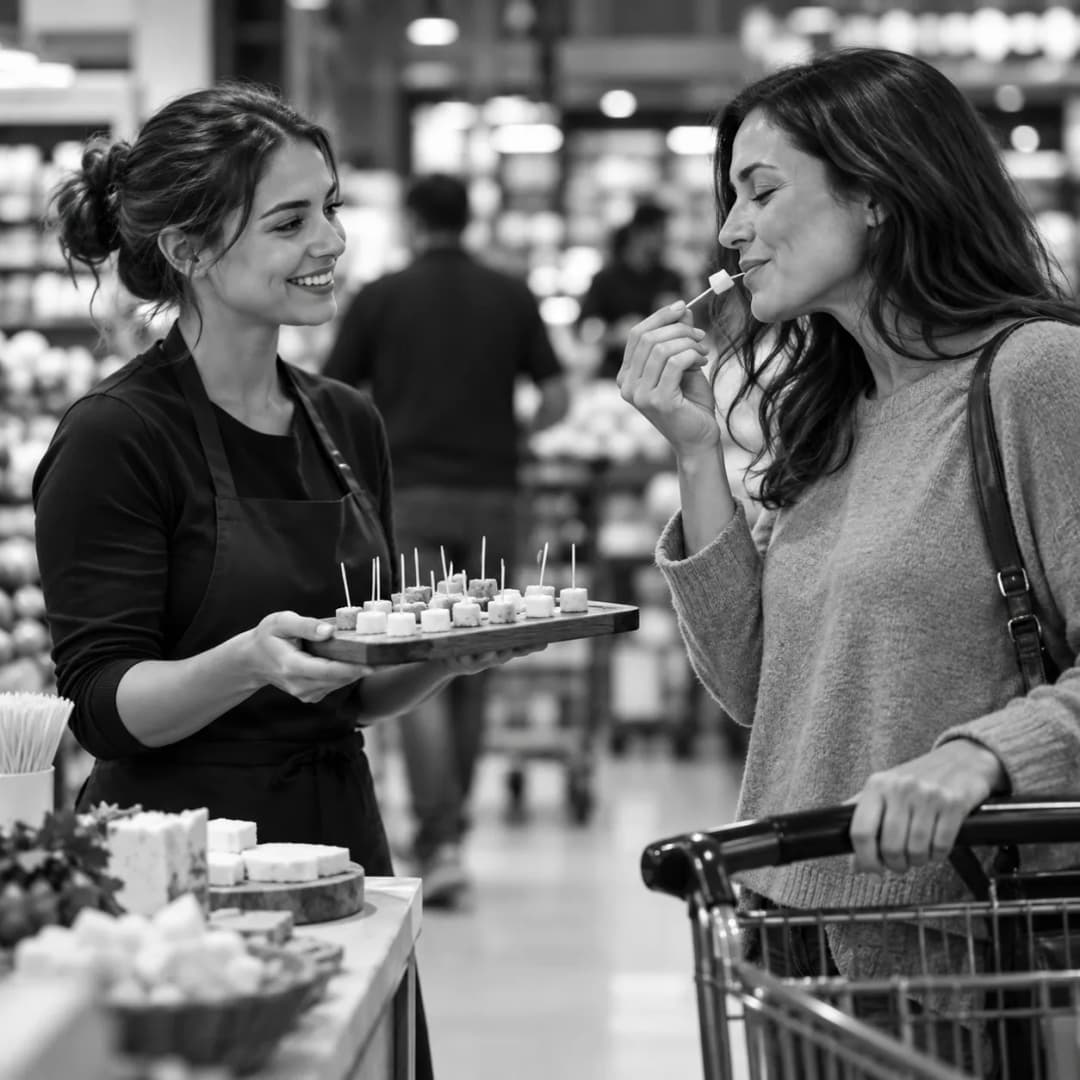
Free sampling means giving shoppers a free taste or trial of a product. It works through two routes at once. A sample is information, a chance to discover that you like something, and it is also a small gift that can create a pull to give something back. Field studies find samples very effective at getting people to try a product, with sales effects that vary widely between brands.
What it is
Carrie Heilman and colleagues studied a free-sample programme run by a US grocery chain, covering six products over six weekends, and published the results in 2011. Sampling was very effective at inducing trial, especially among less-educated shoppers. For people already planning to buy in the category, a sample could switch them to the promoted brand; for others, it could draw them into the category. Shoppers who interacted with the person handing out samples seemed more likely to buy.
Two field experiments reported in Marketing Science in 2004 found that free samples, unlike coupons, could raise a brand's sales for as long as 12 months after the promotion. They broke the effect into people settling into the brand sooner, people not paying for a trial they would have bought anyway, and new buyers drawn in by the sample.
In effect
The gift route shows up in what people buy straight after a taste. In a 1991 study of a chocolate shop, a free sample on entry raised sales immediately, but only for small purchases and only for varieties other than the one sampled. Robert Cialdini's Influence argues that a free sample "is also a gift", so it can engage reciprocity while appearing only to inform.
What it does not say
Free sampling does not guarantee a sale, and its effect is not uniform. The 2004 experiments found large differences even between brands in the same category. Research on reciprocity also suggests the gift route is short-lived: Jerry Burger and colleagues found in 1997 that the pull to return a small favour was strong after about five minutes and had faded after a week. A sample that arrives long before any purchase, or with no giver present, has less reason to work through obligation, and any effect is more likely to come from people learning that they like the product.
Sources
- Heilman, C. M., Lakishyk, K., & Radas, S. (2011). An empirical investigation of in-store sampling promotions. British Food Journal, 113(10), 1252-1266. doi:10.1108/00070701111177674
- Bawa, K., & Shoemaker, R. (2004). The effects of free sample promotions on incremental brand sales. Marketing Science, 23(3), 345-363. doi:10.1287/mksc.1030.0052
- Lammers, H. B. (1991). The effect of free samples on immediate consumer purchase. Journal of Consumer Marketing, 8(2), 31-37. doi:10.1108/07363769110034992
- Burger, J. M., Horita, M., Kinoshita, L., Roberts, K., & Vera, C. (1997). Effects of time on the norm of reciprocity. Basic and Applied Social Psychology, 19(1), 91-100. doi:10.1207/s15324834basp1901_7
- Cialdini, R. B. (2021). Influence, New and Expanded: The Psychology of Persuasion. Harper Business.