Greenwashing
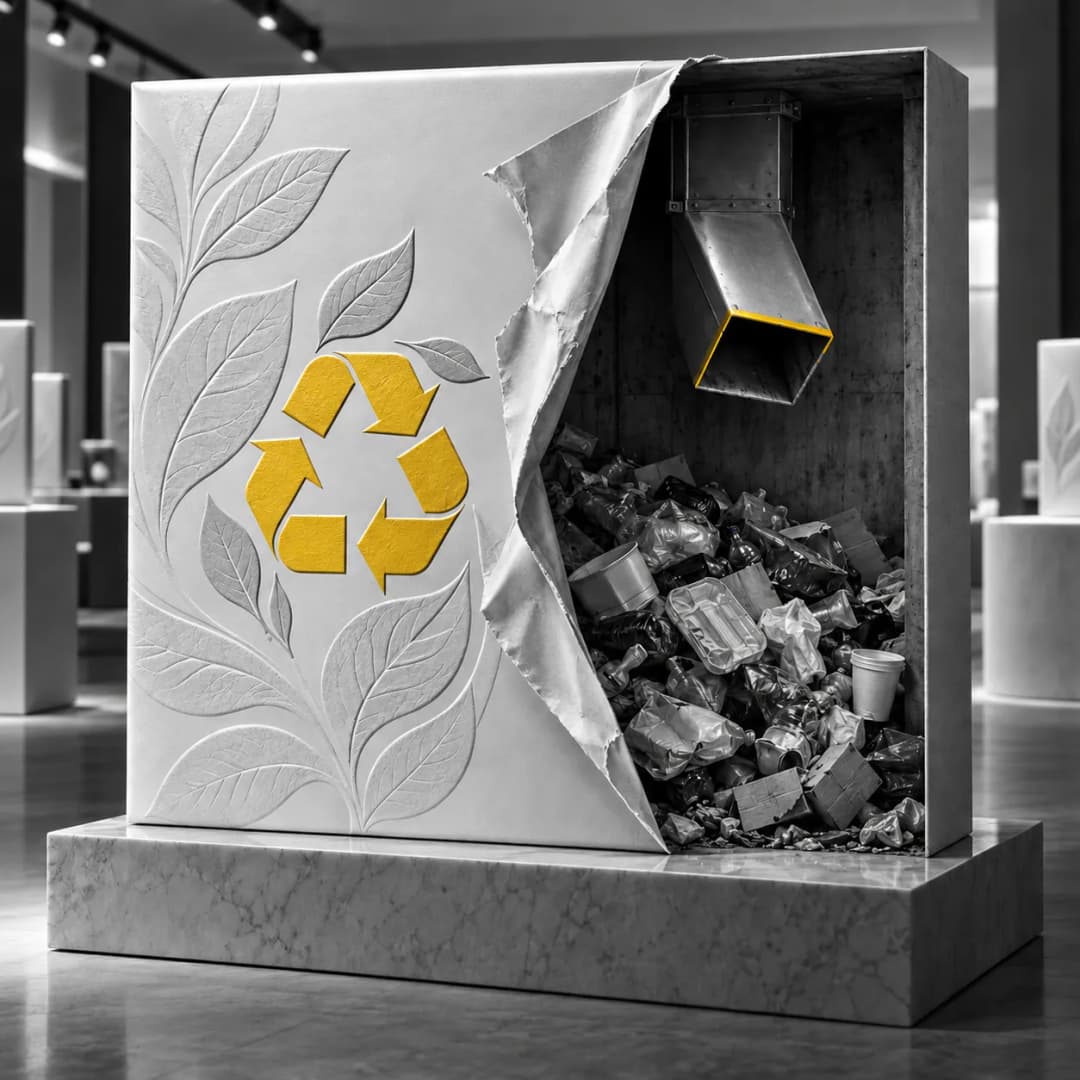
Greenwashing is an environmental claim that works as marketing without a system behind it. The definition used here is McKinsey and NielsenIQ's own, empty or misleading claims about a product's environmental or social merits, printed on the same page where they state that they made no attempt to assess whether any claim in their own dataset was true. The recycling promise is the longest-running documented case, which is why it anchors this page.
What it is
The term covers a spectrum from a false statement to a true statement that cannot be acted on, and the second kind is the common one and the harder one. A mark can be accurate about what a material is and silent about whether anybody will collect it.
Why recycling is the case to learn it from. The gap between the claim and the system is documented at both ends, over decades, in primary material.
The mark. The resin identification code was devised in 1988 to help sorting facilities, and by the early 1990s thirty-nine states had written it into law for rigid containers. The three arrows around the number came from a 1970 design competition and had nothing to do with plastics. California banned the arrows in 2021 on products not regularly collected for recycling.
The reading. "Please Recycle" appeared beside the arrows on packaging that was not recyclable, and surveys showed a majority read it as meaning they could. A 1993 report to senior industry officials said the code was being misused as a green marketing tool.
The system. Roland Geyer, Jenna Jambeck and Kara Lavender Law's material-flow model puts about 9 per cent of the 6,300 megatonnes of plastic waste generated between 1950 and 2015 as recycled, with only 10 per cent of that recycled share recycled more than once. Their own framing is more sceptical than most campaigners' use of their number: recycling delays rather than avoids final disposal, and reduces future waste generation only if it displaces primary production, which they call extremely difficult to establish.
What anybody can document is narrower than what circulates, and keeping that line is the discipline of the subject. Corporate conduct in this story is attributed to the reporting that established it: Saabira Chaudhuri's Consumed, and the NPR and PBS Frontline investigation of 11 September 2020 which worked from internal industry documents. The industry's answer travels with the charge every time, including the Plastics Industry Association's position that the resin code was never an indicator of recyclability and was designed to help facilities sort, and a statement to NPR from a then industry vice president that the industry has never intentionally misled the public about recycling and that the past failure was one of infrastructure and market signals.
No accusation about any named individual is made on this page.
In effect
In the government record: the number that moves without the shopper moving
In the Environmental Protection Agency's 2015 dataset, the United States recycling rate for all plastics was 9.1 per cent, while the rate for polyethylene terephthalate bottles and jars in the same year was 29.9 per cent and for high-density polyethylene natural bottles 30.3 per cent. Same consumers, same year, same bins, a threefold difference by material. No account of shopper psychology separates a person's attitude to a drinks bottle from the same person's attitude to a yoghurt pot. A buyer at the other end does.
In commerce: the strongest case for the claims, and its own limits
The McKinsey and NielsenIQ analysis of 6 February 2023 covered five years of United States sales data to June 2022, 600,000 product lines and 44,000 brands, and found products carrying environmental, social and governance claims growing 28 per cent cumulatively against 20 per cent for products carrying none, with sustainable-packaging claims showing a growth differential of 4.7 per cent over peers. Its authors state plainly that this is correlation, that they did not control for marketing spend, distribution or promotion, and that they checked no claim.
In circulation: the figure with no method attached
The most-quoted claim in the field, that about two thirds of consumers will pay more for sustainable brands, comes from a consumer panel survey of 2015, and this publication's trace stopped at an insights page that returned an empty body. It reaches us only through secondary reports, so no figure from it is printed here. Travelling without a method is the condition greenwashing needs, and it is the condition this page exists to interrupt.
What it does not say
It does not say environmental claims are usually false. It says a claim and a system are different objects, that the claim is cheap to print and the system expensive to build, and that the checkable question is who is paid to make the claim come true.
It is not a finding about anybody's intent, and this page makes no accusation about any named individual. Where a claim about conduct appears, it is attributed to the published reporting that established it, and the industry's own stated position travels beside it.
It does not say marks do not work. The best real-money evidence available, from an online fashion retailer's 58,000 purchase decisions, found eco-labels raising purchases, with higher price premiums reinforcing rather than weakening the effect. Only the abstract was available, so no effect size is attached, and a general eco-label on clothing is a different object from a recyclability claim on a packet.
And one study is missing. Nobody appears to have run a randomised field experiment on real purchases testing a recyclability claim on packaging, and the absence was searched three times with different phrasings and source types.
Sources
- McKinsey & Company and NielsenIQ (2023), "Consumers care about sustainability and back it up with their wallets", 6 February 2023. Read in full at source, including both stated limitations. A consultancy and market-research publication, not peer-reviewed, and labelled as such wherever it appears.
- Geyer, R., Jambeck, J. R., & Law, K. L. (2017), "Production, use, and fate of all plastics ever made", Science Advances 3(7), e1700782, doi:10.1126/sciadv.1700782. Full text read, including the complete Materials and Methods and the sensitivity analysis.
- United States Environmental Protection Agency, "Plastics: Material-Specific Data". Read in full at source. The page names the American Chemistry Council and the National Association for PET Container Resources as its primary data sources.
- Consumed: How Big Brands Got Us Hooked on Plastic, Saabira Chaudhuri (2025), Blink Publishing, chapters 1, 2, 7, 10 and 13 and the Conclusion, cited by chapter. Investigative business history, cited for corporate conduct, marketing history and persuasion machinery and never for health.
- NPR and PBS Frontline, 11 September 2020, joint investigation published alongside the documentary Plastic Wars. Not re-read on this pass; carried from this publication's external verification of 30 September 2026, where it is the preferred citation for the resin code and for the industry's internal doubts.
- Nielsen (2015), "The Sustainability Imperative". Trace stopped: the insights page returned an empty body, so the figure reaches this publication only through secondary reports and is not printed.
- Feuss, S., Fischer-Kreer, D., Majer, J., Kemper, J., & Brettel, M. (2022), on eco-labels and price cues. Abstract read in full at an institutional research portal; full text not read, so no effect size is held.