Group-Level Variety Seeking
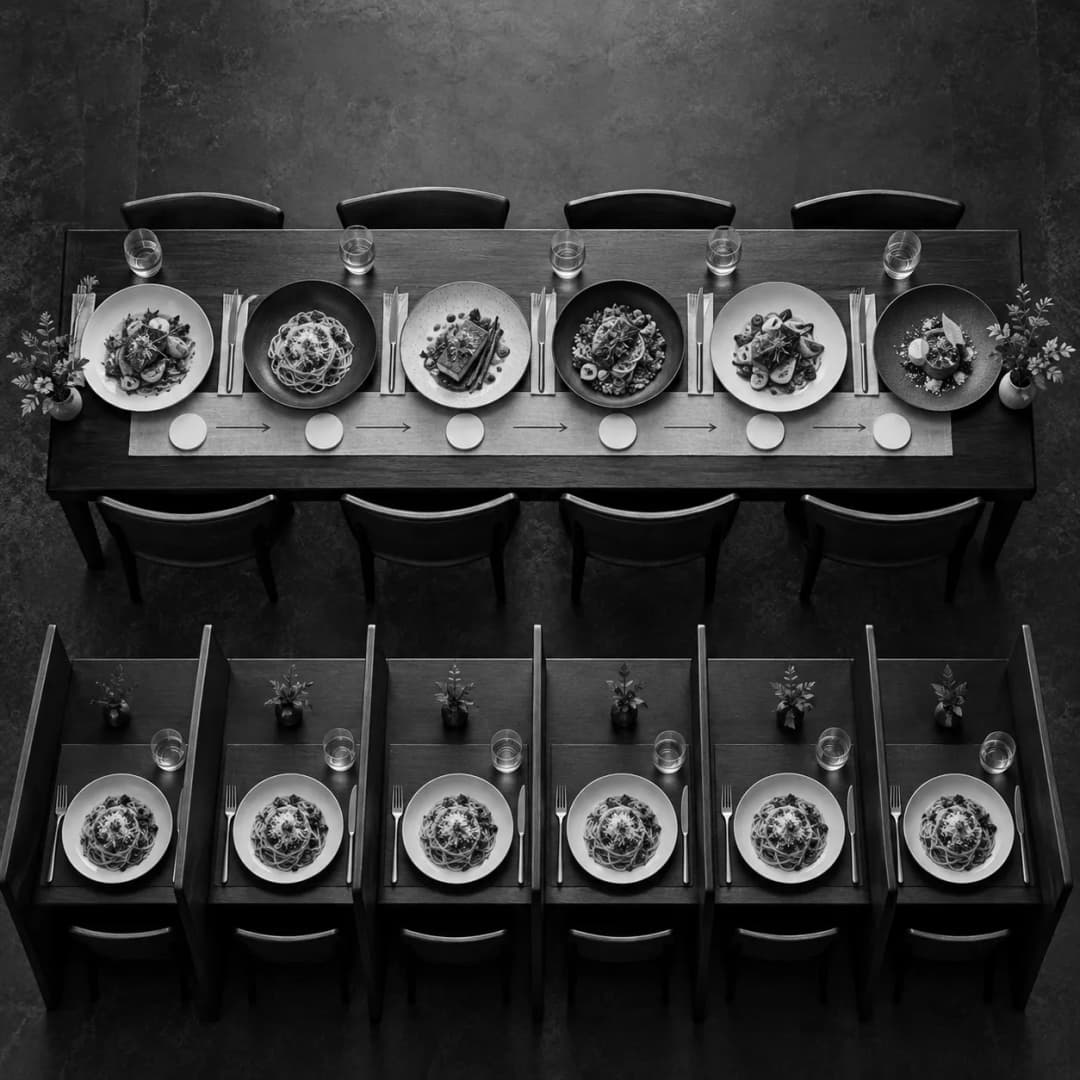
Dan Ariely and Jonathan Levav found that tables order a more varied set of dishes and drinks than the same number of people choosing alone would produce, and that the effect depends on members hearing each other order rather than on anything about the people. It is the best-known consumer finding about deciding together. One published re-examination exists and it narrows the finding to parts of a curve rather than overturning it.
What it is
The 2000 paper reports three studies tracking real orders. The lunch study found that real tables chose more varied dishes than would be expected from random sampling of all individual choices across all tables. The beer study attributed that variety to the interaction among members, implicit or explicit, and showed it dissipating when the group was made to disband and choose strictly individually. The wine study showed that individual choices in a group context also serve information gathering and self-presentation as uniqueness, and the authors' own framing is that choices balance strictly individual goals against goals triggered by the existence of the group, with the second sometimes undermining personal satisfaction and increasing regret.
In effect
The most useful independent support for the mechanism comes from a separate line of work. Rebecca K. Ratner and Barbara E. Kahn found that people build more variety into consumption decisions when their behaviour is subject to public scrutiny, because they expect to be evaluated more favourably for choosing variety, and that the pressure disappears when a social cue signals that consuming one's favourites is appropriate. Pascale Quester and Alexandre Steyer then revisited the table finding directly and concluded that the relationship between individual choice and group opinion is non-monotonic, moderated by the degree of unanimity around an alternative, so the choice patterns are curvilinear and the original findings accurately reflect only specific sections of the overall pattern.
What it does not say
It does not say the effect is well replicated. One published re-examination could be located and it narrows the claim, so nothing here should be written as though the result were settled. No sample size is printed for the original studies, because the full text is paywalled and was not read. The vault's standing handling rule on the first author applies in full: this pass found no retraction, correction or expression of concern attached to the 2000 paper, which is not the same as a clean bill of health and is not presented as one, the co-author Jonathan Levav is named alongside wherever the work is cited, and no sentence rests on this paper alone.
Sources
- Ariely, D., & Levav, J. (2000). "Sequential Choice in Group Settings: Taking the Road Less Traveled and Less Enjoyed." Journal of Consumer Research, 27(3), 279-290. doi:10.1086/317585. Abstract read in full; full text paywalled and not read, so no sample size is printed.
- Quester, P. G., & Steyer, A. (2010). "Revisiting Individual Choices in Group Settings: The Long and Winding (Less Traveled) Road?" Journal of Consumer Research, 36(6), 1050-1057. doi:10.1086/644750. Abstract read in full. The only published re-examination located, and it narrows rather than overturns.
- Ratner, R. K., & Kahn, B. E. (2002). "The Impact of Private versus Public Consumption on Variety-Seeking Behavior." Journal of Consumer Research, 29(2), 246-257. doi:10.1086/341574. Three experiments; sample sizes not established and none is printed.
- Sommer, R., Wynes, M., & Brinkley, G. (1992). "Social Facilitation Effects in Shopping Behavior." Environment and Behavior, 24(3), 285-297. doi:10.1177/0013916592243001. The only direct observational evidence in reach that company changes what leaves the shop, and it is correlational and from 1992.