Habit Discontinuity
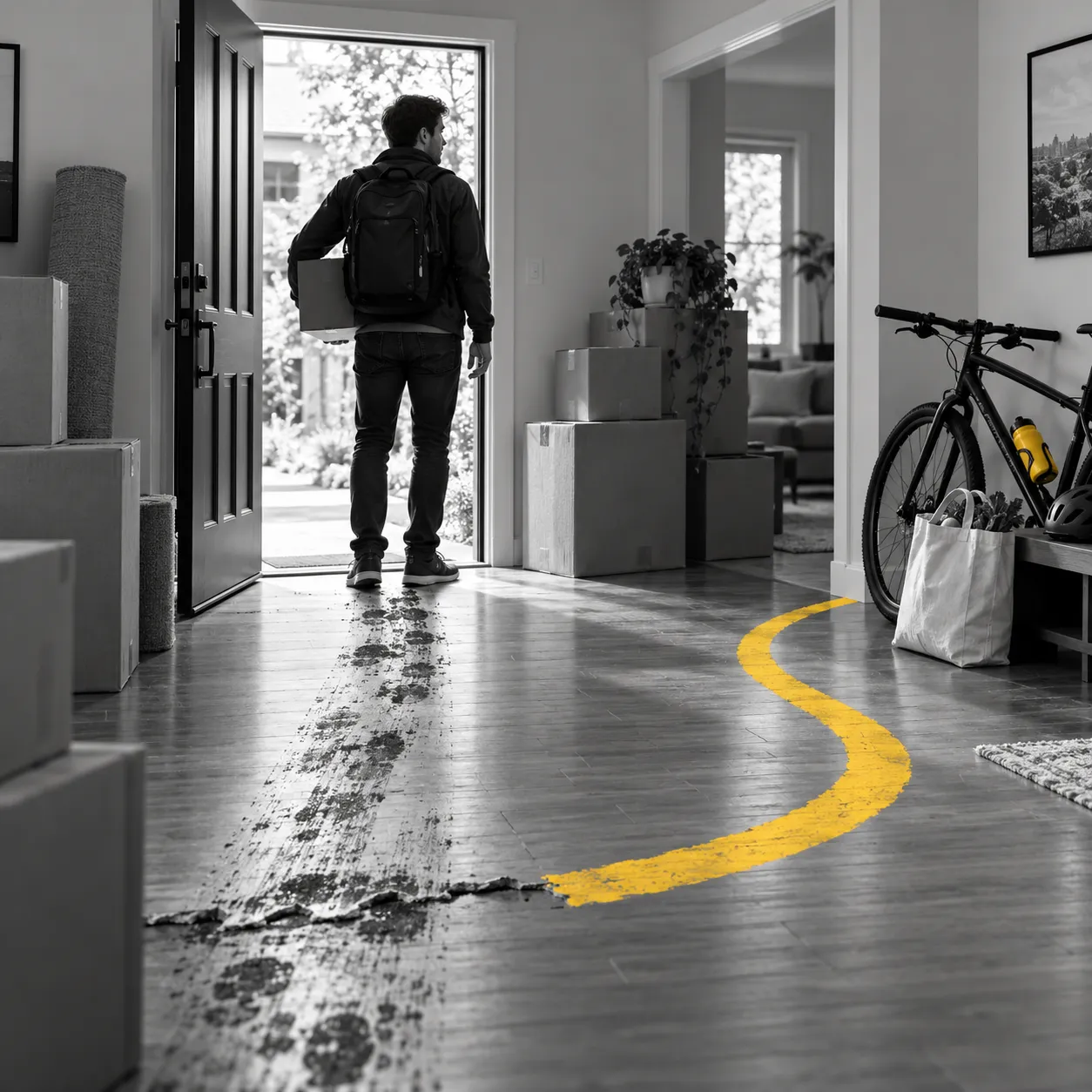
Habit discontinuity is the idea that habits are most open to change at the moment their context breaks. Bas Verplanken's term describes how a move, a new job, a hospital stay or a transport strike removes the cues that were triggering a behaviour, and for a short window behaviour follows what the person intends and not what the environment has been prompting. The evidence is primary and well designed, but the effect is small, short-lived and works in both directions.
What it is
A habit is a learned link between a cue and a response. Because the cue starts the action, removing the cue suspends the response without asking the person to resist it. A change of home, workplace, school, commute or routine removes many cues at once. For a time afterwards the person decides more than they repeat.
The symmetry is the part most often dropped. A disruption breaks good habits as readily as bad ones. It is a window and not a treatment, and nothing about it favours the behaviour a planner wants. About 11 per cent of Americans move house each year and people change jobs roughly every four years, so the windows are common enough to plan around.
In effect
Several designs support the idea. In February 2014 a London Underground strike closed 171 of 270 stations, and closed them unevenly. Records from more than 18,000 regular commuters showed only about 60 per cent entering at their usual station during the strike, with journey times up only about 6 per cent overall. Some commuters were permanently faster afterwards, having been pushed onto a better route they had never tried. A study of 69 recent movers and 364 established residents found that among longtime residents green and indifferent people drove at similar rates, while among recent movers people with strong environmental values made 37 per cent of trips by car against 73 per cent for the indifferent. Without habit, both groups acted on their values.
The symmetry shows in performance data: in baseball trades, 422 declining players improved after a trade and 290 stable or improving players got worse. A tax-lottery study in Montevideo found that winning a one-year tax holiday reduced later on-time payment by four percentage points.
The Peterborough field experiment is the strongest single test. Verplanken and Roy cold-contacted 1,612 people at the door, and 800 agreed to take part. Half were known to have moved in the previous six months and were matched with non-movers on house size, home ownership, recycling facilities and public transport access. Clusters of neighbours were randomised together, and 521 completed the eight-week follow-up. The intervention was modest: an interview, a bag with eco-washing liquid, seeds, a bus timetable and a shower timer, a tailored booklet and two newsletters. Self-reported change across twenty-five environment-relevant behaviours was larger for recent movers and absent for long-settled residents. The effect appeared only in people who had moved under three months before, with nothing in the longer groups.
What it does not say
The authors gave their own caveats and they travel with the result. The size of the extra effect from moving was small. The study is proof of concept. The six-month cut-off for recent movers was arguably arbitrary. By behaviour, the effect was significant for transport, marginal for waste and absent for water and energy. They advised against blanket roll-outs.
The earlier work on interventions after a move could not show that the move made them work, because its comparison groups had moved too. The freeway-closure studies found most disrupted people did not change at all.
The moving-house study is small on the mover side and relies on self-report. The Hurricane Katrina cohort Wood cites was effectively and not formally randomised. A disruption nobody designed, such as the strike, shows that change can occur in a minority. It does not show that such a moment can be aimed at from outside.
Where it comes from
Verplanken and colleagues developed the habit discontinuity hypothesis in the late 2000s. Wendy Wood's book Good Habits, Bad Habits brought it to a wide audience and collected natural experiments around it. Verplanken and Deborah Roy tested the hypothesis in a field experiment in 2016, published in the Journal of Environmental Psychology.
Where opinion differs
Researchers who study life transitions see them as the best leverage point for behaviour change and propose timing campaigns to movers, new parents and new employees. Others hold that the effects are small, varied by behaviour and fade within months, and that the better strategy is to build lasting cues and reduce friction. Both views agree that the window exists. They differ on how much it is worth and whether organisations can reach people inside it.
How this site uses it
The Why We Project uses habit discontinuity to explain why transitions matter in consumer and workplace behaviour, and to caution that the same moment can break a habit worth keeping. It features in the piece on the pregnancy prediction story, where a life event changes shopping routines.
Sources
- Verplanken, B., & Roy, D. (2016). Empowering interventions to promote sustainable lifestyles: Testing the habit discontinuity hypothesis in a field experiment. Journal of Environmental Psychology, 45, 127-134. Read in full.
- Wood, W. (2019). Good Habits, Bad Habits. Farrar, Straus and Giroux; Macmillan Business paperback 2024. The strike, moving, tax-lottery and baseball studies are reported there.
- Larcom, S., Rauch, F., & Willems, T. (2017). The benefits of forced experimentation: Striking evidence from the London Underground network. Quarterly Journal of Economics, 132(4), 2019-2055. Abstract and published summary read.