Hospitality as a Practice
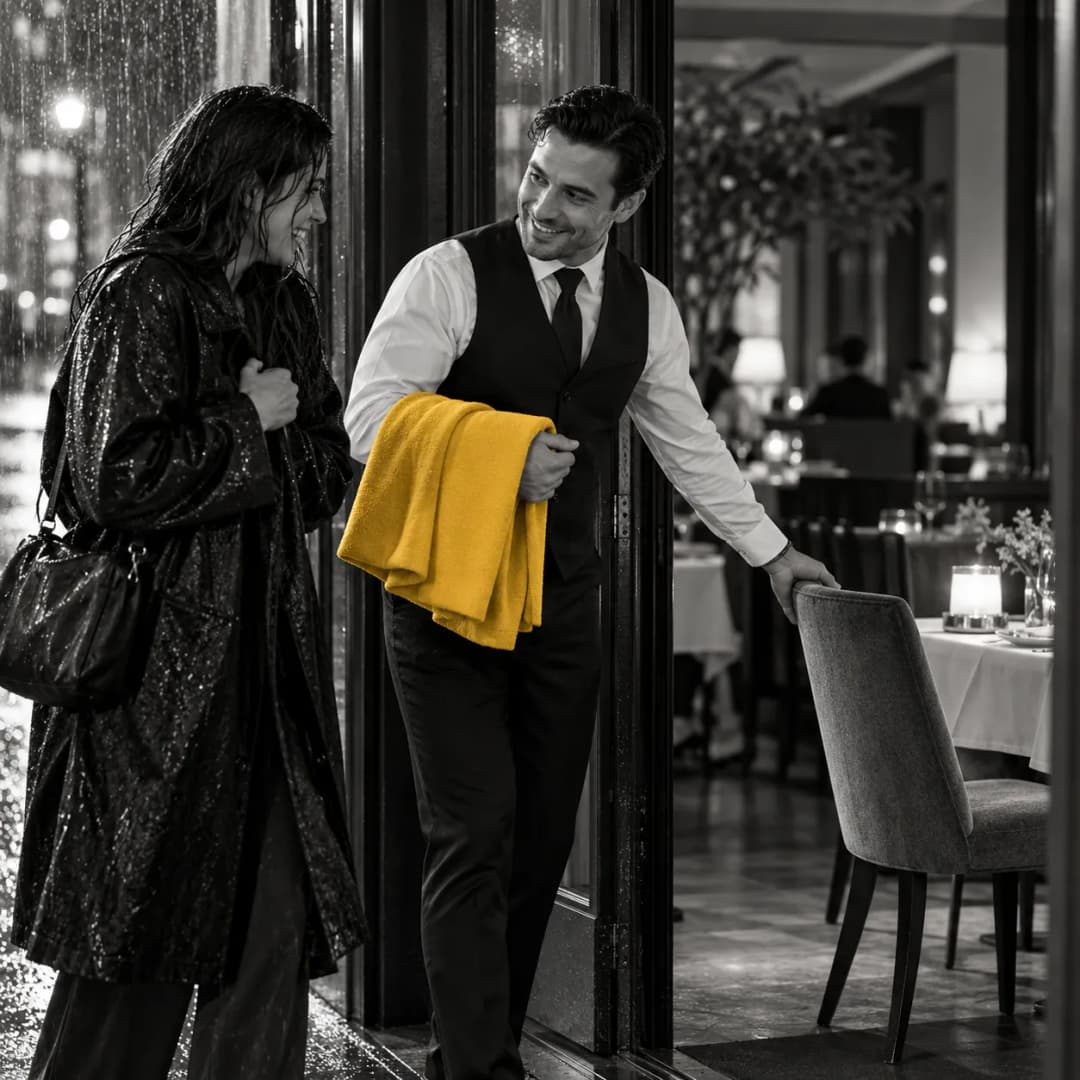
Hospitality as a practice is the distinction between service and hospitality, held as a craft with a vocabulary and not as a measured construct. Service is delivering what was promised, correctly and on time. Hospitality is how the delivery makes the person receiving it feel. Will Guidara states it at page 5 of Unreasonable Hospitality as "Service is black and white; hospitality is color", a line he credits to a job candidate he did not hire. It is a useful distinction and not a research finding.
What it is
The distinction is easiest to see in what can be audited. A service failure is a fact: the dish arrived cold, the booking was lost, the call was not returned. A standard can be written for it, a person can be trained against the standard, and a manager can check. A hospitality failure is a judgement about how a guest felt, and the only way to catch one is to have someone in the room whose job is to notice. The practice therefore lives in judgement, improvisation and a shared vocabulary and not in a procedure. Every attempt to script it risks producing service again.
Guidara's book is a practitioner memoir, one man's account of one restaurant over eleven years, and the vault classifies it as a single-case narrative. It names a large apparatus of its own practices, including the Critic of the Night, a nightly rehearsal on a randomly chosen table, and the role of the Dreamweaver, a person dedicated to improvised gestures. Its own account of where the practice comes from is explicit. The ordering of staff above guests, and of guests above investors, belongs to the restaurateur Danny Meyer, who called it Enlightened Hospitality in Setting the Table in 2006. The vault credits Meyer for the ordering and Guidara for the escalation.
The staff-first ordering is the part that connects hospitality to psychology. It is a bet that how the person serving feels decides what reaches the guest. That bet is the transmission claim at the centre of emotional contagion, and the book does not frame it that way or cite research on mood. The vault's reading of the book's eleven endnotes, at pages 259 and 260, is that they document the restaurant's reviews and not the argument about people.
In effect
In the book
Page 10 carries the maxim most often quoted from the book, that people never forget how you made them feel. The book introduces it as often, but probably incorrectly, attributed to a celebrated writer. The hedge is correct, and it is more careful than the book's handling of most other claims. The maxim assumes that a feeling passes from the person serving to the person served, which is the assumption the studies of service encounters test.
In the evidence
The nearest outside tests disagree with each other. In a staged service encounter reported by Thorsten Hennig-Thurau and colleagues in 2006, the amount of smiling had no effect on customers' emotions, while the genuineness of the display did. In a 2006 study of real encounters by Patricia Barger and Alicia Grandey, customers' smiles followed the employee's, but satisfaction followed their appraisal of service quality and not their own mood. In a 2002 laboratory study, Sigal Barsade found that moods spread among managers in groups and that a positive mood improved cooperation. The last of these is the closest support for putting staff first, because it describes moods moving between colleagues.
In practice
The book's chapter on restoring balance, from page 155, treats the staff's own state as a hazard. A cook arrives ten hours early in a state of exhaustion, and the leadership reads it as a sign that ambition has overrun the culture. The remedy is deliberate slowing, a decision about staff condition made before any guest is involved.
What it does not say
It does not say that hospitality has been measured. There is no founding study, instrument or effect size behind the distinction between service and hospitality.
It does not say that staff feeling reaches the guest. The studies of service encounters give mixed results on that, and the memoir does not test it.
It does not say that the method transfers to other businesses. The book claims it will, and its evidence is one restaurant, run under conditions the book reports but does not offer as limits.
It does not say that more generosity is always better. The book itself records a case, at page 241, where scripted abundance made a meal feel less hospitable, and a newspaper critic saw it before the restaurant did.
Sources
- Guidara, W. (2022; this edition 2026). Unreasonable Hospitality. London: Ebury Edge. Pages 5, 10, 24, 155 and 241, and the endnotes at pages 259 and 260. Cited as Guidara's own frame and never as research.
- Meyer, D. (2006). Setting the Table. Recorded in the vault as the source of Enlightened Hospitality and the staff-first ordering; not opened.
- Hennig-Thurau, T., Groth, M., Paul, M. & Gremler, D. D. (2006). "Are all smiles created equal? How emotional contagion and emotional labor affect service relationships." Journal of Marketing, 70(3), 58-73.
- Barger, P. B. & Grandey, A. A. (2006). "Service with a smile and encounter satisfaction: Emotional contagion and appraisal mechanisms." Academy of Management Journal, 49(6), 1229-1238.
- Barsade, S. G. (2002). "The ripple effect: Emotional contagion and its influence on group behavior." Administrative Science Quarterly, 47(4), 644-675.
- Vault reliability audit of Unreasonable Hospitality, 2026-10-06.