Illusion of Control
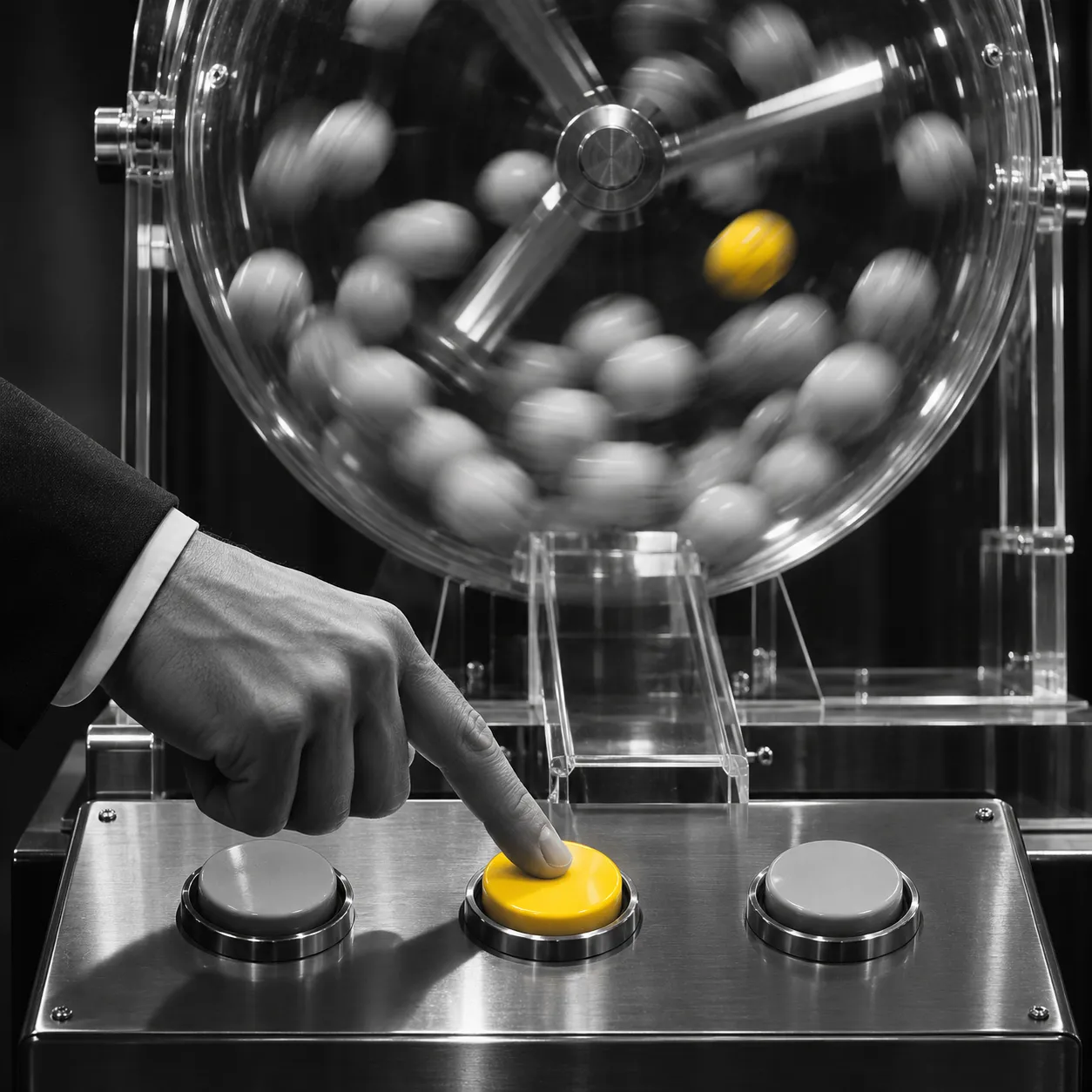
The illusion of control is an expectation of personal success that is higher than the objective odds warrant. Ellen Langer proposed it in a 1975 paper and predicted when it would appear: when a situation governed entirely by chance is given features that normally belong to skilled activities, people become more confident than they should be. The odds are untouched. What changes is the sense of having a hand in the result.
What it is
Langer named four features that tend to signal skill: competition, choice, familiarity and personal involvement. Each is a cue that people use, usually reliably, to judge whether an outcome is theirs to influence. In a game of skill the cues track something real. In a game of chance they are decoration, yet they can still produce the feeling that goes with skill.
The idea belongs to the study of judgement under uncertainty rather than to the study of any one activity. A card player, a person choosing numbers for a draw and a person rolling dice are all in situations where the result is fixed by chance and where the person has small, visible things to do. Langer's claim was that those small acts matter to confidence even when they cannot matter to the odds.
In effect
Langer's 1975 paper in the Journal of Personality and Social Psychology reported six studies, and all six supported the prediction. In the first, participants cut cards against an opponent who appeared either confident or nervous. In the second, people were offered a lottery ticket, with or without a choice of which ticket to hold. In the third, the tickets were either familiar or unfamiliar. The fourth had participants play a novel game with or without practice, either themselves or through a proxy. The fifth asked bettors at a racetrack to rate their confidence at different times, and the sixth varied whether participants received a single three-digit ticket or single-digit tickets across days.
A later piece of work returned to a closely related paradigm. A preregistered online replication of a coin-toss study from the same year, published in 2022 in International Gambling Studies, used about 289 crowdsourced participants and reported that early-win sequences increased perceived control, with smaller effect sizes than in the original. That is a replication of a neighbouring study, not of the 1975 paper itself.
The 2009 near-miss experiment by Luke Clark and colleagues connects to the same theme. In that experiment the added wish to play after a near miss appeared only on trials where the participant had personal control over arranging the gamble. Control, or the sense of it, is part of the finding, which is one reason the two lines of work are often read together.
What it does not say
The illusion of control is a claim about confidence, not about outcomes. It does not say that people who feel in control will win more or less often, because the odds are the same either way. It does not say that choice is bad; choice matters in many settings where outcomes do depend on skill. And it does not describe any individual: the studies compare conditions across groups of participants.
It also does not settle why people take part in games of chance. Hope, entertainment and the way earlier results are counted are separate strands, set out in Why do people gamble?. The illusion of control is one of them.
Sources
- Langer, E. J. (1975). "The illusion of control." Journal of Personality and Social Psychology, 32(2), 311-328. doi:10.1037/0022-3514.32.2.311. Six studies of competition, choice, familiarity and involvement in chance tasks.
- Eben, C., and colleagues (2022). "Outcome sequences and illusion of control - Part I: An online replication of Langer & Roth (1975)." International Gambling Studies, 23(2), 257-268. doi:10.1080/14459795.2022.2133906.
- Clark, L., Lawrence, A. J., Astley-Jones, F., & Gray, N. (2009). "Gambling Near-Misses Enhance Motivation to Gamble and Recruit Win-Related Brain Circuitry." Neuron, 61(3), 481-490. doi:10.1016/j.neuron.2008.12.031.