Implementation Intentions
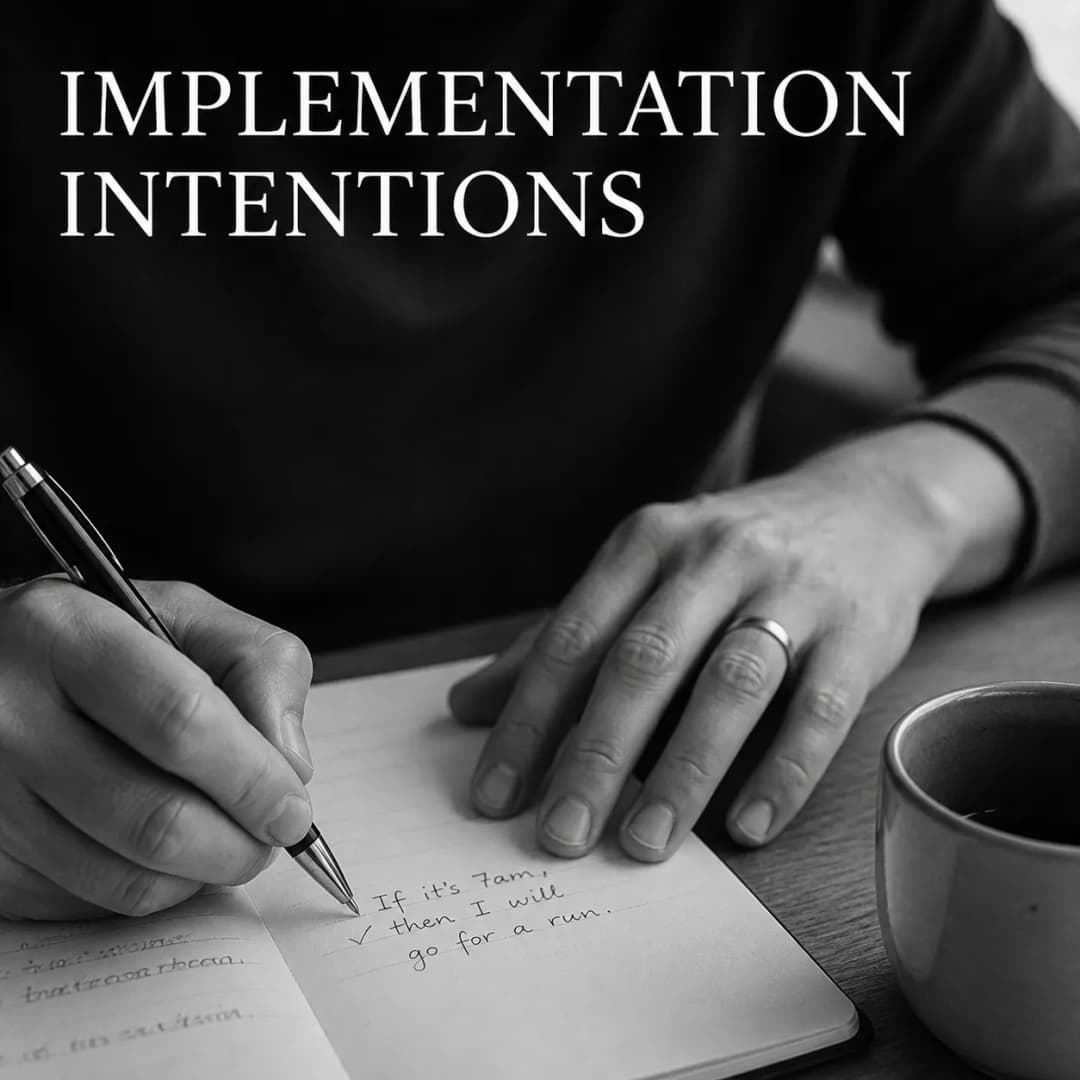
Implementation intentions are Peter Gollwitzer's if-then plans: "if situation X occurs, then I will perform behaviour Y." Binding a behaviour to a specific cue moves the decision off in-the-moment willpower and onto the cue. The effect is real and it is small. The 2006 meta-analysis of 94 studies gave d = 0.65, and that figure is superseded. A 2024 meta-analysis of 642 tests, co-authored by Gollwitzer himself, gives d = 0.36 raw and d = 0.15 once corrected for publication bias.
What it is
Most people who fail to do a thing they intended to do did not change their minds. They arrived at the moment without a decision already made, and made a worse one under pressure. That gap, between intending and acting, is what implementation intentions are designed to close.
The instrument is a sentence with a fixed shape. "If situation X occurs, then I will perform behaviour Y." Not "I will exercise more", but "if it is Tuesday at seven, then I will go to the six-fifteen class." Not "I will eat better", but "if I am offered a dessert menu, then I will order coffee." The specificity is the whole mechanism, and it works by pre-binding a behaviour to a cue that can be a time, a place, an object or an internal state, so that when the cue arrives the response is already assigned. Gollwitzer's account of why this helps is that the decision has been offloaded from the deliberating self to the situation. Nothing has to be negotiated at the point of action, because the negotiation happened while you were calm.
Two properties make the technique unusually portable. It is conceptually narrow, which is a strength: it gives you exactly one move. And it applies wherever there is a cue to attach to, which is why it turns up in health, education, finance and exercise research alike.
The headline number has been corrected sharply downward, and this page uses the corrected version. The figure that made implementation intentions famous is d = 0.65, a medium-to-large effect on goal attainment, from Gollwitzer and Sheeran's 2006 meta-analysis of 94 studies in Advances in Experimental Social Psychology. That citation is accurate. It is also no longer the best estimate.
In 2024, Sheeran, Listrom and Gollwitzer published "The when and how of planning: Meta-analysis of the scope and components of implementation intentions in 642 tests" in the European Review of Social Psychology. Across 642 tests the sample-weighted raw effect was d = 0.36, with a 95 per cent confidence interval from 0.33 to 0.40. Trim-and-fill correction moved it to d = 0.35. A robust Bayesian meta-analysis correcting for bias put it at d = 0.15, with a confidence interval from 0.08 to 0.22. Egger's regression found substantial publication bias, and the Bayesian model returned extreme evidence for it, with a Bayes factor above 161.
So the technique survives, and it survives as something much smaller than the version in the popular literature. Somewhere between a fifth and a half of the effect that circulates is the best current reading, and the bias-corrected estimate is the one to quote when a single number is needed. Anywhere the figure 0.65 appears in our own material, it should be replaced with 0.36 raw or 0.15 corrected, with the choice stated.
The most creditable thing about this correction is who signed it. Gollwitzer is an author on the paper that cut his own headline figure by more than half. That is not how this usually goes. It is worth saying so plainly, because a field in which the originator of an effect co-authors its downward revision is behaving well, and readers who only ever encounter corrections as accusations should see one that is not.
What the correction does not do is void the idea. A bias-corrected d of 0.15 is a small effect that is reliably distinguishable from nothing, produced by an intervention that costs a sentence. Cheap and small is a perfectly respectable place for a behavioural technique to end up. The error was never the technique. It was reporting a 2006 estimate for two decades as though nothing had been learned since.
One boundary condition, from our own notes, matters more than the effect size. Implementation intentions amplify motivation rather than supplying it. They are the answer to "when and where", not to "why", which is why pairing them with contexts that already generate motivation outperforms pairing them with a solo plan resting on willpower alone.