Implicit Association Test
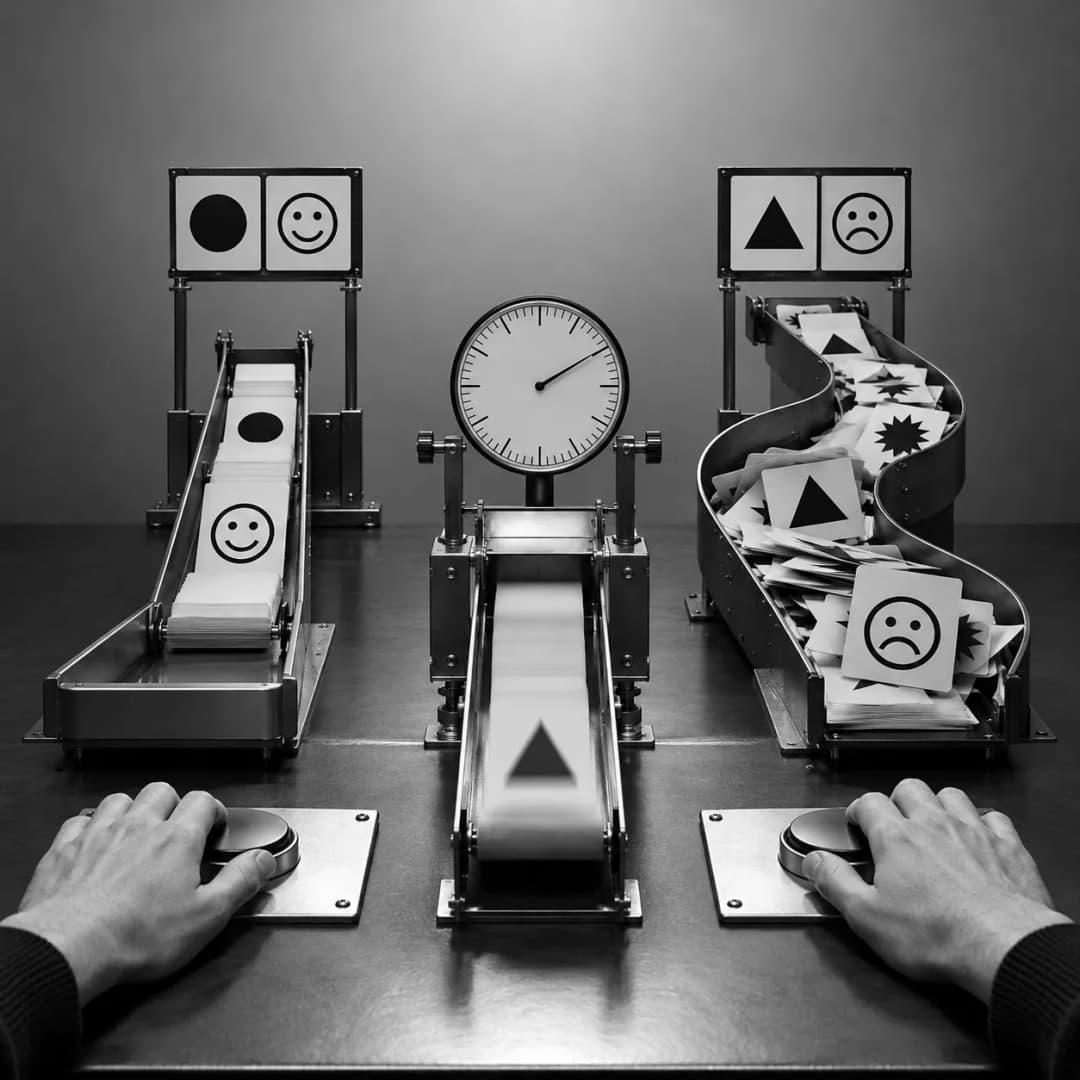
The Implicit Association Test is a reaction-time measure of how strongly two ideas are paired in a person's mind. A participant sorts words under two different pairings and the score is the difference in how quickly they manage each, with a faster sort read as a stronger association. What a score is, exactly, is a difference in milliseconds. What it is usually said to be is an attitude somebody holds without knowing it, and the distance between those two sentences is the whole dispute.
What it is
The test is standardly credited to Anthony Greenwald and colleagues in 1998, which is written here as background because that attribution was not verified at the published record in this pass. Its best-known use in this vault is as the dependent measure in Jennifer S. Mueller's first experiment on the bias against creativity, pairing creativity words such as novel, creative, inventive and original against practicality words such as practical, functional, constructive and useful, each category then paired with pleasant or unpleasant words. Participants under a mild uncertainty manipulation showed an implicit bias against creativity while the baseline group showed a bias in favour of it, with the condition accounting for about a ninth of the variance. Explicit attitudes did not differ at all.
In effect
The instrument's appeal is exactly that gap between the implicit and explicit results, because it appears to reach something a questionnaire cannot. Its weakness is the same gap, since a measure that disagrees with what people say owes an account of which of the two predicts what they do. Frederick L. Oswald and colleagues went after that question directly in a meta-analysis of how well such tests predict ethnic and racial discrimination, across six criterion categories, two versions of the test and four criterion-scoring methods. They found the tests were poor predictors of every criterion category other than brain activity, and performed no better than simple explicit measures.
What it does not say
That meta-analysis does not test a creativity-against-practicality version and says nothing directly about one, which is the whole of the care required here. What it establishes is narrower and still decisive for how any such result is reported, which is that a score is a reaction-time difference, that the general-purpose evidence for such scores predicting behaviour is weak, and that a finding resting on one should be described as a finding about associations rather than about what anybody would do. It also does not say the creativity result is wrong, only that the first experiment supporting it should be reported at the level of its instrument.
Sources
- Oswald, F. L., Mitchell, G., Blanton, H., Jaccard, J., & Tetlock, P. E. (2013). "Predicting ethnic and racial discrimination: A meta-analysis of IAT criterion studies." Journal of Personality and Social Psychology, 105(2), 171-192. doi:10.1037/a0032734. Abstract read in full. A meta-analysis of racial and ethnic versions of the test predicting discrimination, and not of any creativity version.
- Mueller, J. S., Melwani, S., & Goncalo, J. A. (2012). "The Bias Against Creativity: Why People Desire but Reject Creative Ideas." Psychological Science, 23(1), 13-17. doi:10.1177/0956797611421018. Full text read in the author version rather than the version of record, which is paywalled. Experiment 1, N = 73, with a separate pilot of 82 verifying the uncertainty manipulation.
- Greenwald, A. G., and colleagues (1998). The standard attribution for the instrument itself, carried here as background and not verified at the published record in this pass.