Inattentional Blindness
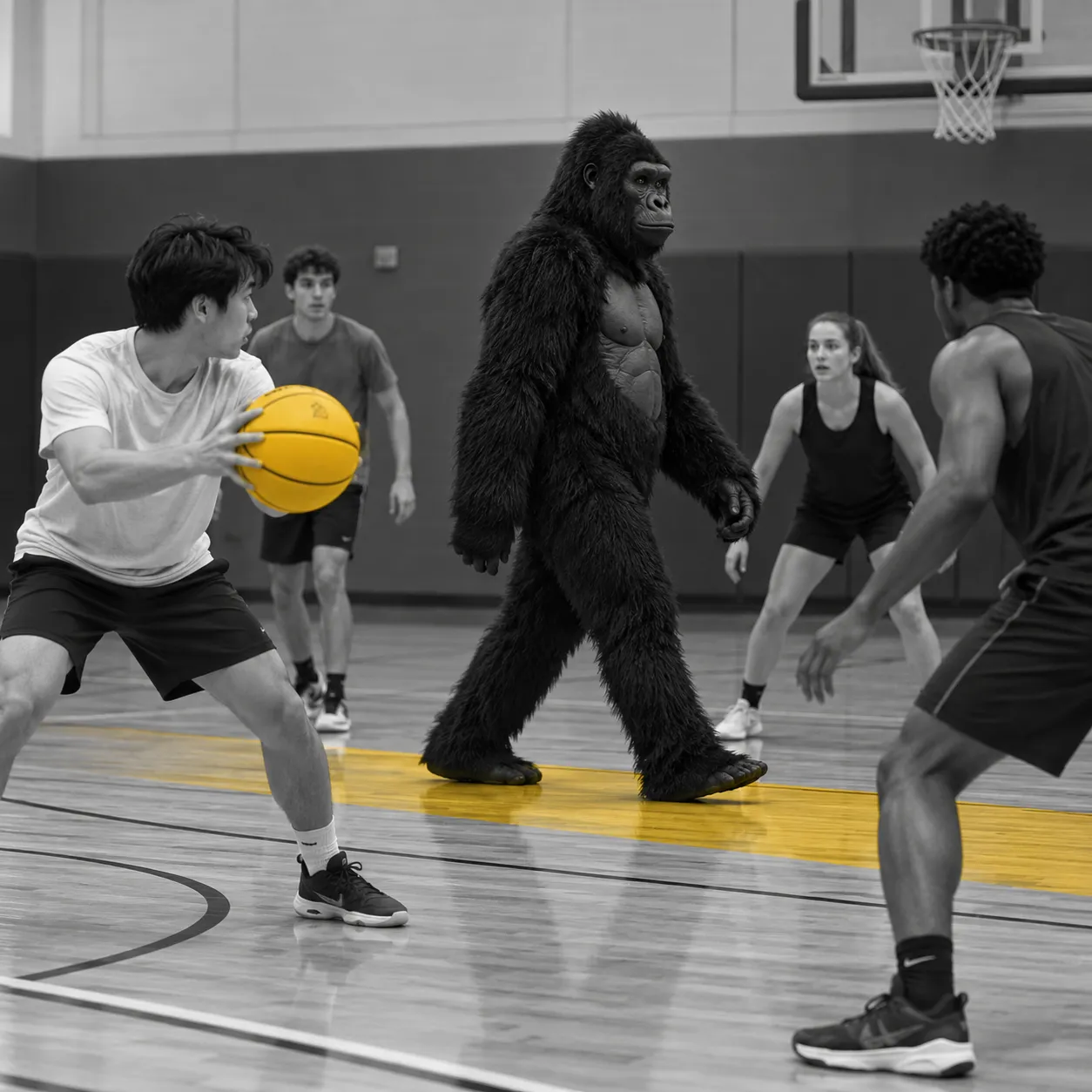
Inattentional blindness is the failure to notice an unexpected object that is in plain view because attention is committed to another task. The observer is looking, the object is visible, and the observer reports seeing nothing. The term was given to the phenomenon by Arien Mack and Irvin Rock in a 1998 book, after a 1992 paper by Rock and colleagues introduced the method. The best-known demonstration, the gorilla video, was published by Daniel Simons and Christopher Chabris in 1999.
What it is
Every study of inattentional blindness has the same three parts: a main task that holds the observer's attention, an unexpected object that appears while the task is under way, and a report afterwards on what the observer noticed. The measure is whether the unexpected object was reported, not whether the eyes landed on it.
The method has a documented origin. Irvin Rock, Christopher Linnett, Paul Grant and Arien Mack published a new method for studying perception without attention in Cognitive Psychology in 1992. Mack and Rock then published the book Inattentional Blindness in 1998, and the book's title is the name the field uses. For that reason first credit for the term goes to Mack and Rock, not to the researchers whose later video made the effect familiar.
That video is the experiment reported by Daniel Simons and Christopher Chabris in Perception in 1999. It was built on classic divided-attention research. People watched a staged video of a ball game and followed one team's passes while an unexpected figure in a gorilla suit crossed the scene. The abstract reports that whether people noticed an unexpected object depended on how similar it was to the other objects in the display and on how demanding the main task was, and that its distance from the places observers were attending had no effect. The authors read the last point as a sign that observers attend to objects and events rather than to positions in space.
Researchers treat the effect as a consequence of selective attention, the capacity to favour one stream of input and leave the rest unprocessed. The listening counterpart is the cocktail party effect, in which a listener following one voice can still sometimes catch their own name in a voice they are ignoring. Inattentional blindness is the same limit met through sight.
In effect
The most direct test of whether the effect depends on expertise comes from Trafton Drew, Melissa Võ and Jeremy Wolfe, who published in Psychological Science in 2013. They asked 24 radiologists to perform a familiar lung-nodule detection task and inserted the image of a gorilla, about 48 times the size of an average nodule, into the final case. The abstract reports that 83 per cent of the radiologists did not see it, and that eye tracking showed most of those who missed it had looked directly at its location. The observers were expert searchers in their own field, and the gaze reached the object without the object being registered.
Simons and a co-author, Melinda Jensen, asked in 2009 whether differences between people explain who notices. They observed that most earlier work used a single critical trial, so noticing on that trial could reflect chance. In the first of two experiments a staircase procedure equalised performance on the main task across participants, and task demands still affected noticing. In the second, individual differences in main-task performance did not predict whether people noticed the unexpected object. The authors concluded that task difficulty affects inattentional blindness and that differences in the ability to meet the task's demands do not.
Ira Hyman and colleagues took the question outdoors in a 2010 paper in Applied Cognitive Psychology. They compared people walking while talking on a cell phone with people listening to an MP3 player, people walking with no electronics, and people walking in pairs. In the first study phone users walked more slowly, changed direction more often and were less likely to acknowledge other people. In the second they were less likely to notice an unusual sight along their route, a unicycling clown. The authors suggest that cell phone use may produce inattentional blindness even during simple activities that need few cognitive resources.
Adam Gazzaley and Larry D. Rosen's book The Distracted Mind discusses the gorilla experiment and then Hyman's clown study in its treatment of safety, as a case that a phone conversation can take up enough attention for unexpected sights to go unnoticed. The book places both studies inside its wider argument that attention is a limited resource and that modern technology competes for it.
Read together, the studies place the explanation of who misses an unexpected object in the task and the display more than in the person. Training did not remove the effect among the radiologists, and skill at the main task did not predict noticing in the Simons and Jensen experiments.
What it does not say
It does not say that people have poor eyesight. In the radiology study most of those who missed the gorilla had looked directly at its location, so the failure lay in what was registered, not in what reached the eye.
It does not say that some people are careless or that others are reliably observant. The 2009 experiments found that differences in main-task performance did not predict who noticed, and the radiology study found the effect among experts. The finding describes how attention works under a demanding task, not a trait of individuals.
It does not give a rate that applies everywhere. The radiology figure of 83 per cent belongs to 24 radiologists in one task with one unexpected image. How often a given unexpected object goes unnoticed depends on its similarity to the other objects and on how demanding the main task is, which are the two conditions the 1999 abstract names.
It does not show that phones cause people to miss things in everyday life. The 2010 authors offer that as a suggestion from two field comparisons, and this page reports it at that strength.
Sources
- Gazzaley, A., & Rosen, L. D. (2016). The Distracted Mind: Ancient Brains in a High-Tech World. MIT Press.
- Mack, A., & Rock, I. (1998). Inattentional Blindness. MIT Press.
- Rock, I., Linnett, C. M., Grant, P., & Mack, A. (1992). Perception without attention: results of a new method. Cognitive Psychology, 24(4), 502-534. doi:10.1016/0010-0285(92)90017-V.
- Simons, D. J., & Chabris, C. F. (1999). Gorillas in our midst: sustained inattentional blindness for dynamic events. Perception, 28(9), 1059-1074. doi:10.1068/p281059.
- Simons, D. J., & Jensen, M. S. (2009). The effects of individual differences and task difficulty on inattentional blindness. Psychonomic Bulletin & Review, 16(2), 398-403. doi:10.3758/PBR.16.2.398.
- Hyman, I. E., Jr., Boss, S. M., Wise, B. M., McKenzie, K. E., & Caggiano, J. M. (2010). Did you see the unicycling clown? Inattentional blindness while walking and talking on a cell phone. Applied Cognitive Psychology, 24(5), 597-607. doi:10.1002/acp.1638.
- Drew, T., Võ, M. L.-H., & Wolfe, J. M. (2013). The invisible gorilla strikes again: sustained inattentional blindness in expert observers. Psychological Science, 24(9), 1848-1853. doi:10.1177/0956797613479386.