Inverted U of Fear and Enjoyment
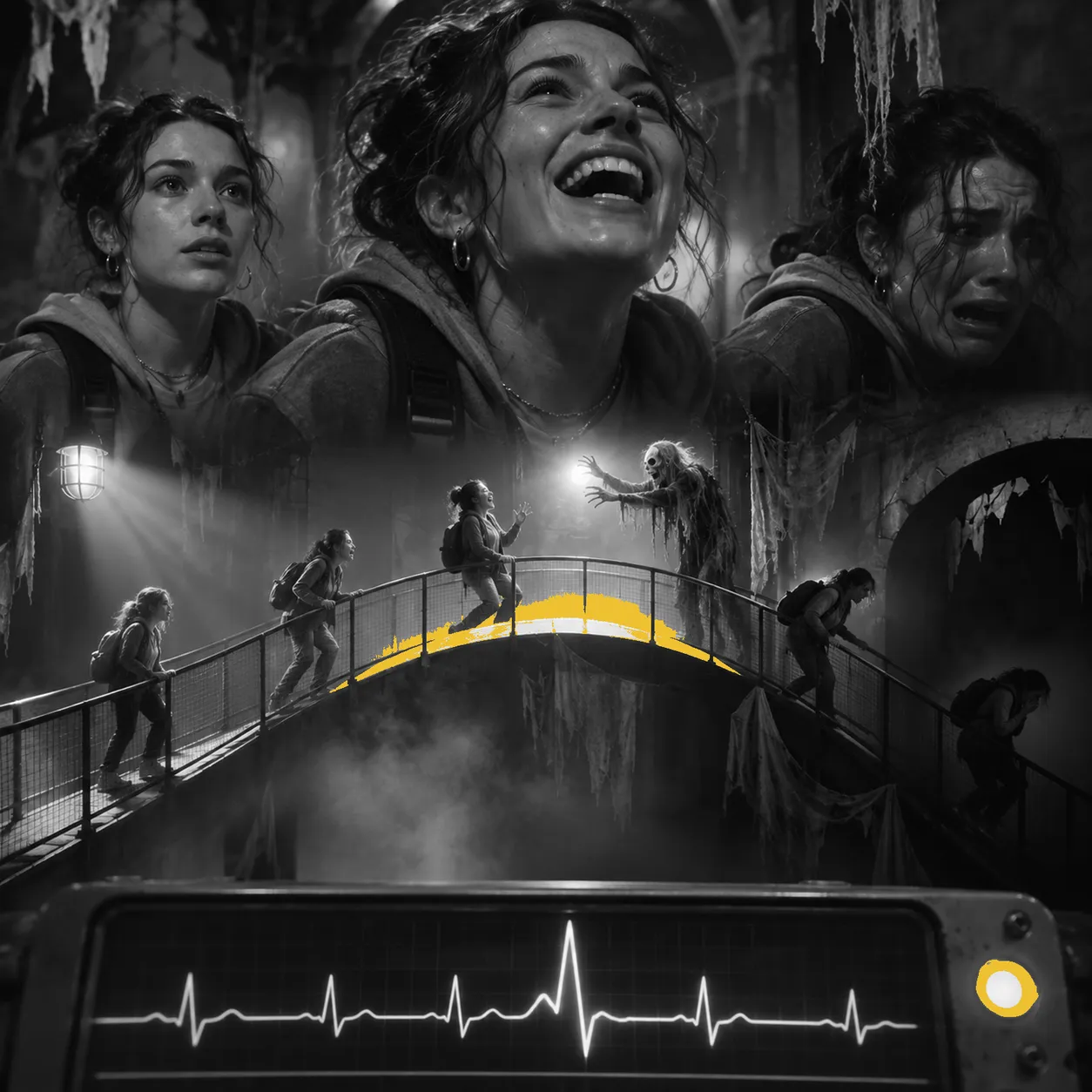
The inverted U of fear and enjoyment is the finding that enjoyment rises with fear to a moderate peak and then falls. It was reported in a 2020 field study of 110 haunted attraction visitors aged 12 to 57, with heart rate monitoring and repeated self-reports.
What it is
An inverted U is a curve that climbs, peaks and descends. Here, the more frightened visitors felt, the more they enjoyed the attraction, up to a point; beyond that point enjoyment dropped. The researchers, led by Marc Malmdorf Andersen, linked this to the body: feeling frightened tracked large-scale changes in heart rate in a straight line, while enjoyment followed an inverted U with smaller moment-to-moment fluctuations.
The authors suggest the pattern reflects arousal that is just right, enough to be engaging but not enough to overwhelm.
In effect
In the article on why we enjoy horror films, the curve explains why a film that is too mild and a film that is too intense can both miss. The best scare sits near the peak. The step from attraction to film is an interpretation made in the article.
What it does not say
It does not give a number for the right amount of fear, and the peak differs between people. It was found in one field study, in a live attraction rather than a cinema. It does not say anything about the effects of fear on health.
Where it comes from
The finding comes from a 2020 field study by Marc Malmdorf Andersen, Uffe Schjoedt, Henry Price, Fernando Rosas, Coltan Scrivner and Mathias Clasen, published in Psychological Science, volume 31, issue 12. This page relies on that study and a 2019 companion paper and does not trace any older lineage of the curve.
What the research found
The design was a field study, not a laboratory task. The researchers followed 110 visitors to a haunted attraction, aged 12 to 57. Visitors wore heart rate monitors, video recorded the scare points, and visitors reported their fear and enjoyment repeatedly during the visit. This gave moment-by-moment records for real people in a real setting.
Enjoyment followed an inverted U against fear: it rose as fear rose, up to a moderate peak, then fell. Feeling frightened tracked large-scale changes in heart rate in a straight line, while enjoyment followed the inverted U and was linked to smaller, moment-to-moment fluctuations. The authors suggest the pattern reflects arousal that is just right.
A related study by Mathias Clasen, Andersen and Schjoedt in Poetics in 2019 asked haunted house visitors to maximise or minimise their fear. Both groups used strategies to manage the experience, thrill-seekers reported stronger fear, and enjoyment was similar across the groups. That points to people steering themselves toward a level they like, which is how the curve could arise in practice.
The reading depth is the abstract of each paper. The claims are stated as the authors reported them, from one study site and one kind of attraction.
Where opinion differs
One reading is that people seek an optimum, so the best scare is the one that lands near the peak. Another stresses differences between people, since thrill-seekers and fear-avoiders differ in the fear they report even when their enjoyment is similar, which suggests that the position of the peak varies. The 2020 study supports an average curve and the 2019 study supports individual steering. Both readings accept that too little and too much fear reduce enjoyment. They differ on whether a single curve describes everyone.
How this site uses it
The Why We Project uses the inverted U in its piece on why we enjoy horror films, to explain why a film can miss by being too mild or too intense. The step from a haunted attraction to a film is an interpretation, and the site says so where it makes it.
Sources
- Andersen, M. M., Schjoedt, U., Price, H. C. W., Rosas, F. E., Scrivner, C. and Clasen, M. (2020), Psychological Science 31(12), 1497-1510.