Joint Attention
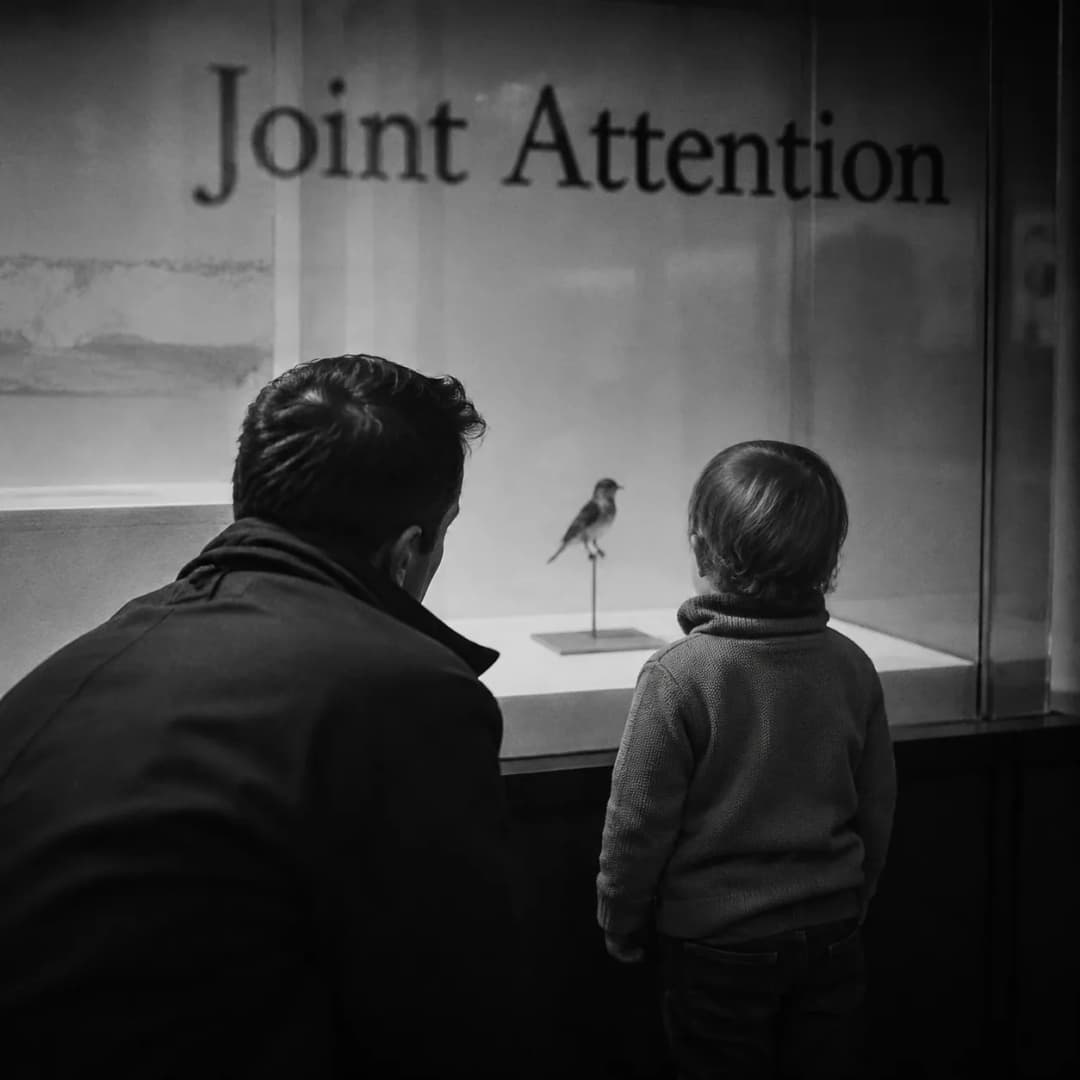
Joint attention is attending to the same thing as someone else, knowingly and together. Michael Scaife and Jerome Bruner established the capacity in infants in Nature in 1975, and that developmental finding is not in dispute. What makes this page mixed is the second claim built on top of it, that attending together amplifies attention or memory in adults. The best objective test of that, by Noam Mairon and colleagues in 2020, found no amplification and returned positive evidence for the null.
What it is
The starting observation is developmental and easy to reproduce at home. Long before a child has language, a caregiver looks toward something and the infant's gaze follows, and both of them are now attending to the same object with some awareness that the other is too. Michael Scaife and Jerome Bruner reported the capacity in Nature in 1975, under the title "The capacity for joint visual attention in the infant", and the construct starts there. Everything else on this page is downstream of it.
The construct has since been carried a long way from an infant and a caregiver, and the distance is the problem this page exists to mark.
Tim Wu uses it in The Attention Merchants as the missing mechanism under both the political rally and the broadcast (p. 115). His argument is that it is not simply that many people happen to see the same thing, it is that seeing it together changes what happens inside each of their heads, and this is what licenses his description of prime time as "a massive ritual of collective attention" rather than a figure of speech. He cites evidence that people solve mental-rotation problems faster when attending jointly than alone, and he notes the infant gaze-following development. Wu reports the construct. He did not build it, and until 2 September 2026 this vault's own note credited him as its originator, with no year and high confidence. That correction is described below and it is not an isolated one.
Then the test. Noam Mairon, Mor Nahum, Arjen Stolk, Robert T. Knight and Anat Perry, publishing in Scientific Reports in 2020, ran the paradigm properly. Forty-two undergraduates at the University of California, Berkeley, in pairs, sat at opposite sides of a table, each about 90 centimetres from a shared screen, silently counting images of flowers for around ten minutes a run. Attention and memory were measured behaviourally and with EEG. There was no amplifying effect of shared attention on either, and the Bayes factors, between 0.13 and 0.64, are positive evidence for the null rather than a failure to detect something.
The one solid social effect ran the opposite way to the popular claim. Flower-counting accuracy was 94.35 per cent alone against 86.25 per cent shared, t(39) = 5.62, d = 1.04, which is a large effect by any standard. Having another person at the table made people measurably worse at the task. That is social facilitation and ordinary distraction, an effect with its own century-long literature, and it is not the effect Wu's framing needs.
Two things keep the status at mixed rather than contested, and both come from the authors themselves. They never measured subjective feeling: nobody was asked how anything felt. And the amplification findings they were testing against, Garriy Shteynberg's, concern self-reported emotion under mediated co-presence, which is a different dependent variable in a different setting. The door is open on feeling and closed on performance.
The scale problem is separate and larger than either. Nothing in this literature is about crowds. The paradigm is two people at one table for ten minutes. Applying it to a stadium, a broadcast, or the 137.8 million Americans who were watching Super Bowl LX at the same moment on 8 February 2026, is an extrapolation across roughly four orders of magnitude with nothing underneath it. This vault has made that extrapolation repeatedly without saying so, which is why the note now says so at the top.