Logo Shape
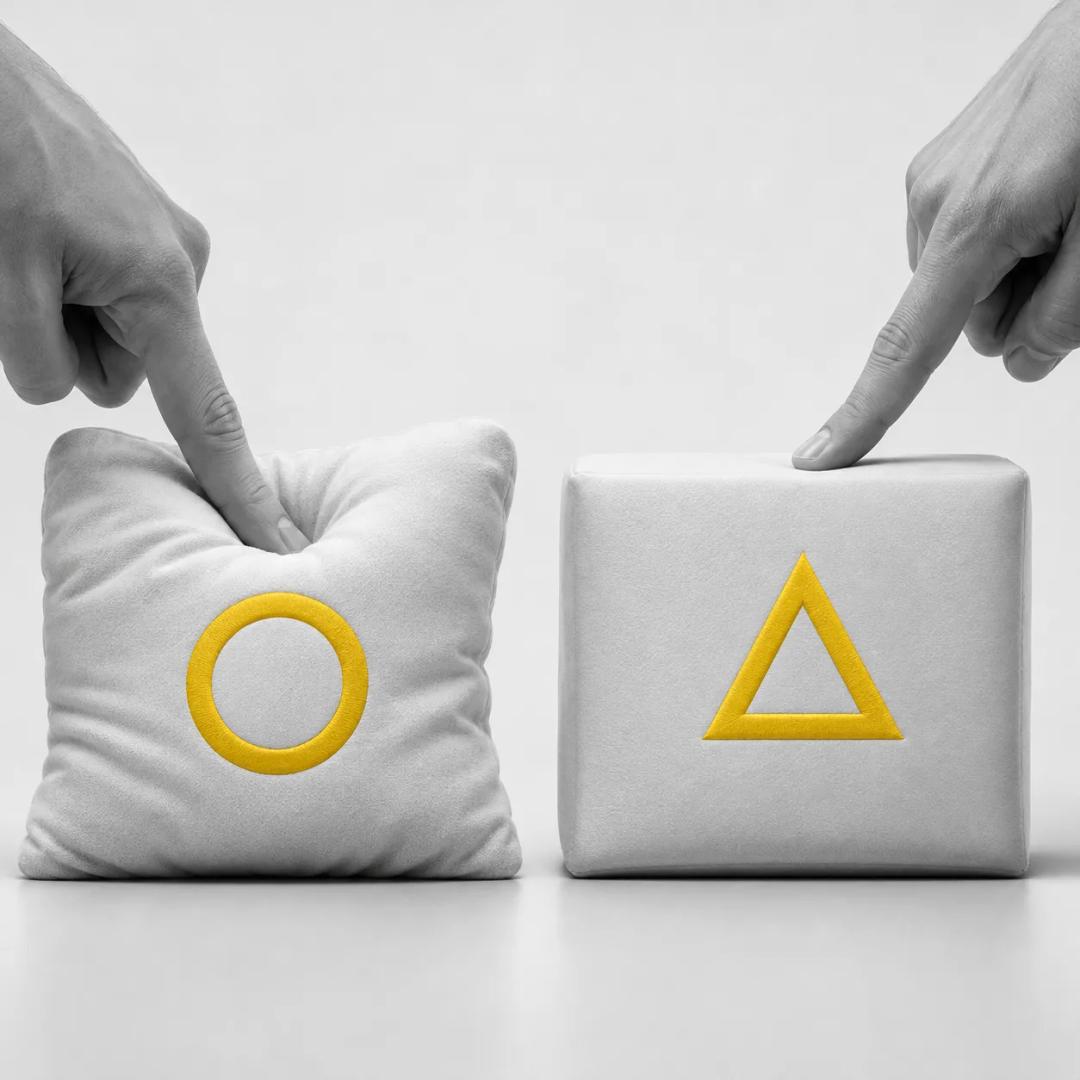
Logo shape is the circular or angular form of a logo and the judgments people draw from it. Yuwei Jiang and colleagues reported five experiments in which circular logos led people to judge a product or company as softer and angular logos as harder, an effect they link to mental imagery that draws on working memory.
What it is
A logo has a shape before it has a meaning, and the shape is chosen once and repeated everywhere. Logo shape asks what a circular or angular form does to the way people judge the brand it stands for.
The research is a 2016 paper by Yuwei Jiang, Gerald Gorn, Maria Galli and Amitava Chattopadhyay in the Journal of Consumer Research. Five experiments tested whether simply having a circular or angular logo changes perceptions of a product's or company's attributes. The authors propose that circular shapes evoke softness and angular shapes evoke hardness, and that these associations shape judgments through the generation of mental imagery, which draws on the visuospatial sketchpad of working memory.
In effect
Two details in the abstract show how the effect is built. When working memory was occupied with irrelevant visual imagery, the shape effects disappeared, which is the pattern the imagery account predicts. The effects also depended on individual differences, since people with a lower tendency to generate imagery processed information less in this way. The shape effect also appeared when people were primed incidentally, and not only when the logo itself was in view.
For a brand identity system, the usable idea is that the shape language of a mark is a signal, and that it is worth deciding what the signal should be before drawing the rest of the kit. A brand that wants to read as gentle and one that wants to read as firm will pull the shape language in different directions. Carrying the same language into secondary assets such as icons, patterns and packaging edges, so that they agree with the mark, is an application of the finding to a wider set of assets. The experiments tested logo shapes, and that extension is an interpretation.
What it does not say
The paper does not say that circular logos are better or that angular logos are better. It reports that the shapes shift judgments of softness and hardness, and the right direction depends on what the brand is trying to convey.
The effect is conditional in the paper's own account: it depends on working memory being free for imagery and on a person's tendency to generate imagery. It was read here at the level of its abstract, so the page states only what the abstract supports. An effect on attribute judgments in an experiment is not a forecast of sales.
Sources
- Jiang, Y., Gorn, G. J., Galli, M., & Chattopadhyay, A. (2016). Does your company have the right logo? How and why circular- and angular-logo shapes influence brand attribute judgments. Journal of Consumer Research, 42(5), 709-726. https://doi.org/10.1093/jcr/ucv049