Measurement Reactivity
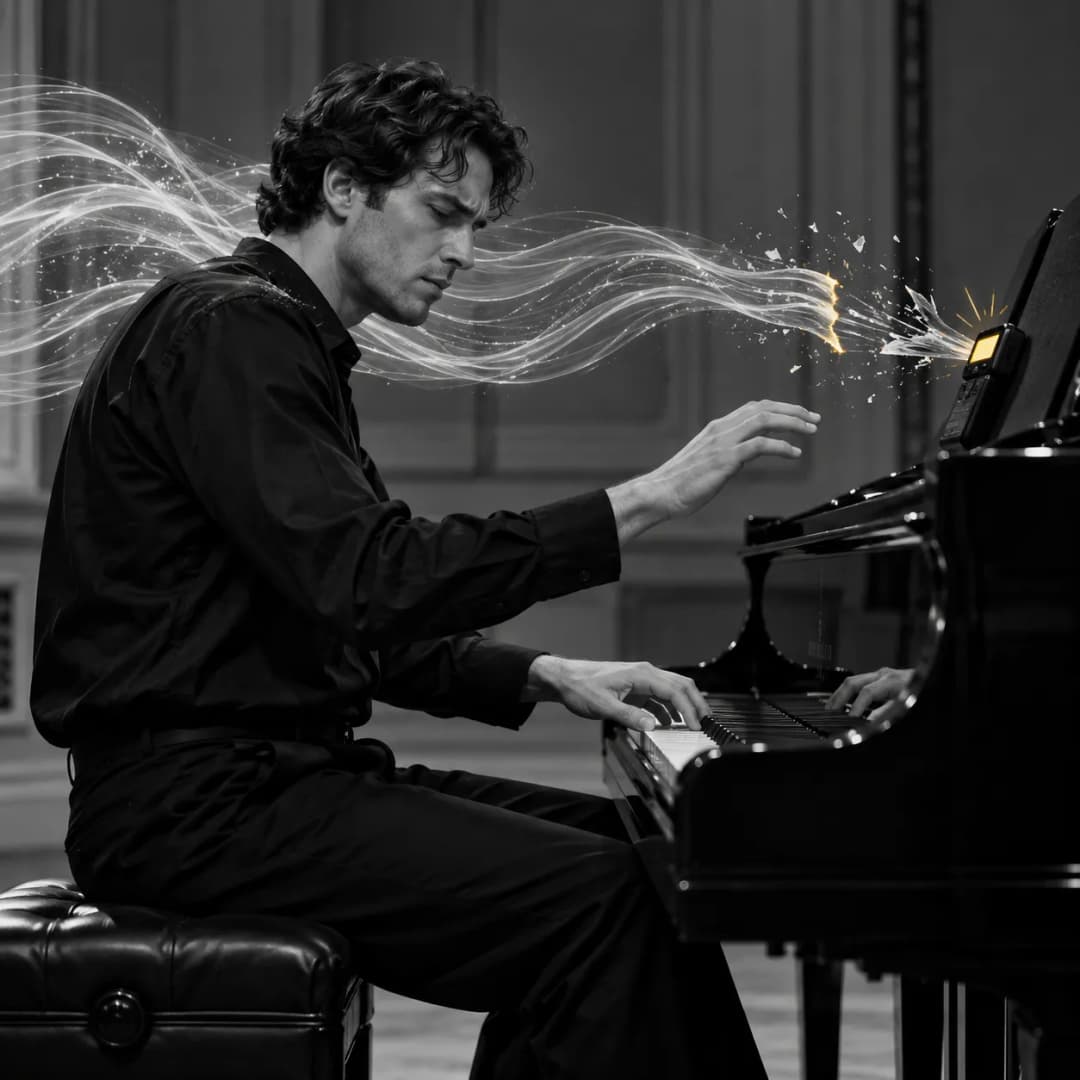
Measurement reactivity is the act of measuring changing the thing measured. In most research it is a background worry handled by unobtrusive instruments or by accepting a known bias. In flow research it is sharper than usual, because the instrument is a pager that breaks concentration in order to ask about concentration, and the unanswered signals are plausibly concentrated in the moments of deepest absorption.
What it is
Two distinct versions of the problem run through this literature and they should be kept apart.
The first is structural, in experience sampling. The method's own literature records signal compliance commonly around sixty-five to eighty-five per cent for studies of four to seven days at five to seven signals a day. Non-response in a sampling study is not random: it is likeliest where the person is busy, absorbed or unwilling to break off. For most constructs that is a nuisance. For a construct defined as complete absorption in a task it means the missing data is the data the construct most needs. The method's own validity paper, by Csikszentmihalyi and Larson in 1987, exists; it was not read for this page and no finding is attributed to it. Nothing in Flow concedes this limitation.
The second is retrospective, and it has a demonstration behind it. D. J. Harris of the University of Exeter, with Kathryn Allen, Samuel Vine and Mark Wilson, pooled 22 studies and 2,462 participants in 2021 and found flow correlating with performance at r = 0.31, with a confidence interval of 0.24 to 0.38 and heterogeneity of sixty-eight per cent, which they gloss as roughly ten per cent shared variance. Their limitations section is the most candid in the field. They state that the major limitation with all research in this area is the difficulty of rejecting reporting bias as the source of the relationship, since flow is measured by retrospective post-event questionnaire, and they cite Brewer and colleagues' 1991 study in which bogus positive feedback made participants rate themselves more focused and confident regardless of actual performance. They also note that no study in their set reported a negative flow-to-performance relationship, and that studies generally did not control for baseline ability, so better performers reporting higher flow could produce the correlation on their own.
A third pattern, from the meta-analytic record, is consistent with both. Carlton Fong, with David Zaleski and Jennifer Leach, report the association between challenge-skill balance and flow weakest under the experience sampling method and weakest for state flow rather than trait flow. The closer the measurement gets to the moment, the smaller the effect; the further it drifts towards a questionnaire about what a person is generally like, the larger it gets. That is what one would expect if part of the relationship were a feature of self-description, and it is not a demonstration that it is.
In effect
The signal that ends the state it asks about
The research case is the compliance arithmetic. A study at six signals a day for a week issues forty-two prompts per person, and at the field's typical compliance rate somewhere between six and fifteen of them go unanswered. If absorption makes a person less likely to stop and respond, the dataset systematically under-represents the state the study exists to measure, and no amount of analysis recovers it. Nobody has measured how much of the missing data is absorption, which is why this page states the problem as a reason for caution rather than as a quantity.
Bogus feedback and a better memory of your own focus
The everyday version is familiar to anybody who has rated their own performance after being told how it went. Brewer and colleagues showed participants could be moved to describe themselves as more focused and confident by feedback unrelated to what they had actually done. Since the standard flow instruments are administered after the event, the score is partly a reading of how the event turned out. A reader should treat "I was completely absorbed" collected after a win as a different kind of evidence from a signal answered in the middle of the task.
The dashboard that interrupts nobody and the survey that remembers
The commercial mirror image is instructive because the reactivity runs the other way. An engagement dashboard counts return visits continuously without touching the user, while satisfaction is asked about quarterly. The instrument that interrupts nobody records pursuit; the instrument that asks a question records a memory. The asymmetry is not a finding about people, it is a property of what is cheap to instrument, and it produces organisations that know a great deal about how often their product is opened and almost nothing about whether anybody enjoyed it.
What it does not say
It does not say experience sampling is unusable. It is a real advance over recall, and the limitation is specific rather than general.
It does not quantify the loss. The claim that missing responses are concentrated in absorbed moments is a plausible inference from the method's structure and has not been measured.
It does not say the flow-performance correlation is an artefact. Harris and colleagues report r = 0.31 and then state the reasons it cannot be taken as causal or as free of reporting bias; both halves are theirs.
It is not the Hawthorne effect. That is the named antecedent and concerns behaviour changing under observation; this page is about the measurement instrument interacting with the specific state being measured.
Who developed it
No single originator, and this page claims none. The Hawthorne studies are the named antecedent. The specific statement of the problem for flow comes from Sami Abuhamdeh's 2020 review, the retrospective-report case from D. J. Harris and colleagues' 2021 meta-analysis, and the moderator pattern from Carlton Fong and colleagues' 2015 meta-analysis.
Sources
- Harris, D. J., Allen, K. L., Vine, S. J., & Wilson, M. R. (2021). "A systematic review and meta-analysis of the relationship between flow states and performance." International Review of Sport and Exercise Psychology, 16(1), 693-721. doi:10.1080/1750984X.2021.1929402. Abstract read in full at the University of Exeter repository; the vault's earlier pass read the version of record.
- Fong, C. J., Zaleski, D. J., & Leach, J. K. (2015). The Journal of Positive Psychology, 10(5), 425-446. doi:10.1080/17439760.2014.967799. Abstract read in full; full text not retrieved.
- Abuhamdeh, S. (2020). Frontiers in Psychology, 11, article 158. doi:10.3389/fpsyg.2020.00158. Full text read at source.
- Csikszentmihalyi, M., & Larson, R. (1987). "Validity and Reliability of the Experience-Sampling Method." The Journal of Nervous and Mental Disease, 175, 526-536. NOT READ. The bibliographic record was confirmed and no finding is attributed to it.
- Brewer and colleagues (1991), on bogus feedback and self-rated focus. Not read; reaches this page only through Harris and colleagues' citation of it.