Minimal Group Paradigm
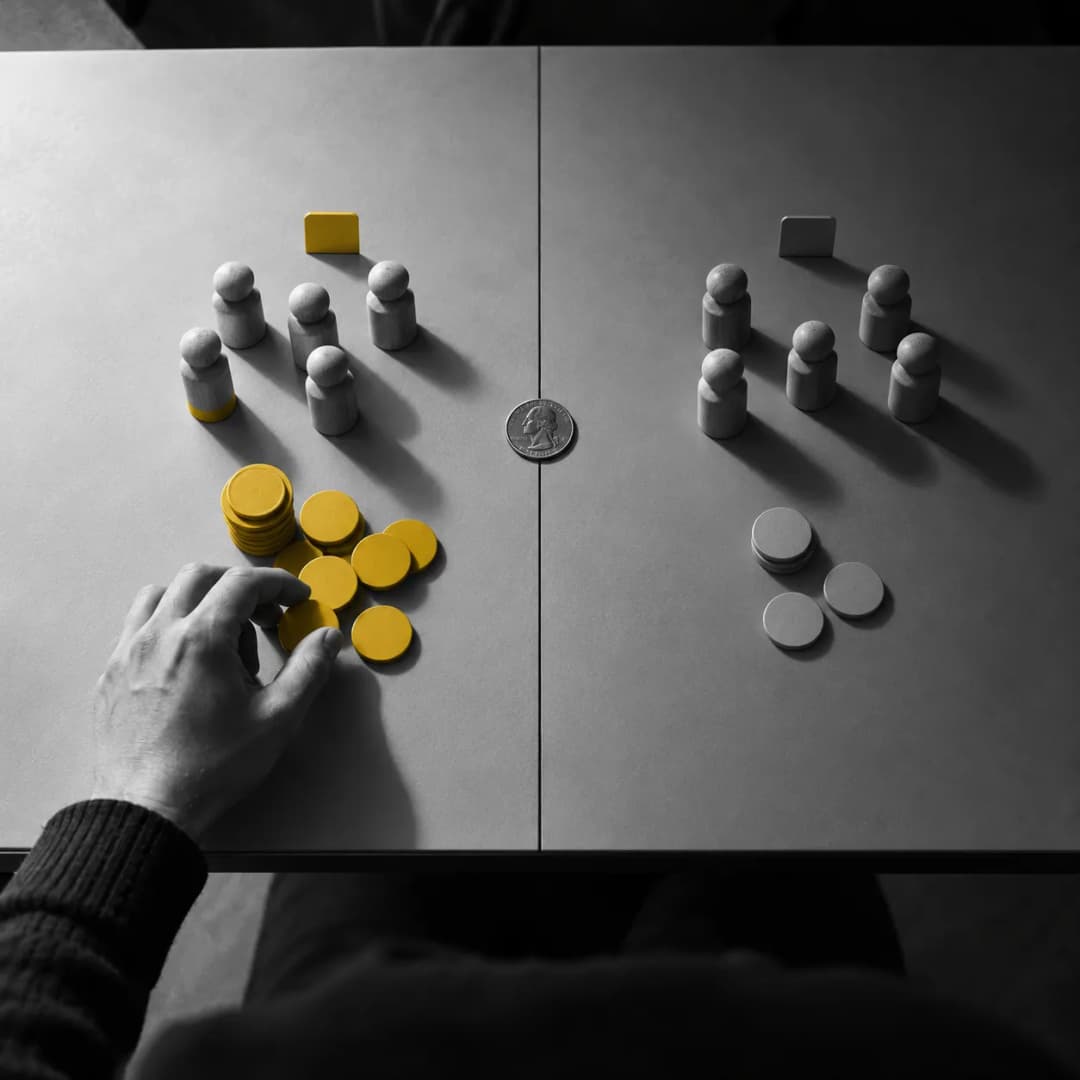
The minimal group paradigm is an experimental design that sorts people into two groups on a trivial or random basis, with no contact, shared history or competition, and then measures how they treat members of each group. It was built to find the least that must be true for a person to favour their own group. In the studies reported since 1971, a bare label has been enough to produce own-group favouring, including in five-year-olds.
What it is
Most accounts of why people favour their own group point to something real: a history together, a rivalry, shared interests or similarity. The minimal group paradigm removes each of those on purpose. Participants are placed in one of two groups on a trivial basis, or at random, and are then asked to do something that treats the groups differently, such as dividing rewards and penalties between members of each. Because nothing else separates the groups, any difference in how the two sets of members are treated has to be traced to the sorting itself.
The design was introduced in a set of experiments reported in 1971 by Henri Tajfel and three colleagues. Participants were divided into groups on a trivial basis and then divided rewards and penalties between members of the groups. They favoured their own group, and the clearest effect was a pull towards the largest possible difference between the two groups in favour of their own, even where that meant giving up other gains. The same experiments reported that maximising the joint reward regardless of group had no significant effect on how rewards were split, while maximising the own group's reward did.
Michael Billig and Tajfel extended the design in 1973 by assigning people to random categories, so that no similarity of any kind joined the members of a category. Once the idea of a group was introduced, participants favoured their own category, and the favouring was stronger than when categories were built from similarities between individuals. Fairness also influenced the choices participants made.
Developmental work has used the same logic with children. Three experiments published in 2011 with Yarrow Dunham as first author placed 140 five-year-olds in randomly assigned groups. With no information about group status and no competition, the children showed in-group preferences on explicit and implicit attitude measures, in resource allocation, in behavioural attribution and in expectations of reciprocity. The preferences persisted when the groups were not labelled with a noun.
In effect
In the laboratory: dividing rewards
The 1971 allocation tasks are the standard example. A participant is given a choice about how much to give to members of each of two groups, and the choices reveal whether the participant's own group is being favoured and whether the gap between groups is being widened. The reported pull towards the largest difference in favour of the own group is the result most often cited from that study.
In childhood: assigned groups
The 2011 experiments show the same design applied to young children. Beyond attitudes and allocation, the children preferentially encoded positive information about members of their own group, and the abstract describes this as distorting the information they received. The finding concerns when the pattern is already present, and the authors discuss it in terms of the developmental origins of intergroup bias.
In the field: help from a stranger
The design belongs to the laboratory, but studies of real helping use a related logic. In 2005, Mark Levine and colleagues had an injured stranger encountered by soccer fans, with the stranger wearing a shirt for the fans' own team or an unbranded sports shirt. The own-team shirt received more help. A second experiment made a broader shared category salient, and help then extended to people wearing another club's shirt but not to people who showed no sign of group membership.
What it does not say
A minimal group is a laboratory construction, and the studies show that a bare label can tilt a choice. They do not show that labels alone explain favouring in everyday life, where history, contact and shared interests are present. The results are also about favouring, not about hostility: Marilynn Brewer argued in 1999 that loyalty to a group and negative attitudes towards other groups are largely separate, and a 2014 meta-analysis of cooperation concluded that discrimination there stems more from favouring the in-group than from derogating the out-group.
The paradigm does not say that favouring is inevitable or fixed. The field study of helping found that making a broader category salient extended help beyond the original in-group. The experiments describe what a trivial category can do when it is the only information available, not what people do once they know more about each other.
Who developed it
Henri Tajfel and colleagues developed the paradigm in their 1971 experiments, and Michael Billig and Tajfel extended it in 1973. See Henri Tajfel and Michael Billig.
Sources
- Tajfel, H., Billig, M. G., Bundy, R. P., & Flament, C. (1971). Social categorization and intergroup behaviour. European Journal of Social Psychology, 1(2), 149-178. https://doi.org/10.1002/ejsp.2420010202
- Billig, M., & Tajfel, H. (1973). Social categorization and similarity in intergroup behaviour. European Journal of Social Psychology, 3(1), 27-52. https://doi.org/10.1002/ejsp.2420030103
- Dunham, Y., Baron, A. S., & Carey, S. (2011). Consequences of "minimal" group affiliations in children. Child Development, 82(3), 793-811. https://doi.org/10.1111/j.1467-8624.2011.01577.x
- Levine, M., Prosser, A., Evans, D., & Reicher, S. (2005). Identity and emergency intervention: How social group membership and inclusiveness of group boundaries shape helping behavior. Personality and Social Psychology Bulletin, 31(4), 443-453. https://doi.org/10.1177/0146167204271651
- Brewer, M. B. (1999). The psychology of prejudice: Ingroup love and outgroup hate? Journal of Social Issues, 55(3), 429-444. https://doi.org/10.1111/0022-4537.00126
- Balliet, D., Wu, J., & De Dreu, C. K. W. (2014). Ingroup favoritism in cooperation: A meta-analysis. Psychological Bulletin, 140(6), 1556-1581. https://doi.org/10.1037/a0037737