Molecules of Emotion
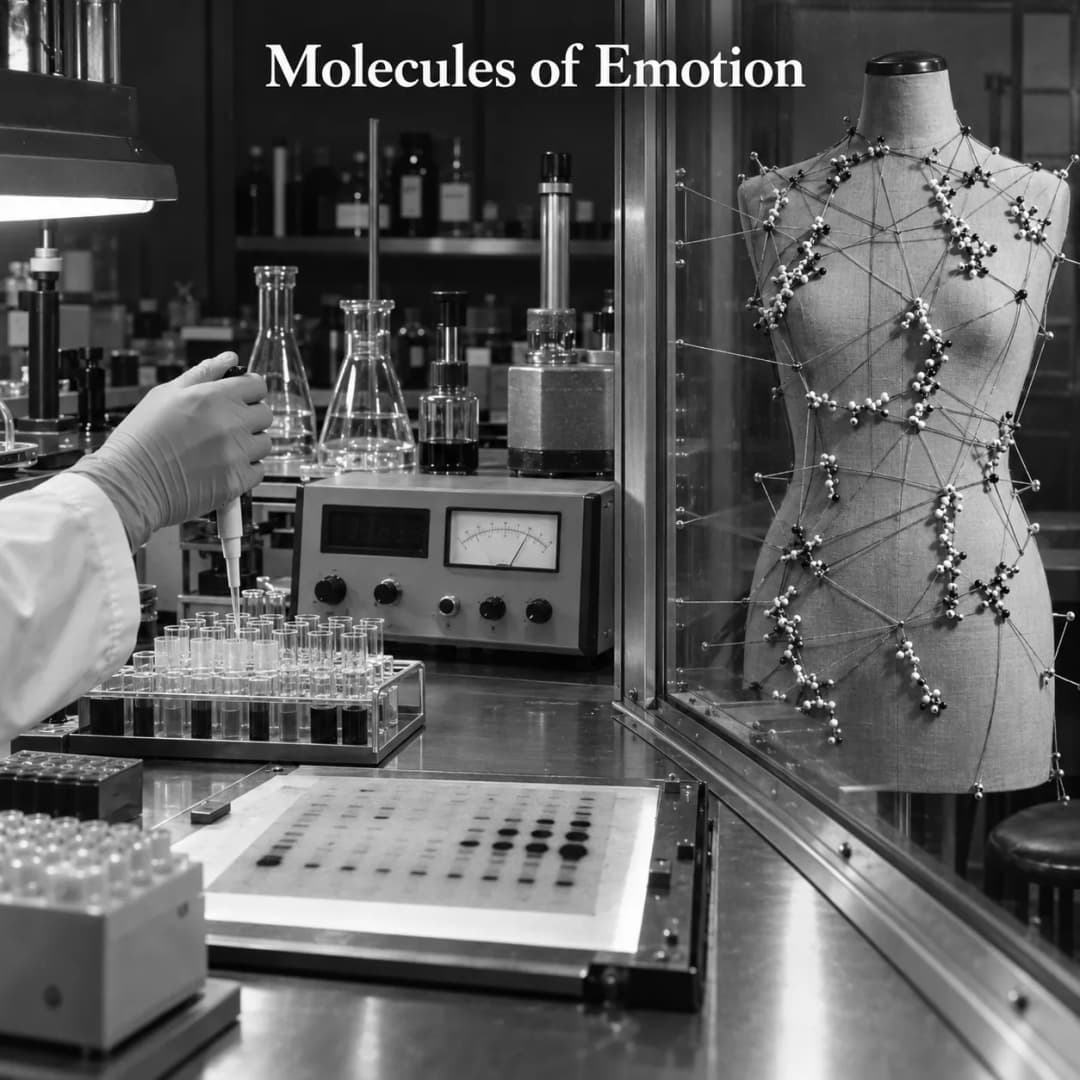
Molecules of Emotion is Candace Pert's thesis, set out in her 1997 book, that neuropeptides and their receptors constitute a body-wide information network which is the physical substrate of emotion, so that emotion is distributed throughout the tissues rather than confined to the brain, and that this provides a scientific basis for mind-body medicine. This page describes that claim rather than reporting it. The governing rule here is that Pert's published science and the trade book's thesis are two separate objects, and the first must never be allowed to vouch for the second.
What it is
The science is real and significant, and it should be said first. Candace Pert and Solomon Snyder published "Opiate Receptor: Demonstration in Nervous Tissue" in Science in 1973. Pert is first author, and was a graduate student at Johns Hopkins at the time. Using radiolabelled ligands, the work demonstrated specific opiate binding sites in nervous tissue. It is one of the foundational results in modern neuropharmacology and it opened the route to the endorphins. She went on to be chief of the section on brain biochemistry at the National Institute of Mental Health, and later held a research professorship at Georgetown University School of Medicine. She died in 2013.
The Lasker episode belongs on the page because it is part of what establishes that her standing was real. In 1978 the Albert Lasker Basic Medical Research Award went to Solomon Snyder, John Hughes and Hans Kosterlitz, and Pert was not included. She wrote to the Lasker Foundation stating she had played a key role in initiating and following up the research, and took the dispute to the scientific press. Snyder himself supported her claim and asked committee members to consider including her. It is a documented episode in the history of scientific credit and in the position of women in laboratory science.
The trade book's thesis is an extrapolation from that work. The underlying observation, that neuropeptides and their receptors are found widely outside the central nervous system including in the immune system, is correct and is her own field. What the book adds is the further step: that this constitutes a unified informational basis for emotion residing in the body, and that it validates mind-body medicine broadly. That step is a trade-book claim rather than a finding, and it is not how the receptor literature is read in her own field.
In effect
One therapeutic application followed from the same reasoning and is on the record. Pert and Michael Ruff identified Peptide T in 1986 and proposed it as an inhibitor of HIV entry. It was contested at the time, with William Haseltine and Joseph Sodroski at Dana-Farber stating there was no scientific basis for an antiviral effect. An NIH-funded, placebo-controlled, three-site trial of more than two hundred patients ran from 1990 to 1995 and found no significant difference from placebo on the study's primary endpoints.
The way the claim reaches most readers is worth recording. Benjamin Hardy's Personality Isn't Permanent cites Pert in chapter 5, at page 185 for the book and at page 188 for an audio recording, so the route runs through a trade book and a spoken-word CD rather than through any paper. Her name appears in the same undifferentiated note column as Science, the Journal of Personality and Social Psychology and Psychological Bulletin, with nothing to tell a reader which of those things they are looking at. That book also spells her name two ways in its own notes; Candace is correct.
The sentence that must never be written is this one: that the discoverer of the opiate receptor showed emotions are stored in the body. Every clause in it is either true or plausible-sounding, and together they launder a 1997 trade-book thesis through a genuine 1973 credential.
What it does not say
It does not say her credentials were anything other than genuine. The 1973 paper is landmark work with Pert as first author, and the Lasker exclusion is a documented credit dispute in which her senior colleague supported her.
It does not establish that emotion is stored in tissue. That is the book's extrapolation and it has not been demonstrated.
It does not follow from the peripheral distribution of neuropeptide receptors. That distribution is real and is her field. The informational-substrate claim is a separate step.
It does not carry a therapeutic implication. The one application pursued from this reasoning failed a controlled trial on its primary endpoints.
It does not permit the 1973 paper to stand behind the 1997 book. That is the standing rule for this page.
Sources
- Pert, C. B., & Snyder, S. H. (1973). "Opiate Receptor: Demonstration in Nervous Tissue." Science, 179(4077), 1011-1014. Author order and journal confirmed.
- Pert, C. B. (1997). Molecules of Emotion: Why You Feel the Way You Feel. Scribner. The thesis, described here and not endorsed.
- Independent verification, 2026-09-11. NIMH and Georgetown posts confirmed. The 1978 Lasker exclusion and Snyder's support for her claim confirmed. The 1990 to 1995 NIH placebo-controlled Peptide T trial and its null primary endpoints confirmed.
- Hardy, B. Personality Isn't Permanent, pp. 185 and 188. Cited via the trade book and an audio recording, in the same undifferentiated note apparatus as Science.