Motor Imagery
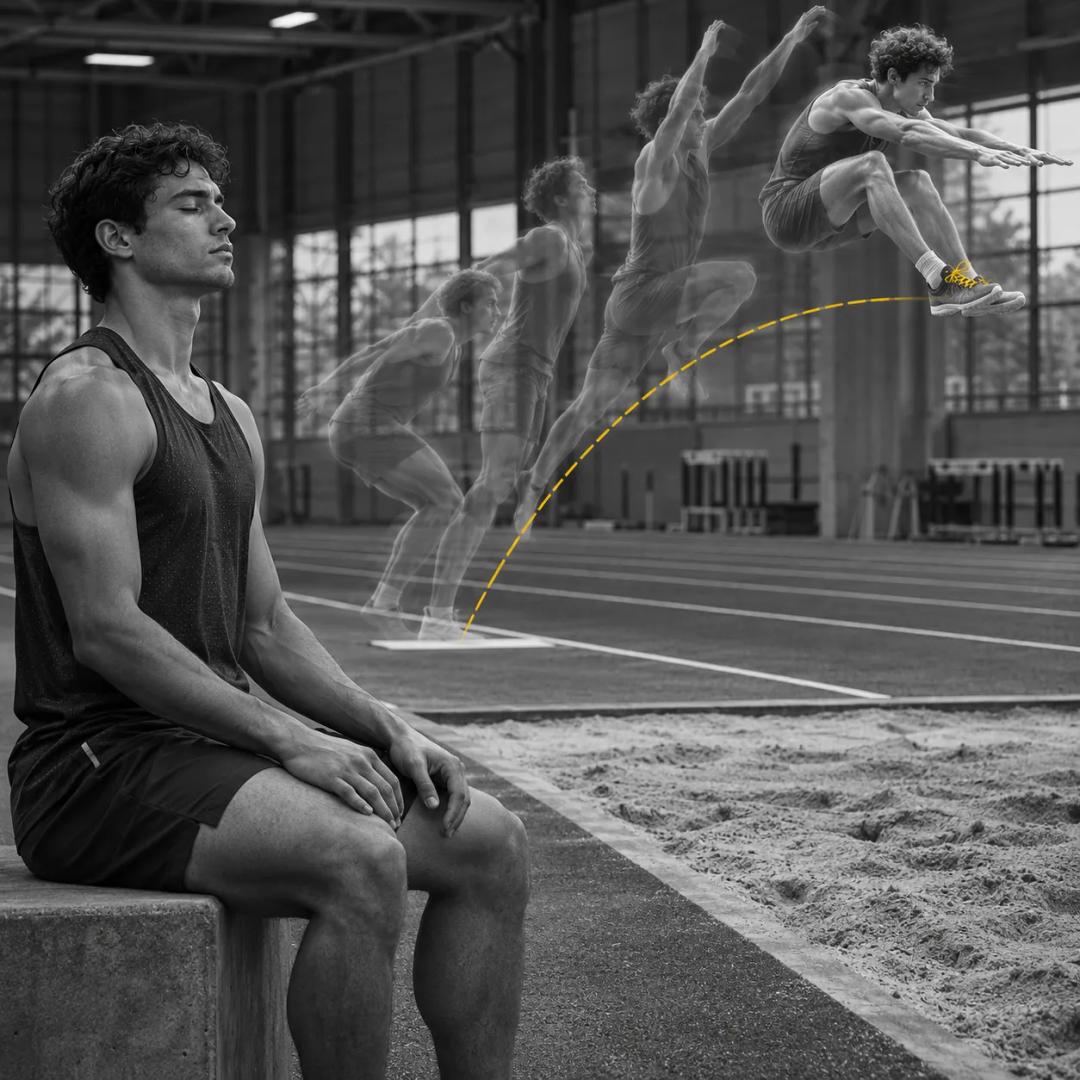
Motor imagery is imagining a movement from the inside, with its effort and its timing, without carrying it out. It is the form of imagery that most of the mental rehearsal studies on this site used, and it is the process that mental rehearsal of a physical task draws on.
What it is
Motor imagery is imagery of action as opposed to imagery of scenes. A person who imagines walking to a door, playing a five-finger piano exercise or straining a finger against resistance is rehearsing the movement as it would feel, not watching a picture of it. Researchers separate this inside view from imagining oneself from the outside, as an onlooker would see it, and the studies described here mostly used the inside view.
Marc Jeannerod set out the simulation account in a 1994 paper in Behavioral and Brain Sciences. In it, imagined and executed actions share neural substrates, so imagining a movement engages part of the same machinery that produces it. Later neuroimaging meta-analyses, including one by Hétu and colleagues in 2013, reported substantial but partial overlap between the networks active during imagery and execution, with the primary motor cortex engaged less consistently. One behavioural consequence in the account is that imagined actions take about as long as real ones, and take longer for farther targets.
In effect
The studies reviewed in Does mental rehearsal improve performance? give motor imagery its working record. In a five-day experiment led by Alvaro Pascual-Leone in 1995, adults who sat at a piano and imagined playing a five-finger exercise, with muscle recordings confirming that they stayed still, made fewer sequence errors and played with steadier timing than a group that did not practise. A group that practised physically improved by more.
In a twelve-week experiment led by Vinoth Ranganathan in 2004, thirty healthy volunteers trained imagined maximal effort of the little finger or the elbow. Finger strength rose by about 35 per cent and elbow strength by about 13.5 per cent, and a no-training group did not improve.
Pooled evidence points the same way. A 2020 meta-analysis led by Adam Toth pooled 37 studies and reported a small positive effect of mental practice on performance, and a 2021 analysis led by Bianca Simonsmeier reported a medium-sized average effect of imagery interventions in sport, with larger effects when imagery was added to physical practice.
What it does not say
Motor imagery overlaps with movement, and overlap is the right word. It does not make imagined and real experience the same thing. In the experiments above, the group that practised physically outperformed the group that imagined, and the best results in the sport analysis came when imagery was added to physical practice, not when it replaced it.
The gains were also specific. They appeared on the task that was rehearsed, whether a piano exercise or a strength measure. The studies tested finger tasks, strength and sport, so extending motor imagery to a presentation, a negotiation or a work routine goes beyond what they measured.
The idea is sometimes stated more broadly in popular books on visualisation. James Doty's Mind Magic cites the Pascual-Leone and Ranganathan studies where it describes measurable gains from imagined action. Those two studies are the stronger and narrower evidence: motor imagery of a trained movement, practised repeatedly, tested on that movement.
Sources
- Jeannerod, M. (1994), The representing brain: Neural correlates of motor intention and imagery, Behavioral and Brain Sciences, 17(2), 187-202.
- Pascual-Leone, A., Nguyet, D., Cohen, L. G., Brasil-Neto, J. P., Cammarota, A., & Hallett, M. (1995), Modulation of muscle responses evoked by transcranial magnetic stimulation during the acquisition of new fine motor skills, Journal of Neurophysiology, 74(3), 1037-1045. https://doi.org/10.1152/jn.1995.74.3.1037
- Ranganathan, V. K., Siemionow, V., Liu, J. Z., Sahgal, V., & Yue, G. H. (2004), From mental power to muscle power: gaining strength by using the mind, Neuropsychologia, 42(7), 944-956. https://doi.org/10.1016/j.neuropsychologia.2003.11.018
- Toth, A. J., McNeill, E., Hayes, K., Moran, A. P., & Campbell, M. (2020), Does mental practice still enhance performance? A 24 year follow-up and meta-analytic replication and extension, Psychology of Sport and Exercise, 48, 101672. https://doi.org/10.1016/j.psychsport.2020.101672
- Simonsmeier, B. A., Andronie, M., Buecker, S., & Frank, C. (2021), The effects of imagery interventions in sports: a meta-analysis, International Review of Sport and Exercise Psychology, 14(1), 186-207. https://doi.org/10.1080/1750984X.2020.1780627