Movement as Punishment
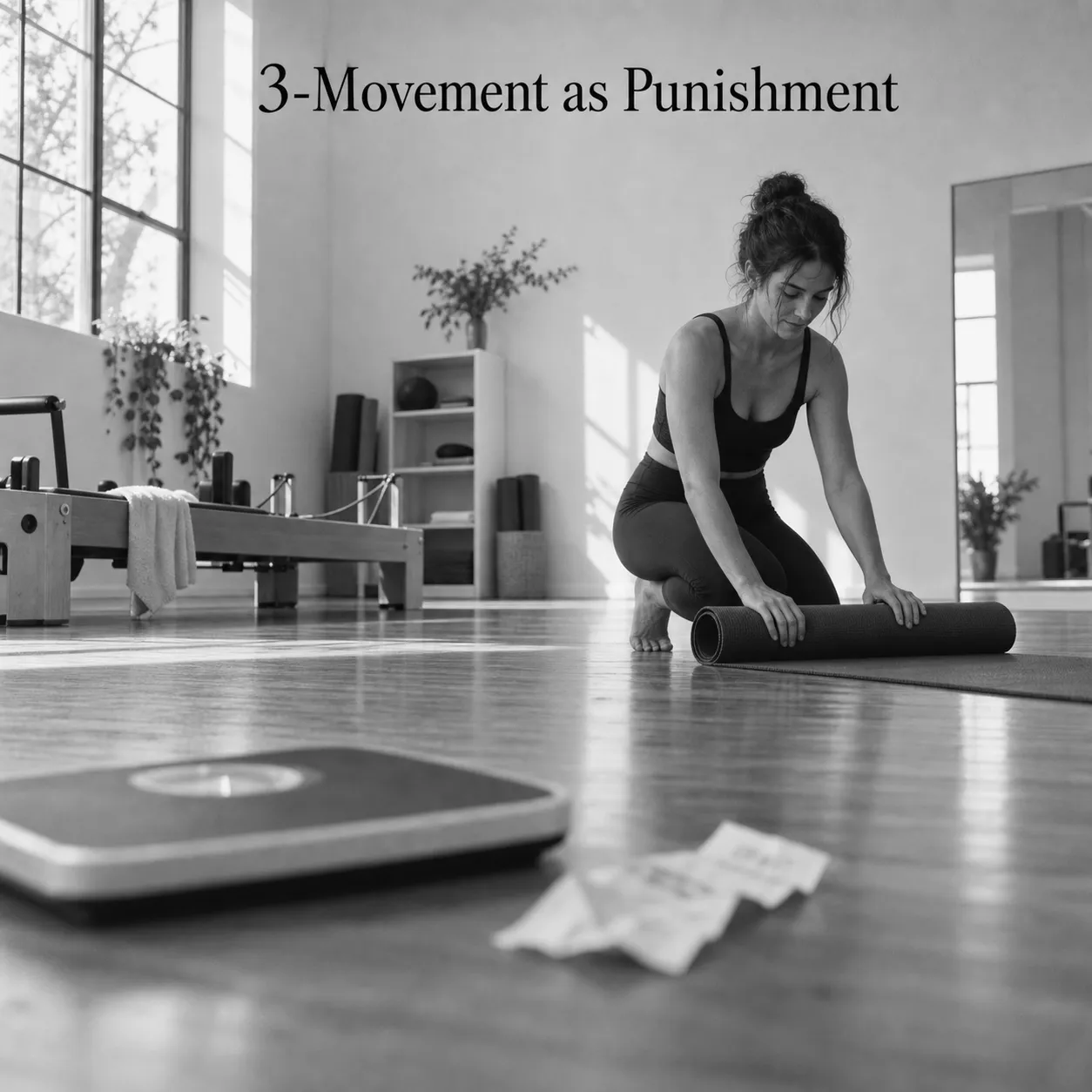
Movement as punishment describes exercise undertaken as penance, for what was eaten, for how a body looks, or for a general sense of having fallen short, rather than as something that supports a life. It is a practitioner observation rather than a measured construct, and this page says so in the first paragraph. The research-backed neighbour is Robert Vallerand's dualistic model of passion, and the closest evidenced mechanism is the overjustification effect. Neither was built to test this framing, and neither is presented here as though it had been.
What it is
The framing is not about intensity or volume. The same forty minutes can be either. What differs is what the person believes the session is for, and what they believe happens if it is missed.
Two people doing the same session. One is there because the week goes better when they move. The other is there because of a meal on Saturday, and will be there again tomorrow if tomorrow's meal is also wrong. When the second person misses a session, they have not missed a session. They have failed to pay something back.
That is the whole of the observation, and the honest tag for it is not-a-research-claim. No verified source establishes movement as punishment as a named, measured construct, and the verification pass for article 14 did not produce one. It is attributed on this site to the instructor who wrote that article, Dildem Smolcic, as something she has watched rather than as something anybody has counted.
A note on scope. This sits next to disordered exercise and compensatory behaviour, which are clinical territory and are not what this page is about. Nothing here should be turned into a judgment about whether a given person's training is a problem. That is a question for a clinician who can see the person.
In effect
The research-backed neighbour: harmonious and obsessive passion
Vallerand's dualistic model is the genuine research distinction covering much of this ground, and it is the one to cite when an argument needs evidential weight. Harmonious passion is freely chosen and sits alongside the rest of a life. Obsessive passion is driven by contingencies such as self-esteem or self-acceptance, which come to control the person rather than the other way round. The vault holds that note as primary-cited.
Two cautions. Vallerand's own labels are descriptive rather than evaluative, and the moralising gloss found in some secondary accounts is not his. And his model is about how an activity is held, not about what somebody believes the activity is repaying, which is close to this framing without being identical to it.
The closest evidenced mechanism: overjustification
The overjustification effect, from Lepper and colleagues and tagged robust in this vault, describes what happens to an activity people enjoy once it acquires an external justification: the enjoyment, and with it the willingness to do the thing unprompted, tends to decline. That is the most plausible available account of why attaching a debt to movement might make the movement less durable. It has not been tested on exercise framing specifically, and that limit travels with it.
Both sides, then where we land
The clinical and qualitative literature on compensatory exercise is real, and the intuition that penance framing is fragile is plausible and widely reported by people who teach movement for a living. What does not exist, as far as the September 2026 pass established, is quantitative evidence that framing exercise as penance predicts dropping out.
We land on this: name it as an observation, cite Vallerand where the argument needs research, and do not tell a reader what their own training means.
What it does not say
It does not have an effect size, a prevalence figure or a dropout rate. None exists. Any number attached to this framing has been imported from somewhere it does not belong.
It does not say hard training is punishment. Intensity is not the variable. A demanding session freely chosen and a gentle one undertaken as penance are on opposite sides of this distinction.
It does not diagnose disordered exercise. Compensatory exercise is a clinical concept with clinical criteria, assessed by clinicians. This page is about a framing, and the two should not be read across.
It does not tell anybody to stop. There is no prescription here, no threshold and no advice. A reader who recognises the pattern in themselves and wants to do something about it needs a person who can see them, not a concept page.
It does not inherit Vallerand's evidence. Citing the dualistic model alongside an observation does not make the observation a finding. The two are kept separate on purpose.
Sources
- Vallerand, R. J. The dualistic model of passion, harmonious and obsessive. Held in this vault as Harmonious and Obsessive Passion, tagged primary-cited. The research-backed neighbour to this framing.
- Lepper, M. R., and colleagues. The overjustification effect. Tagged robust in this vault. Not tested on exercise framing specifically.
- Nobody Is Born Consistent, 2026-09-11. The observation is the contributor's and is marked as hers in the article body as well as here.
- Vault verification record, 2026-09-11. Evidence status not-a-research-claim. No measured construct was found for this framing, and none has been invented for it.
- Where this came from
- No book in this library is the source of this concept. It entered the vault from Nobody Is Born Consistent, built from primary sources rather than from a book.