Multiple Intelligences
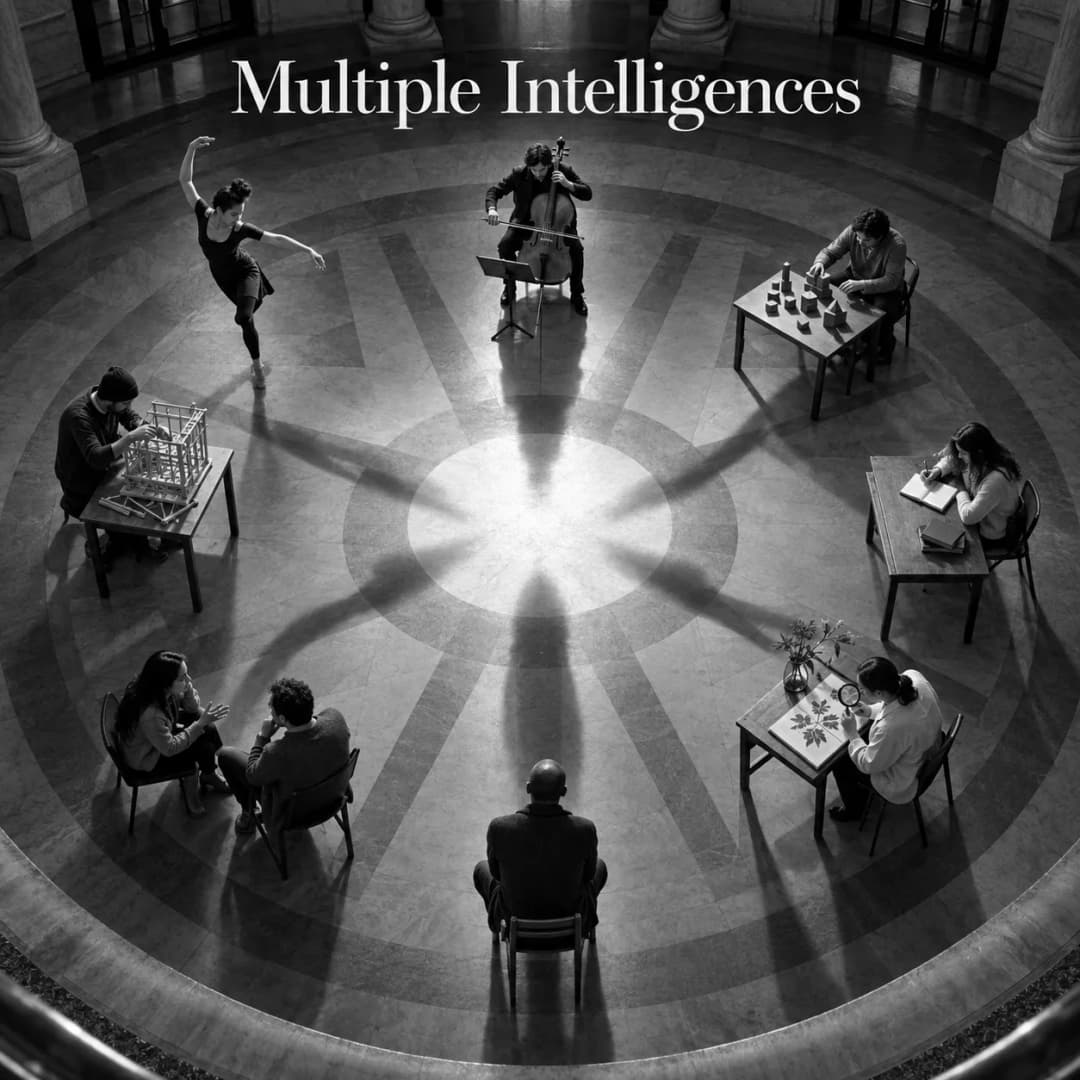
Multiple intelligences is Howard Gardner's proposal, in Frames of Mind in 1983, that human intelligence is not one capacity but several relatively independent ones, each with its own developmental course and its own neural substrate. The psychometric evidence for independent intelligences is weak. Gardner's answer is that psychometrics is not the right test, on grounds that are principled rather than evasive, and this page carries both halves because neither is honest on its own.
What it is
The original list was seven: linguistic, logical-mathematical, spatial, musical, bodily-kinaesthetic, interpersonal and intrapersonal. A naturalist intelligence was added later and an existential one was floated and never confirmed.
The theory's evidence base, as Gardner himself states it, is not psychometric. It is neurological, evolutionary, developmental and anthropological, and the criterion he leans on hardest is selective impairment: a capacity that can be knocked out on its own by brain damage while the others survive has a claim to being its own faculty. That is the theory's actual argument, and it is the reason the psychometric verdict cannot be read as the last word without his position attached.
The cleanest test anyone has run is Beth Visser, Michael Ashton and Philip Vernon's, published in Intelligence in 2006 under the title "g and the measurement of Multiple Intelligences: A response to Gardner". They built a battery of tasks intended to tap each of Gardner's intelligences, gave the whole battery to the same participants, and looked at how the tasks grouped. Most of them loaded on a general factor rather than standing apart as independent abilities. If the intelligences were genuinely separate, that is not the result the battery should have produced.
Lynn Waterhouse, writing in Educational Psychologist in 2006, made the broader charge that there was no adequate empirical validation of multiple intelligences as distinct entities at all, and pressed the same case against emotional intelligence and against the Mozart effect in adjacent papers.
In effect
Gardner's reply is that the theory was not built as a psychometric claim in the first place, so a psychometric battery is not the test it has to pass. He has questioned the construct validity of general intelligence directly. And he has argued that the batteries assembled against him are contaminated by verbal and logical-mathematical demands, so that every task in them draws on the two intelligences psychometrics has always been best at measuring, which guarantees in advance that a general factor will be recovered. On his account the experiment cannot come out any other way, whatever the truth of the matter.
Whether that objection succeeds is a live question. It is also a testable one, and the way to test it would be a battery whose non-verbal tasks make no verbal demands. That is hard to build and it has not been built.
The practical record is a separate matter again. The theory was taken up enthusiastically in schools, most visibly through the learning-styles movement it is often conflated with. Gardner has himself objected to that conflation: an intelligence in his sense is a computational capacity, not a preferred channel for receiving information. This publication does not treat the weakness of learning styles as evidence against Gardner, because they are not his claim.
So the defensible position is this. Multiple intelligences is not supported as a psychometric structural model of ability, and anyone using it that way, to claim that a child has a measurable musical intelligence separate from a measurable verbal one, is claiming more than the evidence carries. As a framework for widening what schools count as accomplishment, it is a normative proposal about education rather than an empirical claim, and it should be defended or attacked on those terms. The theory's lasting contribution is the pressure it put on a single-number account of ability, and that pressure was worth applying whether or not the seven hold up.
What it does not say
It does not say the intelligences have been shown to be independent. The best battery study recovers a general factor instead.
It does not say the psychometric verdict settles the matter. Gardner's objection, that the batteries are contaminated by verbal and logical-mathematical demands, has not been answered by a study designed to avoid that contamination.
It does not endorse learning styles. That is a different claim, it has a poor evidence record, and Gardner has objected to the conflation himself.
It does not support diagnosing a child's intelligence type. Nothing in the evidence permits that use, and it is the commonest one in schools.
It cannot be cited in halves. The psychometric weakness and Gardner's reply go together or neither goes. That is a standing rule here.
Sources
- Gardner, H. (1983). Frames of Mind: The Theory of Multiple Intelligences. The primary. Not read in this vault, so nothing is attributed to it beyond what the verification pass established from secondary description of Gardner's stated evidence base and his published replies.
- Visser, B. A., Ashton, M. C., & Vernon, P. A. (2006). "g and the measurement of Multiple Intelligences: A response to Gardner." Intelligence. The battery study and the cleanest test available.
- Waterhouse, L. (2006). Educational Psychologist. The broader charge of inadequate empirical validation.
- Gardner's replies are recorded here at the level the verification pass established them: that the theory was not offered as a psychometric claim, that he questions the construct validity of general intelligence, and that the batteries are contaminated by verbal and logical-mathematical demands. No verbatim quotation is carried, because none was verified.
- Brydan, D. (2026). Smart. Footnote Press. The book states flatly and without citation that the psychometric evidence remained elusive, and records Gardner's own position in the next clause. The vault's quarantine rule on that sentence is binding: it is defensible about the psychometric literature and incomplete about the theory. The book misprints Gardner's forename at p. 342 and again in a chapter 9 note.
- Adam, D. (2018). The Genius Within. Picador. Names Gardner among the theorists it surveys.