Neuromarketing
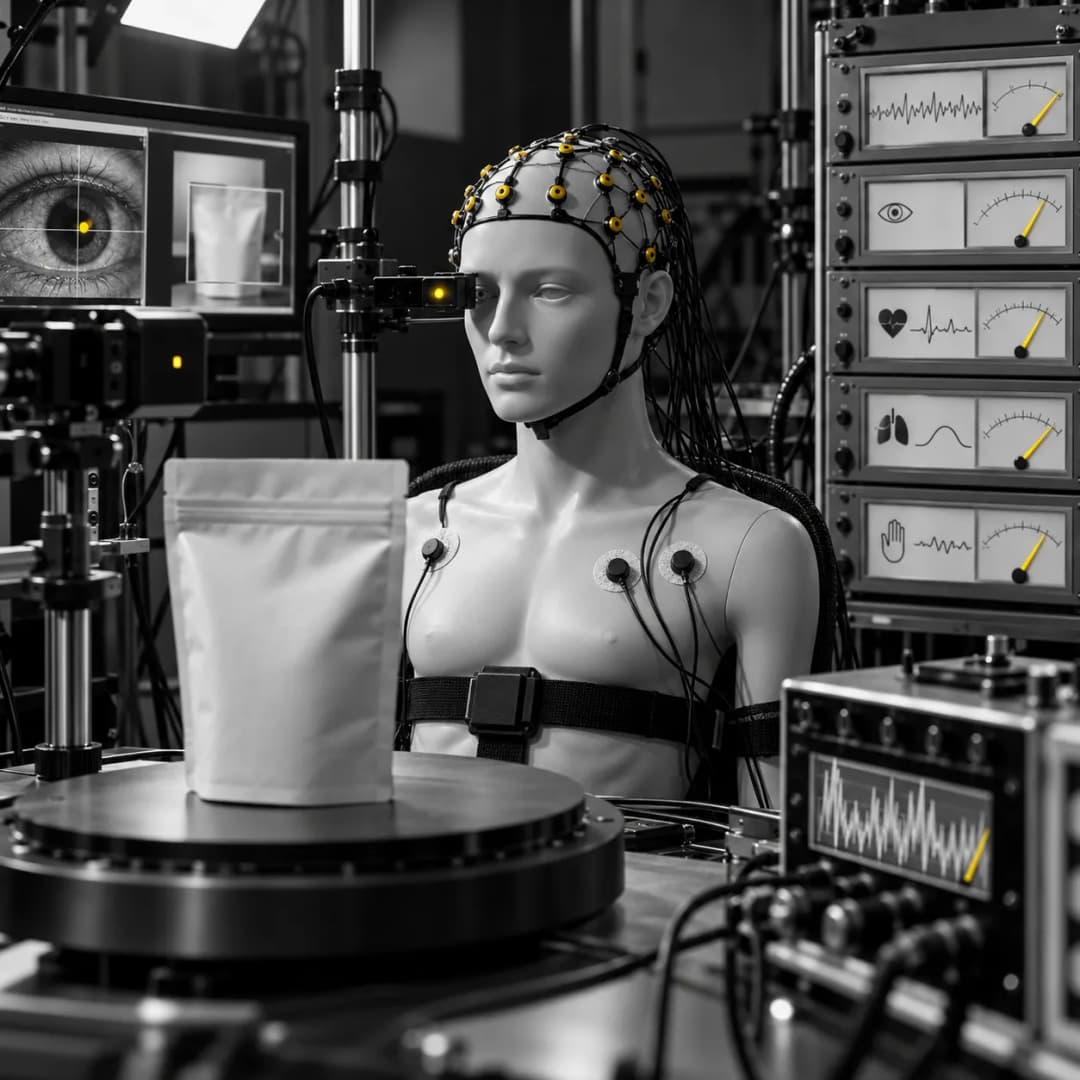
Neuromarketing is the use of brain and body measurement, chiefly functional magnetic resonance imaging and electroencephalography, to study how people respond to products, brands and advertising. The word covers two things that share a vocabulary and little else: an academic programme that publishes its samples and effect sizes, and a commercial service industry whose protocols are proprietary. The academic work has a real result, narrower than the one the trade sells. A 2010 review in Nature Reviews Neuroscience found no evidence for a single buy button in the brain.
What it is
The academic strand measures group neural responses to stimuli and tests whether they predict outcomes that self-report does not. The commercial strand sells scanning and related measures as a service to brands and agencies, with stimuli developed for each campaign, results delivered through marketing channels rather than journals, and central claims that outsiders cannot check. Both appear under the same label, which is why a sentence that begins "neuromarketing shows" needs a second question: which kind, and published where.
The strongest supported claim is not that a scan can read an individual mind. It is that group neural response can forecast aggregate market outcomes, in some cases where self-report from the same people cannot. In Gregory Berns and Sara Moore's 2012 study in the Journal of Consumer Psychology, averaged likeability ratings from a scanned adolescent sample did not forecast later song downloads, while group imaging activity from the same session did. Emily Falk and colleagues reported that brain responses in a small scanned sample predicted population-level campaign response beyond what the sample's own self-reports predicted. Alexander Genevsky and Brian Knutson found that nucleus accumbens activity generalised to forecast crowdfunding outcomes where behavioural measures did not, and Vinod Venkatraman and colleagues reported in 2015 that imaging added explanatory power for advertising elasticities beyond traditional measures. Knutson and Genevsky's 2018 review in Current Directions in Psychological Science gathers the programme. These findings are as recorded in this site's vault after an external verification pass, and they were not re-read in full for this page.
Training programmes sold to marketers draw on the other tradition. The conversion-marketing site CXL reports that neuromarketing "has suggested" that an "old brain", the primitive fight-or-flight part, "makes most of our decisions", and credits Patrick Renvoise and Christophe Morin's book Neuromarketing with six stimuli that speak to it: self-centred messages, contrast, tangible input, a strong beginning and end, visuals and emotion. CXL is a secondhand source here, and the book itself was not checked. That is a claim about anatomy and a set of copywriting advice joined together, and the two have different evidence.
In effect
Dan Ariely and Gregory Berns reviewed the field in Nature Reviews Neuroscience in 2010 under the title "Neuromarketing: the hope and hype of neuroimaging in business". They write that there is no evidence for a single buy button in the brain, because purchase decisions have many contributors. They call the cost-efficiency claims largely hype and say neuromarketers are quick to invert findings, treating activity in a region as a sign that a person likes something. That inversion is reverse inference, and it is the methodological objection that decides most individual claims in the field. Their own conclusion was constructive: imaging may reveal hidden information about the consumer experience, and its most promising use may come before a product is released, while it is still an idea. Berns appears on both sides of this page, which is how a healthy literature looks.
Hilke Plassmann, Vinod Venkatraman, Scott Huettel and Carolyn Yoon, writing in the Journal of Marketing Research in 2015, set out three fundamental challenges for consumer neuroscience, cautioned explicitly against reverse inference and exaggerated claims, and observed that sample sizes in this work are far smaller than in traditional psychological research, with consequences for reliability, generalisability and opportunistic findings. Fisher, Chin and Klitzman defined the practices and professional challenges of the field in the Harvard Review of Psychiatry in July 2010. The editors of Nature Neuroscience raised the ethical questions in a 2004 editorial, "Brain Scam?", and they have not gone away.
A structural point bears on how to read the commercial claims. The firms selling scanning services are the parties reporting that scanning works. Their protocols are proprietary and their results reach the public through marketing rather than review. For the commercial work there is no replication position, because there is nothing published to replicate. That is not a finding that the work failed. It means the question cannot be asked. The academic neuroforecasting programme, by contrast, has been extended across unrelated markets by more than one group.
The link to the lizard brain is direct. The idea that an old reptilian layer decides purchases comes from the triune brain, which researchers who study nervous-system evolution reject. A model of the brain that does not hold cannot supply a buy button. What the better research offers is narrower and testable: forecasting aggregate outcomes from group neural response, scoped to populations and to incremental validity over conventional measures.
What it does not say
It does not say that brain measurement is useless to marketers. The neuroforecasting literature is the demonstration that it can tell a researcher something self-report cannot, within a scope.
It does not say that a scan can read an individual customer's preference. Almost every commercial claim in circulation is stated at the individual level, and the supported result is about aggregates.
It does not say that the simple, visual, emotional messages taught in sales training are wrong. Whether those messages work is a question for tests of the messages on customers, and it does not depend on any brain layer.
It does not say that the commercial industry has been shown to fail. It says its studies are mostly not published, so most of its claims cannot be assessed.
It does not rest on the academic strand's papers being the last word. The supporting and critical literature above was confirmed at an external verification pass and was not read in full by this site, which is why the evidence status stays at contested.
Sources
- Ariely, D., and Berns, G. S. (2010). "Neuromarketing: the hope and hype of neuroimaging in business." Nature Reviews Neuroscience, 11(4), 284-292. PMID 20197790. Read through a copy of the paper.
- Berns, G. S., and Moore, S. E. (2012). Journal of Consumer Psychology. Falk and colleagues on the neural focus group. Genevsky and Knutson on microlending and crowdfunding. Venkatraman, V., et al. (2015). "Predicting advertising success beyond traditional measures." Journal of Marketing Research. Knutson, B., and Genevsky, A. (2018). "Neuroforecasting aggregate choice." Current Directions in Psychological Science. Plassmann, H., Venkatraman, V., Huettel, S., and Yoon, C. (2015). "Consumer neuroscience: applications, challenges, and possible solutions." Journal of Marketing Research. Fisher, Chin and Klitzman (2010). "Defining neuromarketing: practices and professional challenges." Harvard Review of Psychiatry. "Brain Scam?" (2004), Nature Neuroscience. All recorded in the vault note after the external verification pass of 2026-10-01 and not read in full for this page.
- CXL, "Old brain stimuli", https://conversionxl.com/old-brain-stimuli, read for what a trade summary says the method teaches.
- Vault note: [[Neuromarketing]]. Evidence status contested.