New Thought
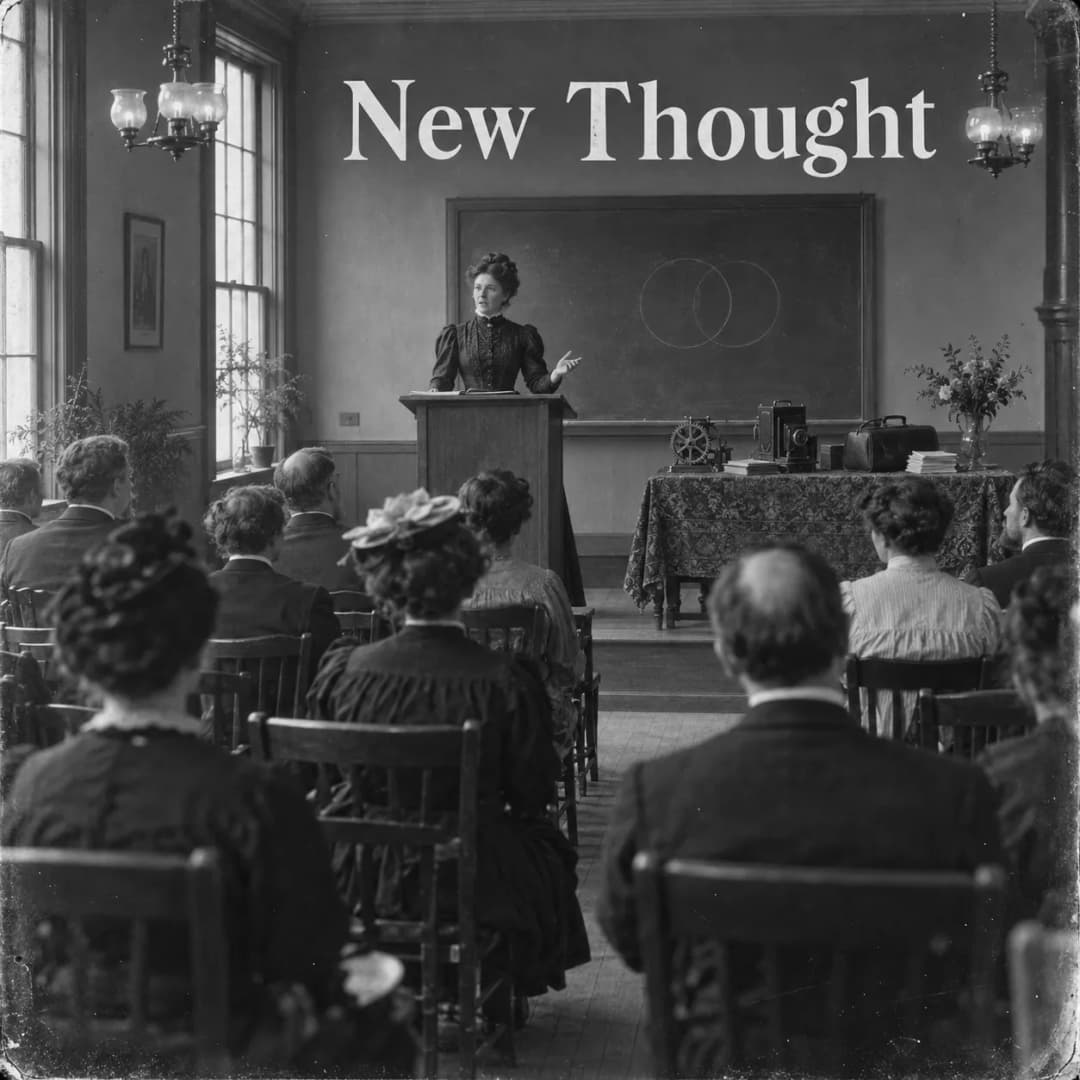
New Thought is a nineteenth-century American metaphysical movement holding that mind is prior to matter, that illness and misfortune follow from wrong belief, and that right thought reorders the world. It draws on Mesmer's animal magnetism and Swedenborg's doctrine of influx, with later inputs from Transcendentalism and philosophical idealism. William James discussed it in 1902 under the name mind-cure. This page is history rather than evidence: it describes what the movement claims and never reports those claims as findings.
What it is
The dating of the term itself is unsettled in the scholarship, with a first notable usage placed at 1889 and institutional adoption in the middle of the 1890s. Emma Curtis Hopkins is the figure the movement's main lines actually descend from.
The correction that matters concerns Phineas Parkhurst Quimby, 1802 to 1866, a New England clockmaker and daguerreotypist with little formal education, who worked from about 1842 with a hypnotic subject and then abandoned hypnosis for verbal persuasion. He held that all illness is a matter of mind and follows from the patient's mistaken beliefs. His surviving handbill says he gives no medicines and makes no outward applications, and that his explanation is the cure. He published nothing in his lifetime.
Quimby's writings were unavailable until 1921, so they did not directly shape the movement's formative development. The largest denominations descend not from him but from defections from Mary Baker Eddy's system by way of Emma Curtis Hopkins, who broke with Eddy in 1886 and taught the Fillmores, Malinda Cramer, Annie Rix Militz and Ernest Holmes. The story that Quimby founded New Thought is a retrospective construction, largely the Dresser family's, and the 1921 Quimby Manuscripts that carry it are a partisan edition with an anti-Eddy chapter attached.
The relation to Christian Science needs the same care. Mary Baker Eddy, 1821 to 1910, was Quimby's patient in 1862 and dated her own discovery to an 1866 healing, publishing Science and Health in 1875. The charge that she took her system from Quimby was pressed publicly from 1887 and carried into the muckraking press two decades later. The scholarly weight now runs against the strong version of that charge. Stephen Gottschalk holds Christian Science to be a religious teaching that is only incidentally a healing method, while Quimbyism was the reverse, and Gillian Gill finds on the full record only general similarities between the two bodies of text. The two movements are siblings with a shared irritant rather than parent and child.
Divine Science, the denomination Joseph Murphy served, was founded by Malinda Cramer in San Francisco in 1888, with Nona Brooks ordained in 1898 and the Denver church holding its first service in 1899. It joined the International New Thought Alliance in 1922. Both Ernest and Fenwicke Holmes were ordained Divine Science ministers before founding Religious Science in 1927, so a move between the two is a move inside one lineage rather than a change of tradition.
In effect
The forward link is the illuminating part, and it is the reason this page is worth having at all. The modern manifestation literature is this movement with the religion removed and a neurological vocabulary bolted on.
The two-minds scheme that Joseph Murphy's The Power of Your Subconscious Mind runs on comes from Thomson Jay Hudson's The Law of Psychic Phenomena of 1893, by way of Thomas Troward and Ernest Holmes. Hudson was a patent examiner and journalist rather than a scientist, and the objective and subjective mind duality was never part of psychology. It has a traceable literary genealogy and not an empirical one, it was criticised as pseudo-science in its own day, and modern dual-process theory is not descended from it and does not license its claims. Anyone reading a contemporary book about the subconscious drawing abundance towards them is reading Hopkins and Hudson at three removes.
Murphy himself was Minister-Director of the Church of Divine Science in Los Angeles for about twenty-eight years. His book is a late, popular and commercially enormous document of a real religious movement, and placing it in that movement is the only thing worth taking from it.
Every health claim the tradition makes is governed by the mind and illness boundary, and the real mechanism the tradition mistook for a general law is the placebo effect, which moves what a patient reports and does not cure organic disease.
What it does not say
It is not a research claim and nothing on this page should be read as one. The movement is described, not assessed for efficacy, because there is no research object here to assess.
It was not founded by Quimby. His writings were unavailable until 1921 and the founding lineage runs through Emma Curtis Hopkins.
It is not the parent of Christian Science, nor its child. The scholarly weight runs against the strong version of the borrowing charge in either direction.
It does not have an empirical genealogy. The two-minds scheme at its centre comes from a nineteenth-century popular work and was never part of psychology, and modern dual-process theory is unrelated to it.
It does not support any health claim, in any wording. The mind and illness boundary governs anything written from this material.
Sources
- Murphy, J. The Power of Your Subconscious Mind. Used here as a late popular document of the movement, not as a source for anything about the movement.
- External verification pass, 2026-09-27: John Haller on the dating of the term; Beryl Satter on the unavailability of Quimby's writings until 1921 and the Hopkins line of descent; Gottschalk (1973) and Gill (1998) on the Eddy and Quimby question; Britannica on Quimby's own doctrine; the Divine Science and International New Thought Alliance institutional record.
- Dresser, H. W., ed. (1921). The Quimby Manuscripts. Thomas Y. Crowell. A partisan edition. The standard modern scholarly edition is Seale, E., ed. (1988), Phineas Parkhurst Quimby: The Complete Writings, three volumes, DeVorss.
- Hudson, T. J. (1893). The Law of Psychic Phenomena. A. C. McClurg. The source of the two-minds scheme, by way of Thomas Troward and Ernest Holmes.
- James, W. (1902). The Varieties of Religious Experience, where the movement is discussed as mind-cure.