Package Imagery
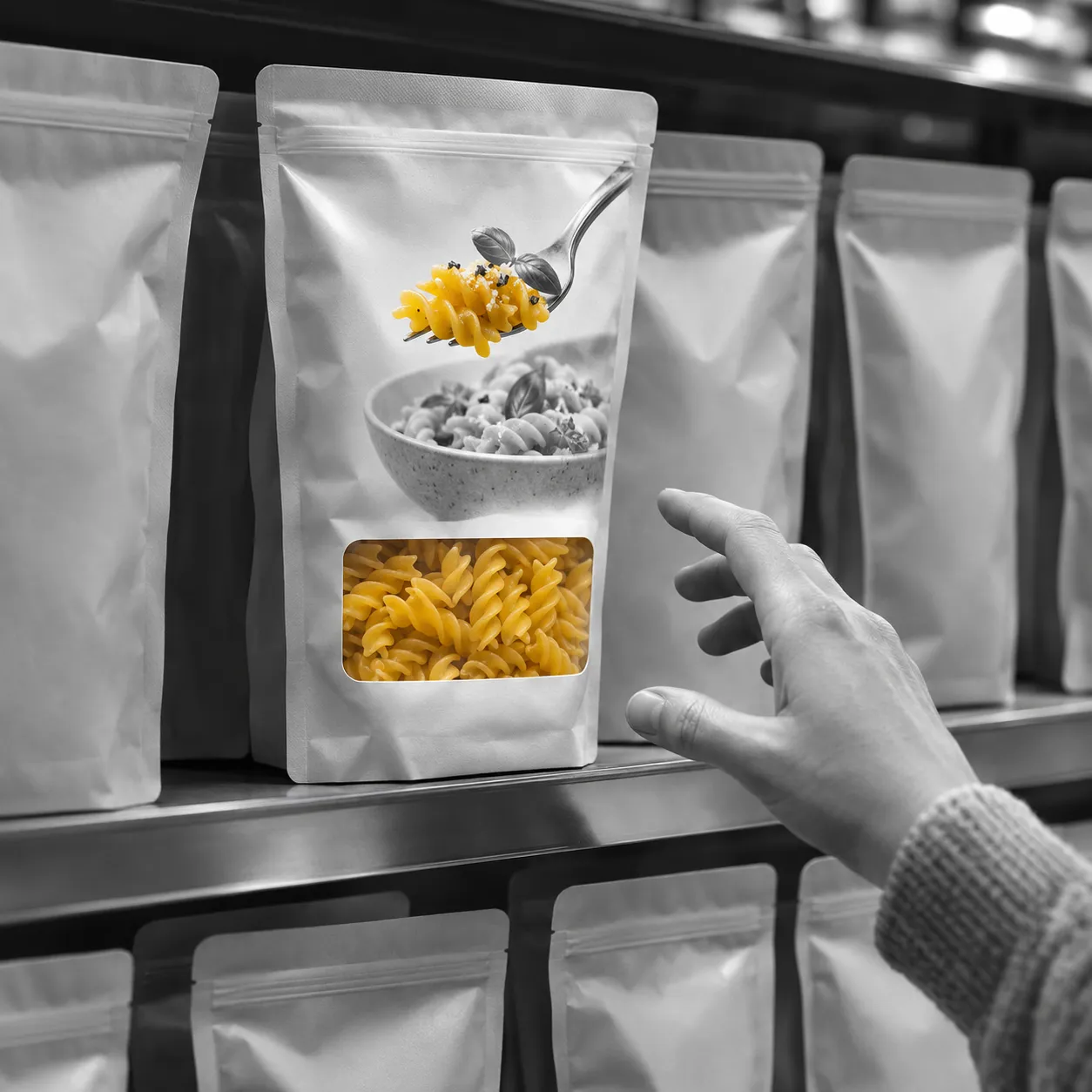
Package imagery is the use of pictures of the product, or windows that show the product itself, on a pack. Two studies measured its effect on attention.
What it is
A pack can show what is inside it in two ways. It can carry a picture, or it can carry a window through which the product is visible. Both are choices about imagery, and both ask the shopper to look at something other than the name.
Robert Underwood, Noreen Klein and Raymond Burke proposed a framework in 2001 for how product imagery on packaging affects attention to the brand, and tested it in a virtual reality shopping simulation. Xueer Ma, Xiangling Zhuang and Guojie Ma compared two kinds of window in 2020.
In effect
In the 2001 simulation, package pictures increased attention to the brand. The effect was conditional: it appeared only for brands with low familiarity, private-label brands being an example, and in product categories offering relatively high experiential benefits. The authors suggested the approach may help such brands enter consideration sets.
In the 2020 study, college students viewed nuts, preserved fruits and instant cereals on a computer screen while their eye movements were recorded. Windows drew more attention than a no-window baseline, and the effect varied by product category. A transparent window and a graphic window of the same size did not differ significantly in attention.
For a brief, the two studies suggest asking whether the brand is already familiar to shoppers and whether the category is bought for its experience, and comparing a window against a printed image. Those are interpretations by this site.
What it does not say
Both studies measured attention. The 2001 abstract reports attention to the brand, and the 2020 abstract reports attention as eye movements, so neither page shows that imagery changes what people buy.
The 2020 study used images on a computer screen, and the 2001 study used a simulation. Neither is a measurement of sales on a real shelf.
Sources
- Underwood, R. L., Klein, N. M., & Burke, R. R. (2001). Packaging communication: attentional effects of product imagery. Journal of Product & Brand Management, 10(7). https://doi.org/10.1108/10610420110410531
- Ma, X., Zhuang, X., & Ma, G. (2020). Transparent windows on food packaging do not always capture attention and increase purchase intention. Frontiers in Psychology, 11, 593690. https://doi.org/10.3389/fpsyg.2020.593690