Paid Priority
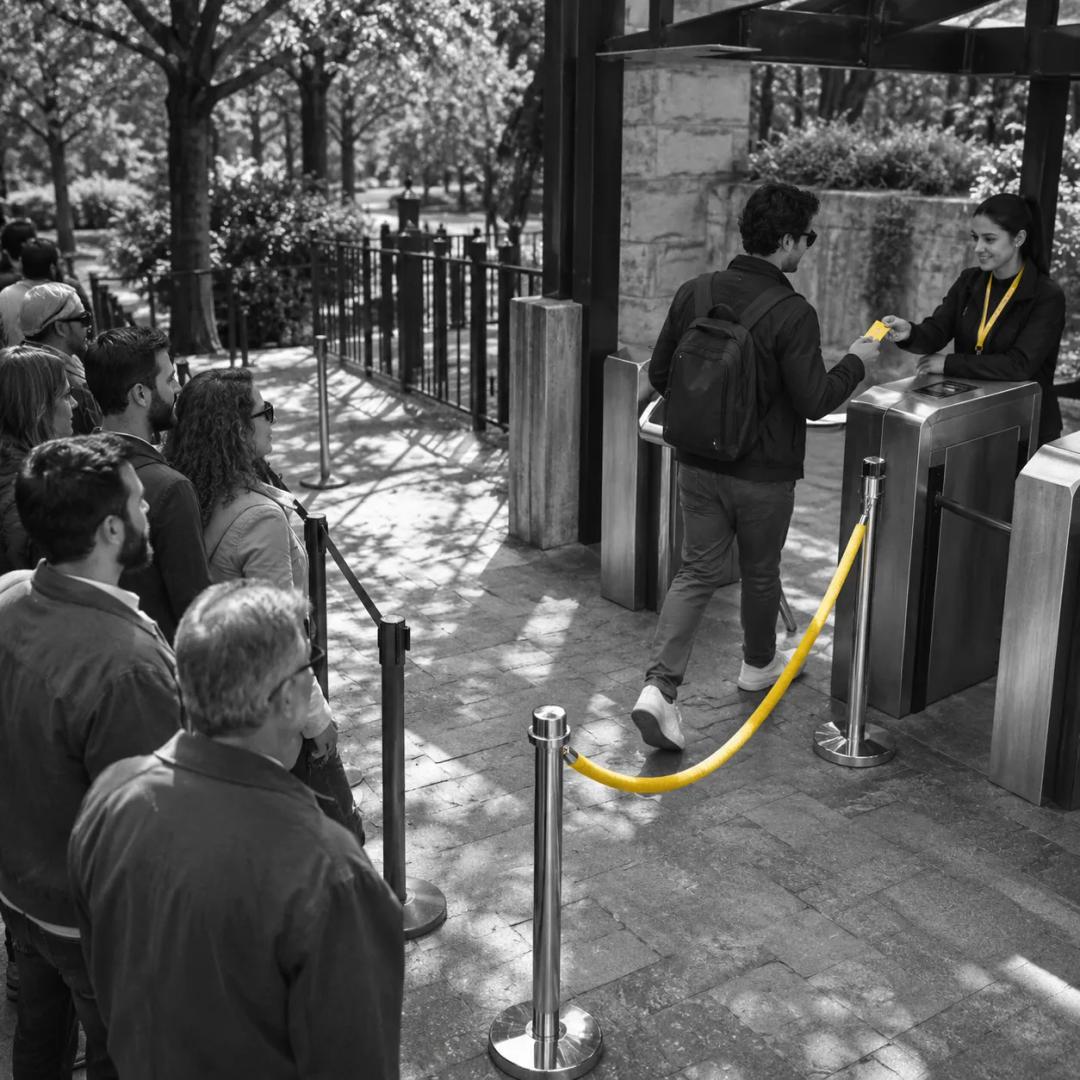
Paid priority is an arrangement in which a fee moves a customer ahead of people who arrived earlier, as in an express or fast-track lane. People already queueing judge it by whether anyone else loses ground.
What it is
A queue rations a scarce counter or gate by arrival order, which charges everyone in the same currency, time. Paid priority adds money, which people hold in very unequal amounts. Dan Ariely, in Predictably Irrational, argues that people move between social norms and market norms, and that bringing money into a social setting switches the rules.
In effect
Abdullah Althenayyan and colleagues compared line-sitting with express lanes in three experiments. With equal waiting times, people were more satisfied when they met a line-sitter than an express-lane customer and judged the express lane less fair, and the fairness gap explained the satisfaction gap. The authors point out that an express lane inserts a priority customer with no one removed, while a line-sitter is a one-for-one swap.
Buyers may also gain status. Lan Jiang, JoAndrea Hoegg and Darren Dahl found that unearned perks brought social discomfort when received in front of other customers, though a bought lane was not among the cases they tested.
What it does not say
Fairness judgements depend on structure and context. In a field experiment by Felix Oberholzer-Gee, a small minority accepted money to let a stranger cut in. The research does not show that every paid lane is rejected, and the experiments hold waiting time equal, so real queues may differ. The page makes no claim about pricing advice.
Sources
- Althenayyan, A., Ülkü, S., Yang, L., & Cui, S. (2025). Not all lines are skipped equally: An experimental investigation of line-sitting and express lines. Manufacturing & Service Operations Management, 27(1), 287-304. https://doi.org/10.1287/msom.2022.0338
- Jiang, L., Hoegg, J., & Dahl, D. W. (2013). Consumer reaction to unearned preferential treatment. Journal of Consumer Research, 40(3), 412-427. https://doi.org/10.1086/670765
- Oberholzer-Gee, F. (2006). A market for time: Fairness and efficiency in waiting lines. Kyklos, 59(3), 427-440. https://doi.org/10.1111/j.1467-6435.2006.00340.x
- Ariely, D. Predictably Irrational.