Para-Social Interaction
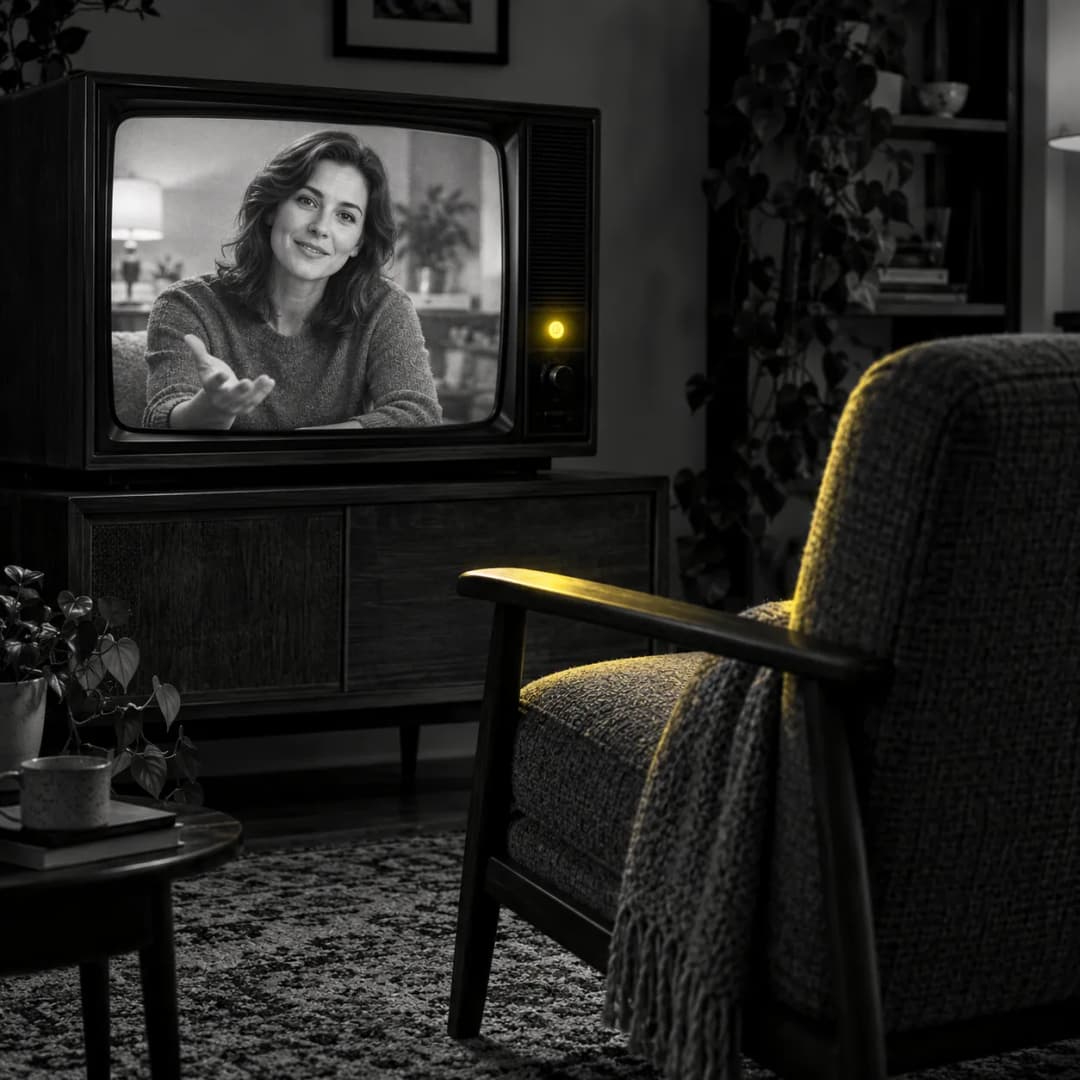
Para-social interaction is the term Donald Horton and R. Richard Wohl introduced in 1956 for the one-sided sense of closeness between an audience and a media performer. Later researchers narrowed it to the experience of mutual awareness during a single viewing and used the phrase parasocial relationship for the longer attachment. The concept has been measured with scales, tested in experiments on direct address and applied to marketing.
What it is
Horton and Wohl published the term in the journal Psychiatry in 1956, in a paper titled Mass communication and para-social interaction, with the subtitle observations on intimacy at a distance. The subtitle holds the idea in four words: closeness, felt by an audience member, toward a performer who is not present and does not know them. The hyphen in the original has since dropped out of most research writing, which now uses parasocial.
Tim Wu, in The Attention Merchants, invokes the term to explain why celebrity coverage works as a business and not only as gossip. His point is commercial: a performer who feels like an acquaintance holds an audience in a way a distant name does not. The idea therefore sits at the meeting point of two traditions, the psychology of audiences and the history of attention as a commodity.
The academic literature moved from observation to measurement. Giles, in a 2002 review in Media Psychology, found the concept widely used but thinly theorised and named three open questions: how the experience fits into ordinary social activity, how it varies between kinds of media figure from celebrities to fictional characters, and which processes over time create a parasocial relationship. He proposed a model that places the experience within everyday social interaction.
A conceptual clean-up followed in 2016. Dibble, Hartmann and a colleague argued that parasocial interaction should be understood as a within-viewing experience of mutual awareness, while a parasocial relationship is the longer-term attachment. They tested two measures against each other in an experiment with 383 participants and found the Experience of Parasocial Interaction Scale better suited to the first of the two. The older PSI-Scale may be picking up longer-term liking, or something else.
In effect
In research: direct address
In the experiment behind the Experience of Parasocial Interaction Scale, reported in the Journal of Communication in 2011, a television performer addressed 198 participants bodily, verbally, both or neither. Viewers reported the most intense parasocial experience when the performer addressed them both bodily and verbally. Ratings of the performer's attractiveness and the viewer's own ability to take another person's perspective were also associated with a more intense experience. A stronger experience went with greater commitment to social norms and more enjoyment of the viewing situation.
In everyday viewing: the moment of being spoken to
Presenters commonly look at the camera and speak in the manner of conversation. As an illustration, a viewer who feels spoken to during a programme is having the within-viewing experience that the 2016 paper separates from a longer attachment. The 2011 experiment is the research that connects presenting habits of this kind to the viewer's sense of being addressed.
In commerce: where the interaction becomes a relationship
Marketing researchers pick up the concept at the point where moments accumulate into a bond. Reinikainen and colleagues, in a 2020 experiment on a YouTube vlog in which an influencer endorsed a brand, found that a stronger parasocial relationship with the influencer went with higher perceived credibility, and that credibility went with brand trust and purchase intention. That study concerns the relationship, and the article on the parasocial relationship covers it in more detail.
What it does not say
The term describes an experience and a research programme. It does not say anything about the health or wellbeing of any viewer, and nothing on this page is health advice.
Within the research, the 2011 and 2016 experiments used short videos and measured an experience during viewing. They cannot show how a bond develops over months or years, which is the question the staged model of Tukachinsky and Stever raises. The coining paper of 1956 is cited here for its term and its subtitle, and this page does not report its arguments beyond that.
Who developed it
Donald Horton and R. Richard Wohl introduced the term. Tilo Hartmann and colleagues built the Experience of Parasocial Interaction Scale and clarified the interaction and relationship distinction, and Tim Wu brought the idea into the history of the attention business.
Sources
- Horton, D., & Wohl, R. R. (1956). 'Mass communication and para-social interaction: Observations on intimacy at a distance.' Psychiatry, 19(3), 215-229. doi:10.1080/00332747.1956.11023049
- Giles, D. C. (2002). 'Parasocial interaction: A review of the literature and a model for future research.' Media Psychology, 4(3), 279-305. doi:10.1207/S1532785XMEP0403_04
- Hartmann, T., & Goldhoorn, C. (2011). 'Horton and Wohl revisited: Exploring viewers' experience of parasocial interaction.' Journal of Communication, 61(6), 1104-1121. doi:10.1111/j.1460-2466.2011.01595.x
- Dibble, J. L., Hartmann, T., & Rosaen, S. F. (2016). 'Parasocial interaction and parasocial relationship: Conceptual clarification and a critical assessment of measures.' Human Communication Research, 42(1), 21-44. doi:10.1111/hcre.12063
- Reinikainen, H., Munnukka, J., Maity, D., & Luoma-aho, V. (2020). 'You really are a great big sister: Parasocial relationships, credibility, and the moderating role of audience comments in influencer marketing.' Journal of Marketing Management, 36(3-4), 279-298. doi:10.1080/0267257X.2019.1708781
- Wu, T. (2016). The Attention Merchants.