Peak Attention
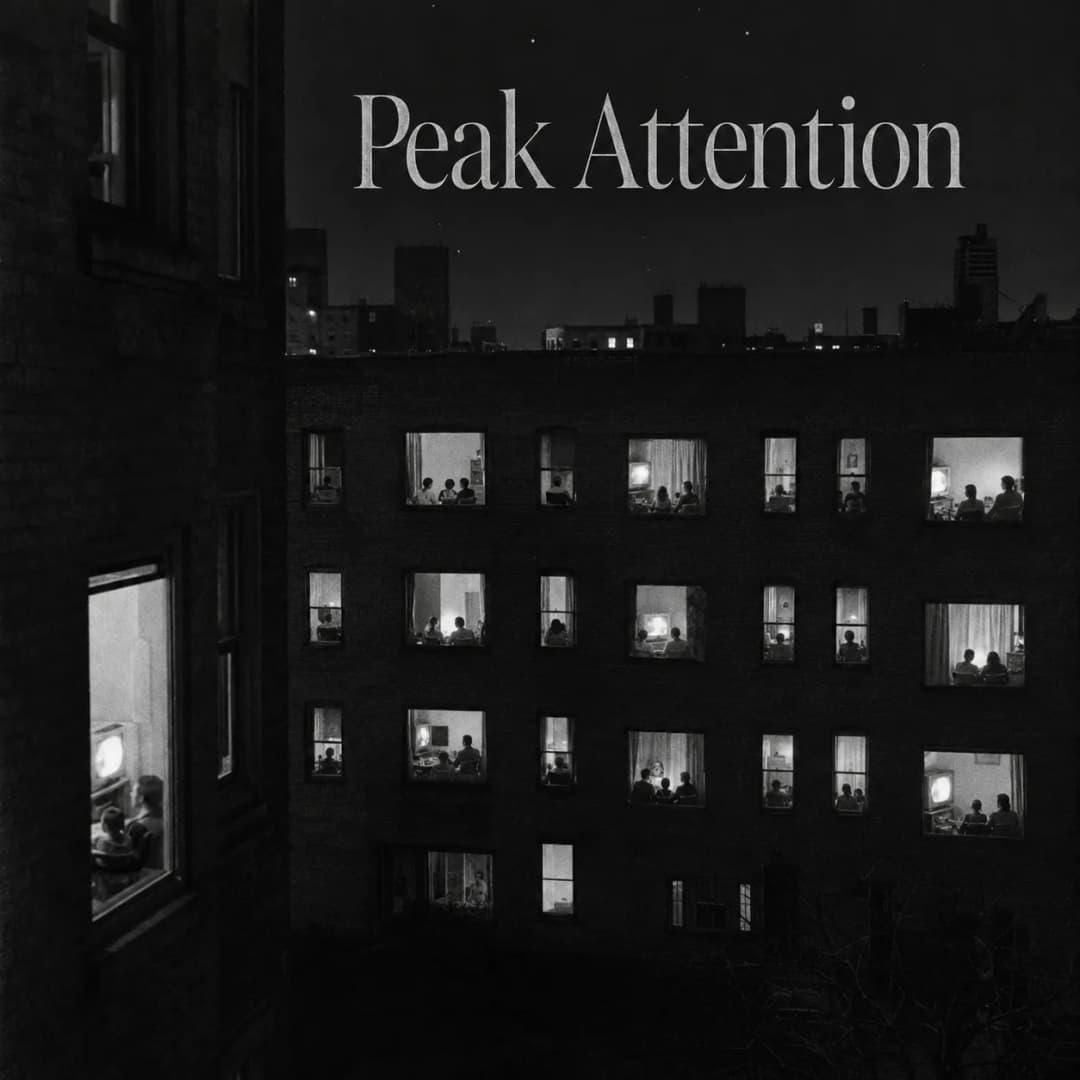
Peak attention is Tim Wu's name for the bounded window in which most of a country watched the same programme, and the same advertisements, at the same moment. The point of naming it a peak is that it was not the natural state of mass media but a specific arrangement with a beginning and an end. Once it has a name, two questions become available: who benefited from it, and what was given up to sustain it.
What it is
For roughly two decades, American television concentrated an entire national audience into a handful of hours. CBS held ratings dominance from 1955 to 1976 under William Paley, and the numbers from that era are not comparable to anything a single programme reaches now. The I Love Lucy episode in which Lucy has her baby drew 71.7 per cent of American television households on 19 January 1953. Elvis Presley's first appearance on The Ed Sullivan Show, on 9 September 1956, drew 82.6. Eisenhower's inauguration, the morning after the Lucy episode, drew 67.7 and was beaten by the sitcom.
The concentration was possible because attention had first been made countable. Robert Elder's Audimeter, built in 1936 and turned into an empire by Arthur Nielsen, is where measurement starts, and measurement is what turned an audience into inventory. Once counted, attention could be priced, and the unit was the Gross Rating Point. From there the programming logic follows without anyone having to intend it: what survives is whatever holds the broadest audience, and what does not survive is everything else. Edward R. Murrow's See It Now, the programme that had helped expose Joseph McCarthy, was cancelled because journalistic quality could not win a ratings war. Wu's verdict on Paley is that he built the system and the system ended up swallowing him.
The reason the concept is still worth having in 2026 is that the obvious modern comparison breaks it in an interesting way. Super Bowl LX, on 8 February 2026, peaked at 137.8 million simultaneous viewers late in the second quarter, reported as the highest peak audience in American television history, on a 125.6 million average. That is more people watching one thing at one time than at any point in the era this concept describes. The same broadcast drew a 39.7 combined household rating against I Love Lucy's 71.7.
Both facts are true and they point in opposite directions. Measured in people, the peak is now. Measured in share of the country, the proportion has roughly halved. Which number counts as "peak attention" depends entirely on whether the interesting quantity is the size of the crowd or the fraction of the population inside it, and Wu's concept is built on the second. The gap between the two is the audience that stopped showing up for the free version, and where it went is the subject of priced simultaneity.
There is a second claim folded into the term that should be separated out. Wu treats the peak as unrepeatable, on the grounds that attention is now too fragmented to be reassembled. That is a forecast, not a measurement, and the 2026 figure is at least awkward for it. The honest version is narrower: the free, advertising-funded concentration of a national audience across a whole schedule has not recurred and shows no sign of doing so. A single event reaching a record headcount for four hours is a different thing from a network owning a country's evenings for twenty years.
In effect
Research: the mechanism the concept is usually explained by, and its best test
Peak attention is a historical claim rather than a research finding, but it is routinely explained by one: that simultaneous attention is cognitively different from the same attention distributed across time, so a national audience watching together is not merely a large audience. That mechanism is joint attention, and its best objective test in adults, by Noam Mairon and colleagues in 2020, found no amplifying effect on attention or memory, with Bayes factors between 0.13 and 0.64 supporting the null. What the study did find was that co-presence made people worse at the task, at d = 1.04.
Peak attention as an economic and historical description survives that result intact. Peak attention as an explanation of why the era mattered does not, and pages on this site should not borrow the second while citing the first.
Everyday life: two evenings in January 1953
A sitcom drew 71.7 per cent of American television households on a Monday, and a presidential inauguration drew 67.7 the following morning. Set aside which was the more important event. What the pair records is a country in which almost every household with a set was, on any given evening, tuned to one of a very small number of things.
That is the condition the concept names, and it is the condition nobody under fifty has experienced as ordinary.
Commerce: what a rating bought, and what it cost
Gross Rating Points are the moment attention becomes a priced commodity rather than an outcome. Once an hour has a price per point, programming decisions become inventory decisions, and the effect is visible in the record: See It Now was cancelled not because it failed but because it could not compete for a slot on the only measure the slot was sold on.
This is the mechanism the disenchantment effect eventually acts on from the other side. A format that reliably holds an audience is monetised until it stops reliably holding one, and the industry's response is to look for a new hour, a new room or a new device rather than to change the format. That search is what produced narrowcasting, and narrowcasting is what ended the peak.
What it does not say
Ratings and viewer counts are different units and this page does not treat them as comparable. A 71.7 rating is a percentage of American television households in 1953, when far fewer homes had a set and a household could contain several viewers. 137.8 million is a count of people in 2026. Any sentence that puts them side by side is comparing two measurements of two different things, which is exactly why the comparison is interesting and exactly why it cannot be resolved into a single trend line.
It is an interpretation, not a finding. "Peak attention" is a framing Wu applies to a documented history. The history, the CBS dominance, the Audimeter, the Gross Rating Point, the See It Now cancellation, is sourced. The claim that it constitutes a peak that will not recur is a judgement about the shape of the past and a forecast about the future.
It does not say mass simultaneous attention has ended. The record peak audience in American television history was set in 2026. What declined is the free, advertising-funded version, spread across a whole schedule rather than concentrated into a few annual events.
The vault records this note as unreviewed. Nobody here had assessed the evidence behind it when it was written. It rests on one secondary source, and this vault's own reliability audit of that source advises treating every bare number in it as unchecked until traced to an endnote. The numbers on this page that come from outside Wu, the 1953 and 1956 ratings and the 2026 Super Bowl figures, were verified separately.
It does not establish who is to blame for anything. Wu's verdict on Paley is a verdict, quoted here as his. The page does not have an independent basis for it.
Who developed it
Tim Wu, in The Attention Merchants (2016). This is one of the concepts in this vault that is genuinely his framing rather than a construct he was reporting, which is worth stating explicitly, because on 2 September 2026 this vault found 72 concept notes crediting the author of the book they were extracted from rather than the person who originated the idea. Peak attention survived that sweep. The only correction it needed was the missing year.
Sources
- Wu, T. (2016). The Attention Merchants. Knopf. CBS ratings dominance 1955-1976 and the Paley verdict, pp. 128-141; Robert Elder's 1936 Audimeter and Arthur Nielsen, pp. 104-105; Gross Rating Points as priced attention, p. 140; the cancellation of See It Now, p. 141.
- "Lucy Goes to the Hospital", I Love Lucy, broadcast 19 January 1953: 71.7 rating. Elvis Presley's first appearance on The Ed Sullivan Show, 9 September 1956: 82.6. Eisenhower's inauguration, 20 January 1953: 67.7. Percentages of US television households.
- Nielsen (2026). Super Bowl LX final viewership: 125.6 million average, 39.7 combined household rating, 80 household share. Broadcast 8 February 2026.
- NBC Sports / NFL (2026). Super Bowl LX peak audience of 137.8 million late in the second quarter, reported as the highest peak viewership in US television history. Super Bowl LIX (2025) remains the highest average at 127.7 million.
- Mairon, N., Nahum, M., Stolk, A., Knight, R. T. & Perry, A. (2020). "Behavioral and EEG Measures Show no Amplifying Effects of Shared Attention on Attention or Memory." Scientific Reports, 10, 8458.
- This vault's reliability audit of The Attention Merchants, 2026-09-01, on the distinction between Wu's sourced history and his interpretation, and on treating his bare numbers as unchecked.
- Where this came from
- One book in this library carries this concept. A concept resting on a single popular retelling is roughly twice as likely to be contested, mixed or unverified as one two or more books carry, so treat it as unchecked until it has been taken to a primary source.