People Attract People
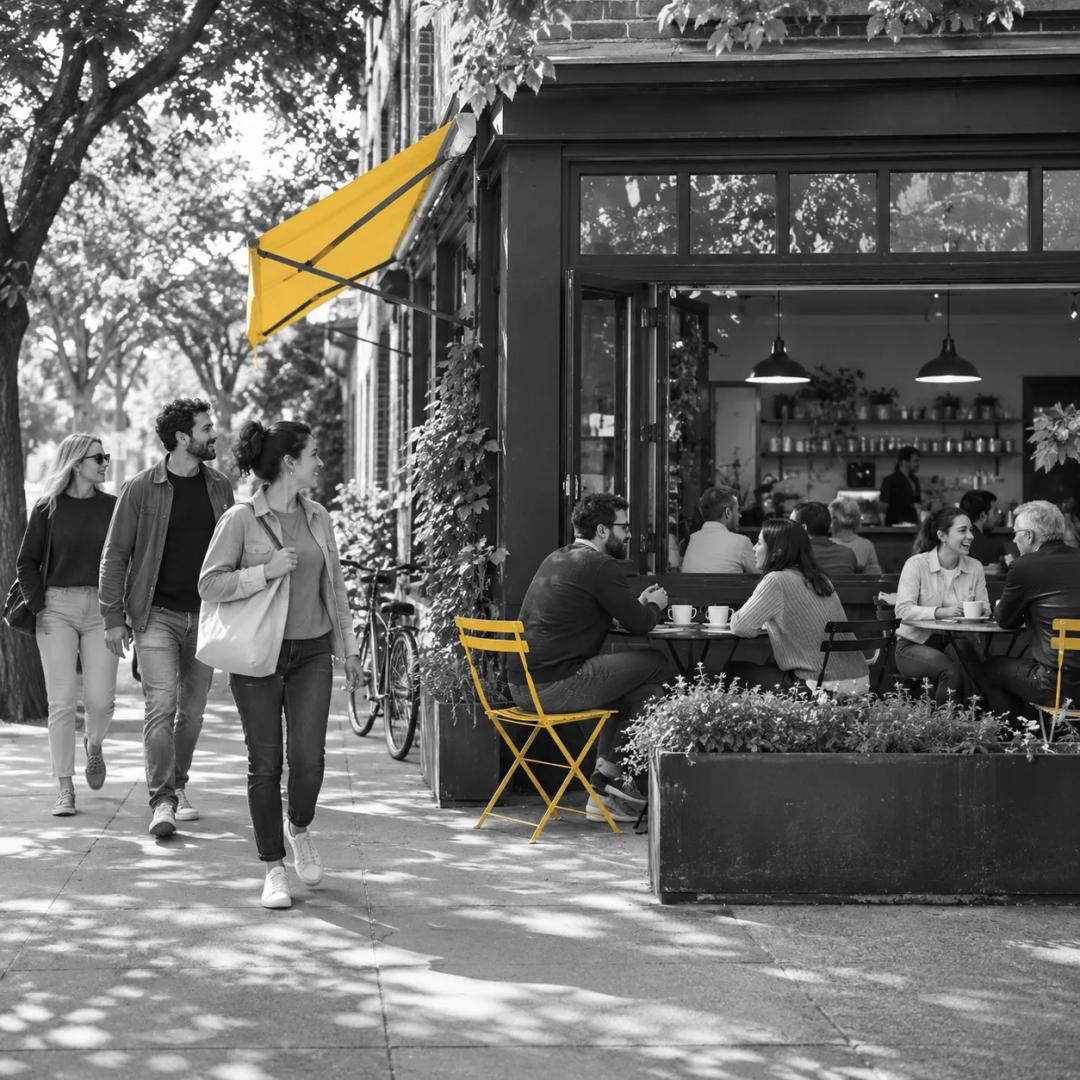
People attract people is the observation that people are drawn by the sight of other people doing things in a public space. A seated, talking group becomes part of what makes a street worth stopping on.
What it is
The idea comes from the public life studies of the Danish architect Jan Gehl, who watched how people use streets and squares. Charles Montgomery repeats the point in Happy City: activity attracts more activity, and places that show human presence hold people longer than places that are empty, however well designed they look.
In effect
On a street, the principle ties lingering to the people who have already stopped. Mehta and Bosson found that businesses used as third places were distinctive, recognisable and open to the street, with seating and shelter the most important design features for sociability. A pavement café is then both an active frontage and a source of visible company, and the sight of people sitting and talking tells passers-by that the place is worth a pause.
What it does not say
The principle is stated in the sources as an observation of public life, and the street studies cited here did not isolate it as a separate cause. It does not say that crowding is always attractive: Fránek found that walkers moved faster where there were more people and less open space. It also does not say how many people are enough to draw others in.
Sources
- Montgomery, C. Happy City: Transforming Our Lives Through Urban Design. Penguin, 2013.
- Gehl, J., Kaefer, L. J., & Reigstad, S. (2006). Close encounters with buildings. Urban Design International, 11(1), 29-47. https://doi.org/10.1057/palgrave.udi.9000162
- Mehta, V., & Bosson, J. K. (2010). Third places and the social life of streets. Environment and Behavior, 42(6), 779-805. https://doi.org/10.1177/0013916509344677
- Fránek, M. (2013). Environmental factors influencing pedestrian walking speed. Perceptual and Motor Skills, 116(3), 992-1019. https://doi.org/10.2466/06.50.PMS.116.3.992-1019