Perceived Volume
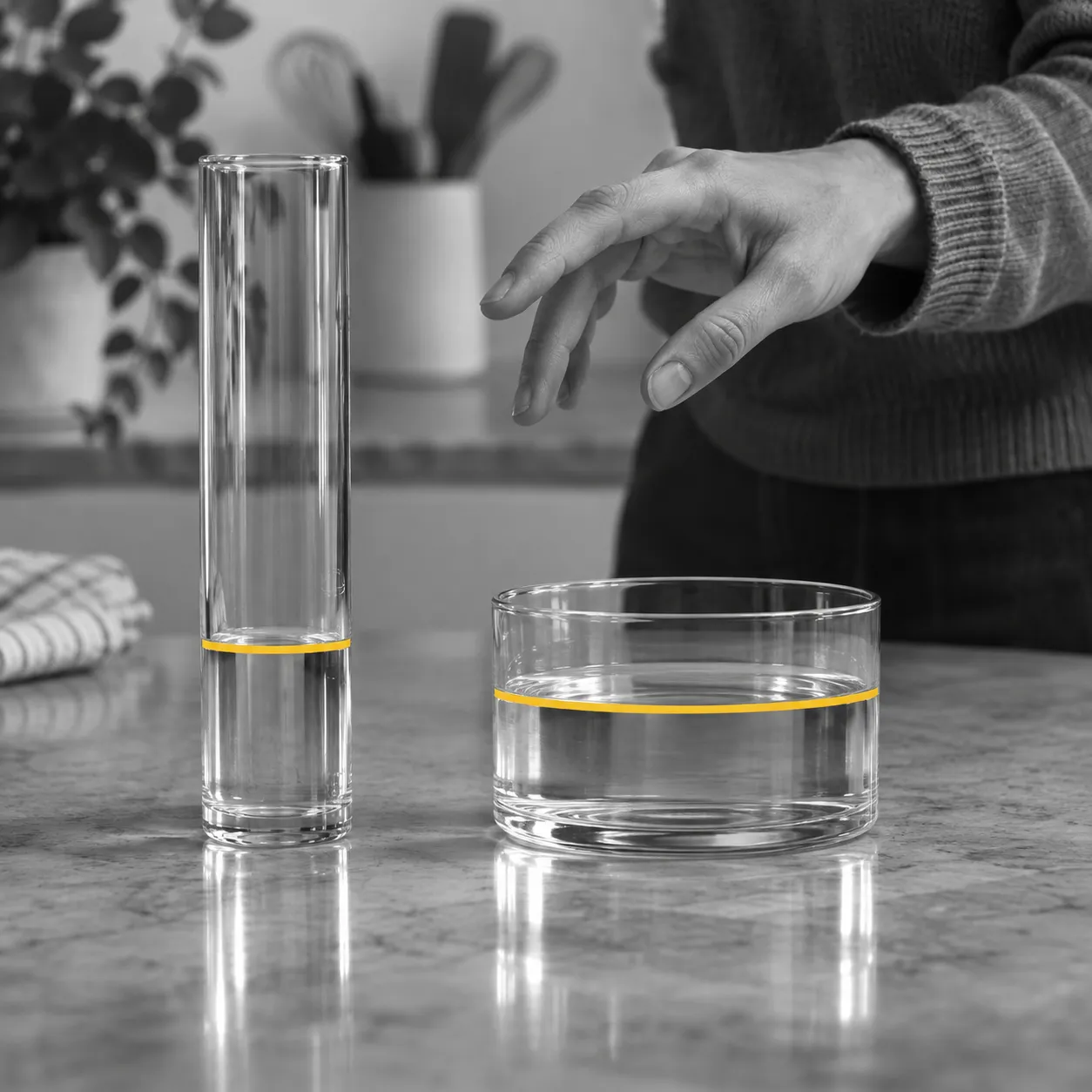
Perceived volume is the impression of how much a container holds. In a set of seven experiments published in 1999, container height emerged as a main cue people use as a shortcut when judging volume.
What it is
A shopper looking at a bottle, tub or carton usually has no way to measure what is inside it. The judgement of how much it holds is made by eye, from the shape of the container. Priya Raghubir and Aradhna Krishna took that judgement as the subject of a 1999 paper in the Journal of Marketing Research.
Their starting point was the way expectations formed from visual cues interact with sensory experience. They chose container shape as the cue to study, and the paper asks in its title whether the eye can fool the stomach.
The term perceived volume is used on this site for the impression that results. It is the experience of the shopper, which can be measured in an experiment, and it is separate from the actual volume of the container.
In effect
The paper reports seven laboratory experiments. Across them, container height emerged as a main cue that people use as a shortcut when judging volume.
Shape also affected preference, choice and satisfaction after consumption. The authors discuss what follows for contrast effects when expectations are disconfirmed, and for package design, communication and pricing.
For a brand, the practical reading is that a decision about the proportions of a container is also a decision about the impression of quantity it gives before any label is read. That reading is an interpretation of the experiments by this site, not a rule stated in the paper. The article on packaging psychology uses it as the first of four pack cues.
What it does not say
This page reports the account given in the paper's abstract and does not give the size of any effect, so it makes no claim about how large the shift in judgement is.
The experiments were laboratory studies of container shape. They do not show how a change of proportions would change sales of a particular product, and they say nothing about cues other than shape.
Sources
- Raghubir, P., & Krishna, A. (1999). Vital dimensions in volume perception: Can the eye fool the stomach? Journal of Marketing Research, 36(3). https://doi.org/10.1177/002224379903600302