Personality Prediction
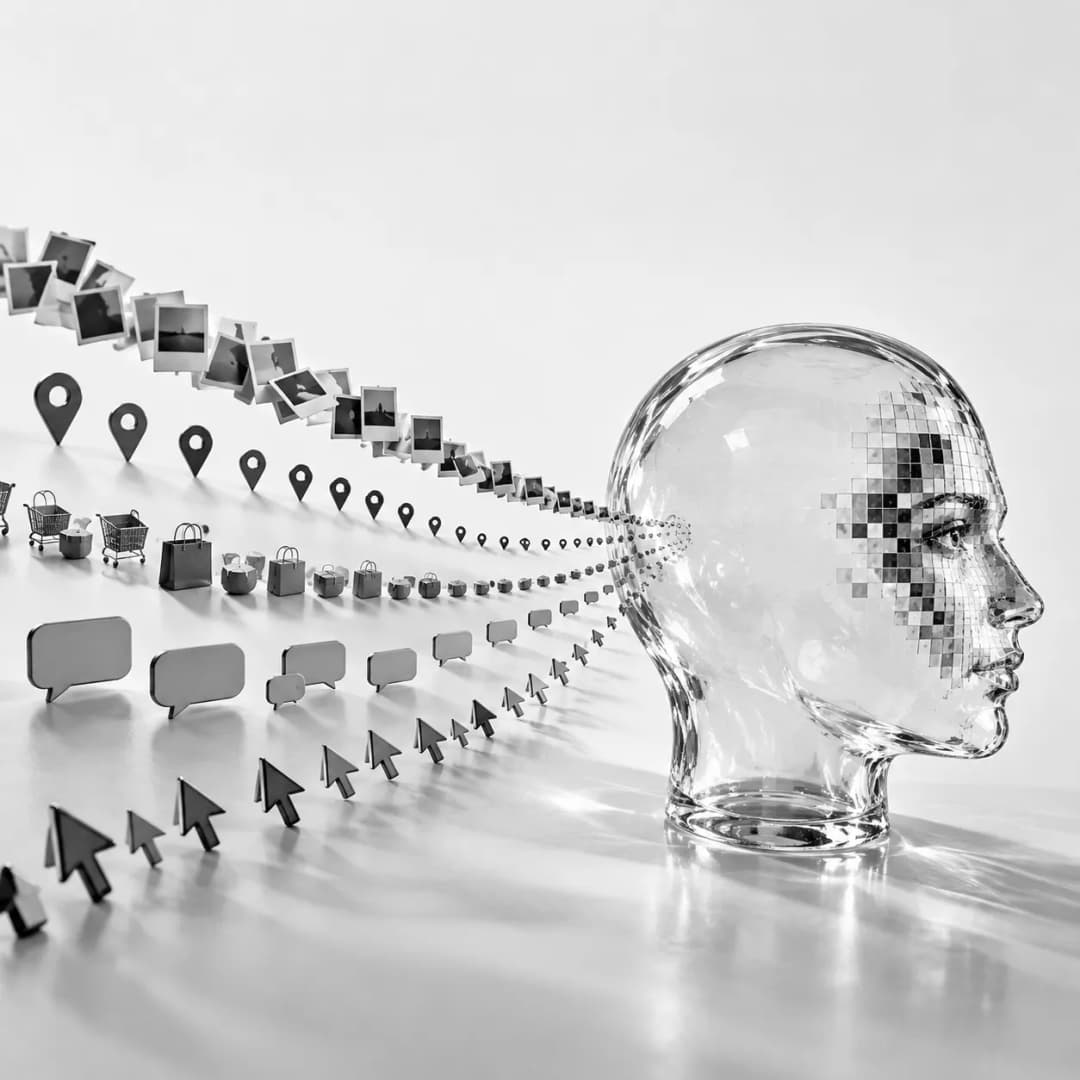
Personality prediction is inferring somebody's position on a personality trait from behavioural traces rather than from a questionnaire. A model is trained on people who supplied both their traces and their test scores, then applied to people who supplied only traces, and the traces can be Facebook Likes, written language, photographs, card transactions or location histories. The vault's per-trait figures come from single very large studies. The field's leakage-controlled out-of-sample average is a correlation of about 0.23, which leaves about ninety-five per cent of the variance in personality unexplained.
What it is
The founding study is Michal Kosinski, David Stillwell and Thore Graepel's work on 58,000 volunteers who supplied Likes, demographic profiles and psychometric test results. Correlations between predicted and actual scores run at about 0.43 for openness and about 0.40 for extraversion, with the remaining traits between about 0.17 and 0.30, and the paper's own benchmark, routinely dropped when the result travels, is that only openness approaches the test-retest reliability of the questionnaire while the rest correspond to roughly half of it. Age and network density were predicted far better than any trait. Wu Youyou and colleagues later reported computer predictions from Likes outperforming judgements by the participants' own Facebook friends.
In effect
Raphael Perla and colleagues' meta-analysis is the correction, and it is the first synthesis this question has had. Searching four databases, they found that only forty per cent of studies could be positively identified as free from data leakage while forty-two and a half per cent were confirmed to suffer from it, and that leakage nearly doubles the reported result. Pooling the leakage-vetted studies gives about 0.23 against about 0.35 for all eligible studies. Their mechanical explanation is that the median study had only six observations per feature and that almost sixty per cent failed to meet even minimal data requirements for linear regression, which makes rigour rather than model class the main determinant of reported accuracy.
What it does not say
It does not say a model can tell you who somebody is. The criterion in every study is a questionnaire score, so the reliability of the self-report instrument is the ceiling on the whole literature, and all three founding papers say so. It does not say the five traits are predicted comparably, since only two of them are predicted reasonably well and those are the two the targeting experiments chose, for exactly that reason. And the headline numbers that circulate are not comparable with each other, because classification accuracies for categorical attributes and correlations for continuous traits are different quantities, and reporting an eighty-eight per cent and a 0.43 in the same breath is the move that makes this field sound stronger than it is.
Sources
- Kosinski, M., Stillwell, D. J., & Graepel, T. (2013). "Private traits and attributes are predictable from digital records of human behavior." PNAS, 110(15), 5802-5805. doi:10.1073/pnas.1218772110. Full text read in the vault's pass of 5 October 2026; the per-trait correlations are from that read and not from the abstract. Declared interests: Stillwell received revenue as owner of the myPersonality application, and Graepel was at Microsoft Research.
- Youyou, W., Kosinski, M., & Stillwell, D. (2015). "Computer-based personality judgments are more accurate than those made by humans." PNAS, 112(4), 1036-1040. doi:10.1073/pnas.1418680112. 86,220 volunteers. Credit Youyou.
- Perla, R., Maran, T., Bagci, B., Kraus, S., Kanbach, D. K., & Bouncken, R. B. (2026). "The (In)Effectiveness of Psychological Targeting: A Meta-Analytic Review." Psychology & Marketing, 43(3), 575-590. doi:10.1002/mar.70073. Full text read, open access. Online 28 October 2025, print issue March 2026.