Power of Context
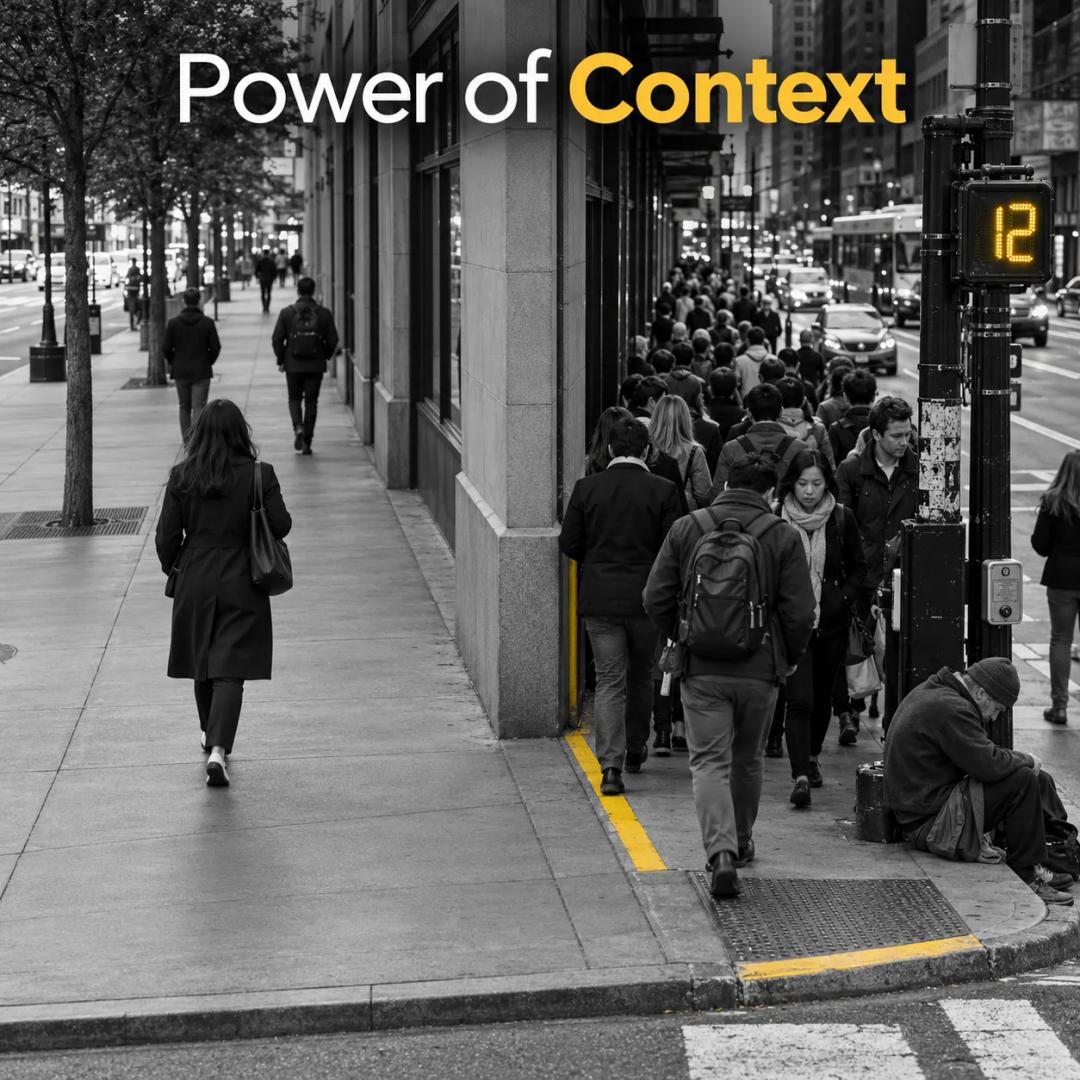
Power of Context is Malcolm Gladwell's name, in The Tipping Point (2000), for the claim that people are far more sensitive to their immediate surroundings than they believe, so that small details of a situation can change what they do. In his account it is the third lever that can tip an epidemic of behaviour. It is a framing of findings from several studies, not a single experiment with a single result.
What it is
The idea is a claim about where behaviour comes from. When we explain what someone did, we reach for their character. Gladwell argues that we should look first at the setting: who else is present, what the place looks like, how much time the person has. His book gathers studies that he reads this way, among them the bystander experiments and the Stanford Prison Experiment.
The name is his, and the vault records it as a label for an argument rather than as a tested finding. Whether any one of the studies supports the strong form of the claim is a separate question, taken up on the pages for each study.
In effect
In research
The 1973 Good Samaritan experiment found, according to its abstract, that people in a hurry were more likely to pass a person slumped by the road, while the topic of the talk they were about to give made no significant difference. Gladwell tells it as a case of context outweighing character.
In everyday life
Gladwell's own example is Baltimore, where, in his account, syphilis cases fell back in winter when people stayed home. A change in the setting changed the pattern of behaviour without any change in the people.
In group settings
The bystander studies show that group size alone can change whether people help. They are laboratory results, and the page on The Bystander Effect records that the evidence is mixed.
What it does not say
It does not say character is irrelevant. The Good Samaritan page notes that a single study cannot measure how far character matters, and that the book uses the study as proof of more than it shows. The claim also gets its force from studies whose own standing varies: the Stanford prison study is contested, and the bystander findings are mixed. Treat Power of Context as an argument worth testing, not a settled result.
Who developed it
Malcolm Gladwell named it in The Tipping Point. The underlying observation that situations shape behaviour is older and belongs to the studies he draws on.
Sources
- Gladwell, M. (2000). The Tipping Point. Little, Brown (pp. 29, 139-140, 259 in the vault's notes).
- Darley, J. M., & Batson, C. D. (1973). "From Jerusalem to Jericho": A study of situational and dispositional variables in helping behavior. Journal of Personality and Social Psychology, 27(1), 100-108. doi:10.1037/h0034449 (abstract read)