Praise
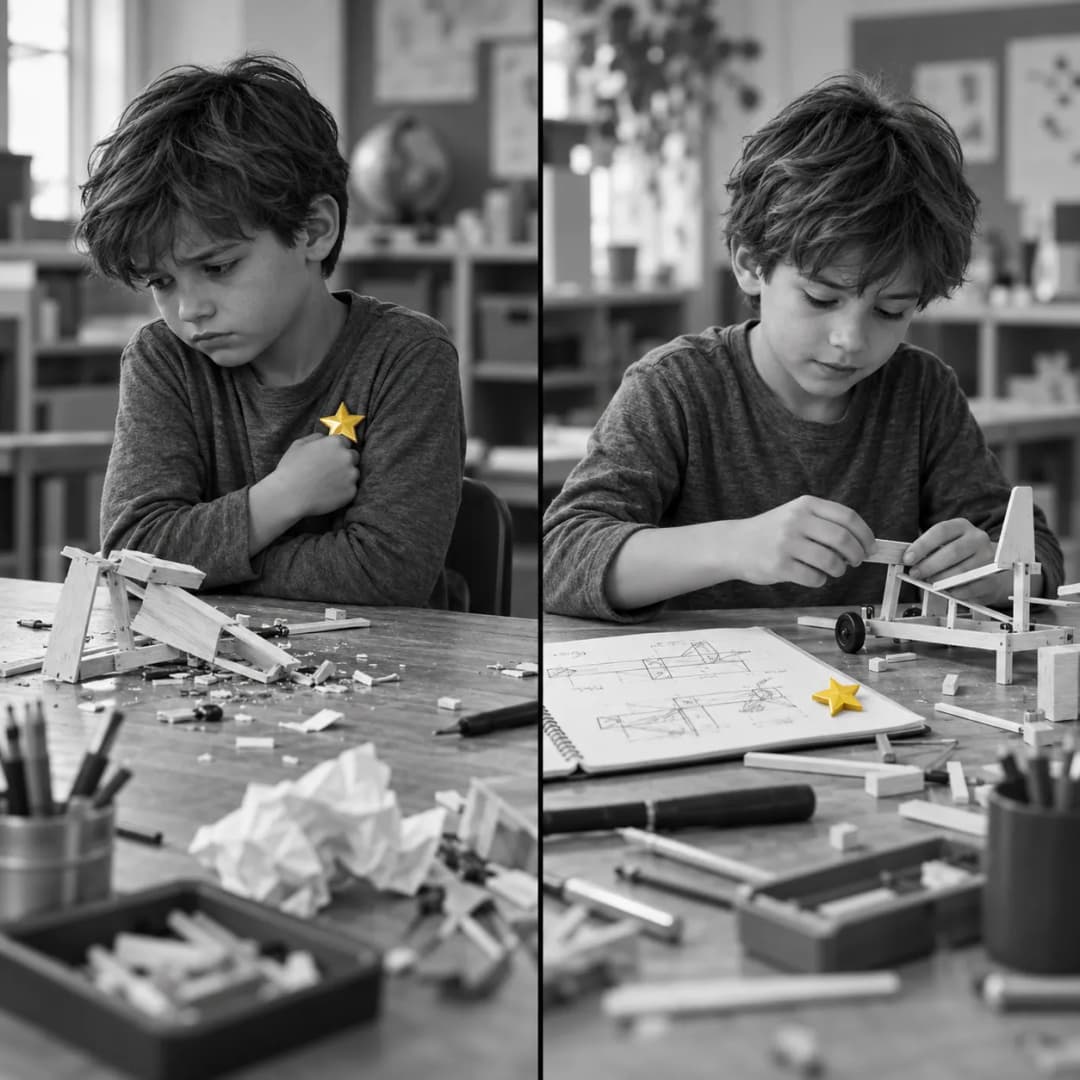
The founding claim is that praising a child for being clever and praising them for working hard have different consequences, and that the difference shows up after failure rather than after success. It comes from Claudia Mueller, then in the Department of Psychology at Columbia University, with Carol Dweck second: six studies on 412 fifth graders, the largest sample 128. The paper contains every quantity the popular retelling leaves out, and the gap between the two documents is the most instructive thing about it.
What it is
The design is the same across the six studies with variations. Children work on a task, receive praise framed either around ability or around effort, then encounter failure, and their persistence, enjoyment, attributions and subsequent performance are measured. The abstract's summary is that fifth graders praised for intelligence cared more about performance goals relative to learning goals and, after failure, displayed less task persistence, less task enjoyment, more low-ability attributions and worse task performance than children praised for effort, and described intelligence as a fixed trait where children praised for hard work believed it subject to improvement.
The samples, read off the Participants paragraphs, are 128, 51, 88, 51, 46 and 48. Study 1 drew forty-nine per cent of its children from one public elementary school in a small midwestern town and fifty-one per cent from two public elementary schools in a large northeastern city, with a mean age of 10.7. Study 2 had seventeen children per praise group. Study 4 had seventeen per feedback group.
The result that circulates as "almost forty per cent of children lied about their scores" is Study 3, and it is worth stating precisely: thirty-eight per cent of ability-praised children misrepresented their scores to unfamiliar children against thirteen per cent of the comparison group, with a chi-square of 6.61 on a sample of 88. The finding is real, the direction is clear, and the base is eighty-eight ten-year-olds.
Study 1 also reports two-way analyses of variance showing no significant interaction between praise condition and initial task ability on any dependent measure, which is the basis of the later claim that the effect held at all ability levels. That is a null used as support, which is legitimate in a sample of 128 and would be stronger in a larger one.
One independent direct replication has been located, and its results are mixed in a specific way. Yue Li and Timothy Bates of the University of Edinburgh ran three studies on 624 children aged ten to twelve in Harbin, each powered at about eighty-five per cent to detect a medium effect. Their close replication of Study 1, on 190 children, did not reach conventional significance, with beta = -0.24, an interval of -0.48 to 0.02 and p = 0.064, though the direction matched the prediction, while initial reasoning score strongly predicted the outcome at beta = 0.48. There was no effect on learning goals, enjoyment or perceived performance, and no interaction with initial ability. They also report that Mueller and Dweck's Study 1 separated its conditions by about 1.3 standard deviations, and that nothing in the subsequent literature is remotely that size.
The proponents' counter-argument is specific and checkable, which is why it belongs here rather than in a footnote. Yeager and Dweck argue that three individually underpowered replications should be aggregated, and that doing so across the three studies replicates Mueller and Dweck at p < .05. They also argue from PISA 2018 across 74 nations that mainland China showed a significant negative mindset-achievement association, placing the Harbin samples in a context with among the weakest such links measured. Both arguments are about design and data.
In effect
Thirty-eight against thirteen, in a study of eighty-eight
The research case worth holding is Study 3, because it is the result most often repeated and the one whose base is least often given. Children praised for being clever were nearly three times as likely to misrepresent their scores to strangers as children in the comparison group. That is a striking finding about what ability praise does to a ten-year-old's relationship with a bad result. It is also one study, in one pair of regions, on eighty-eight children, and anybody citing the percentage owes the reader the denominator.
The sentence a parent actually says
In everyday terms the contrast is between "you are so clever" and "you worked hard at that". The research supports the second over the first specifically in what happens next time something is difficult: the clever child has been given a label that failure threatens, and the hard-working child has been given a process that failure merely interrupts. What the research does not support is the simplified rule the finding became, and the correction is the author's own rather than a critic's. See process praise.
Performance reviews and the same two framings
The managerial version is immediate and almost nobody runs it as an experiment. Telling somebody they are a natural and telling them they prepared well are different attributions of the same outcome, and the research predicts they diverge at the first failure rather than at the moment of praise. The honest limit on borrowing the finding this way is that it was measured on ten-year-olds doing puzzles, with no adult workplace replication located, so the transfer is an argument by analogy and should be labelled as one.
What it does not say
It does not rest on large samples. Six studies, 412 children in total, with the largest at 128.
It does not say praise is harmful. The comparison is between two framings of praise, and effort praise is the arm that did better.
It does not say the effect is settled. The one independent direct replication did not reach conventional significance on its close replication of Study 1, and the proponents' answer is that the replications should be pooled.
It does not license the rule it became. Praising effort and ignoring whether the work succeeded is a misconception the originator names as such in the current edition of her own book.
Who developed it
Claudia Mueller is first author of the 1998 paper, then at Columbia University, with Carol Dweck, Lewis and Virginia Eaton Professor of Psychology at Stanford, second. Author order is verified at OpenAlex. The study everyone calls Dweck's is Mueller's first-authored paper, and this site credits her. The independent replication is Yue Li's with Timothy Bates at Edinburgh.
Sources
- Mueller, C. M., & Dweck, C. S. (1998). "Praise for intelligence can undermine children's motivation and performance." Journal of Personality and Social Psychology, 75(1), 33-52. doi:10.1037/0022-3514.75.1.33. Full text read at source, including all six Method sections.
- Li, Y., & Bates, T. C. "Does mindset affect children's ability, school achievement, or response to challenge? Three failures to replicate." Manuscript read in full at source; the 2019 published version was not read.
- Yeager, D. S., & Dweck, C. S. (2020). "What can be learned from growth mindset controversies?" American Psychologist. Full accepted manuscript read at source. Source of the aggregation argument and the PISA tabulation, neither of which was independently verified.
- Dweck, C. S. (2017). Mindset, revised edition, Robinson. The trade account of the praise studies is at pp. 71 to 73 and 178. Read in full by the vault.