Pre-Sleep Cognitive Arousal
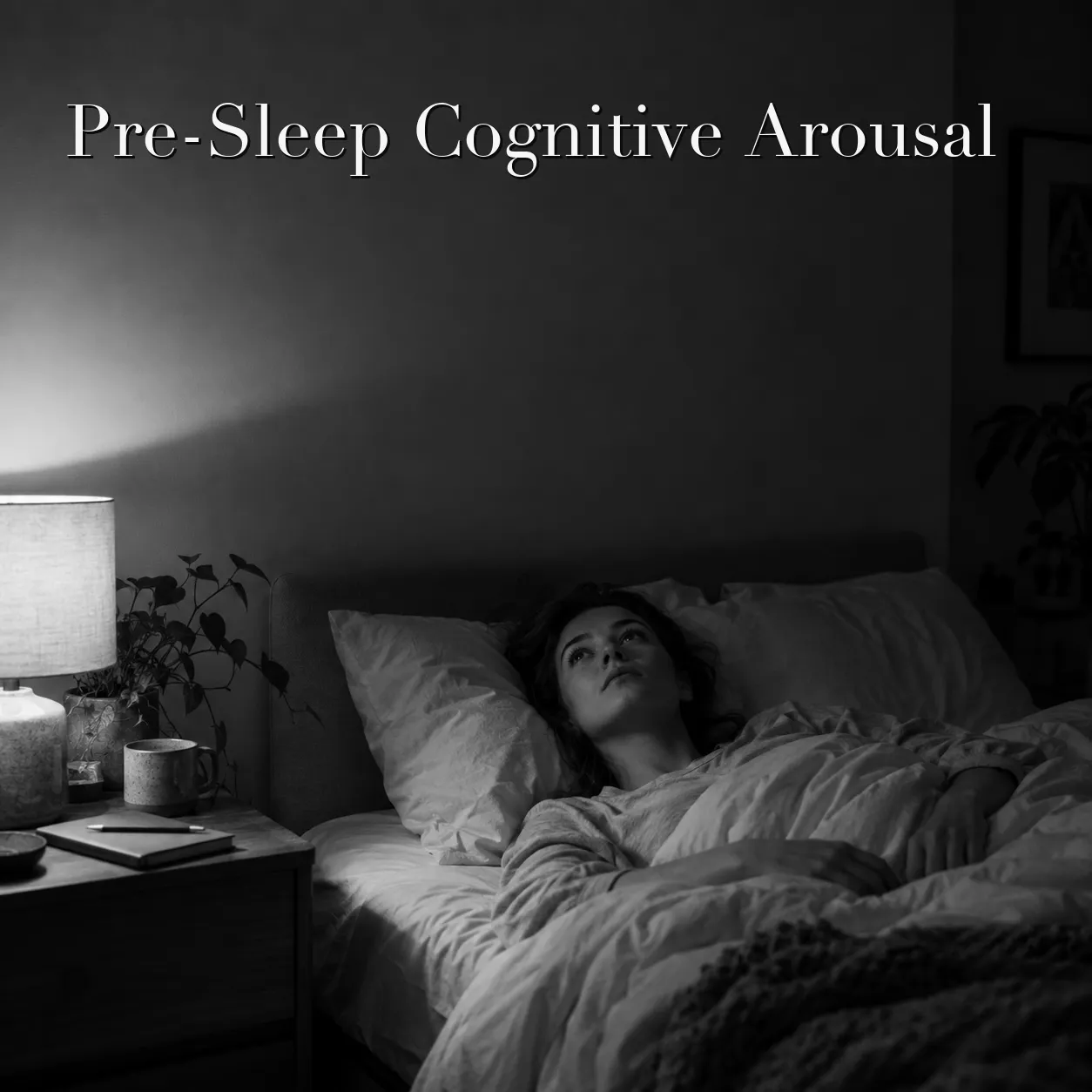
Pre-sleep cognitive arousal is a busy, unsettled mind at lights out. Not a racing heart and not caffeine, but thoughts that keep arriving after you have stopped doing anything. It is the best-measured link between how somebody was thinking during the day and how the night goes, and it is what most of the sleep-and-worry research is actually measuring. Give good sleepers something to chew on before bed and they take longer to fall asleep.
What it is
Researchers separate two kinds of arousal at bedtime. Somatic arousal is the body version: a fast pulse, tense muscles, the feeling of being physically wound up. Cognitive arousal is the mental version: replaying a conversation, rehearsing tomorrow, noticing that you are still awake and starting a second commentary about that. The cognitive kind is the one that predicts a slow night most reliably, and it is the kind that survives doing everything the sleep advice told you to do.
The distinction matters because it changes what a bad night is evidence of. A person who has darkened the room, put the phone away and still cannot sleep has not failed at anything. They have a mind that is still running, and the room was never the variable.
No single originator is recorded. The construct grew out of the insomnia literature and the worry literature at the same time, rather than out of one founding paper, so the field is credited here and no individual is. Thomas Borkovec ran the experimental work that anchors it, and Colleen Carney is central to the later line treating pre-sleep arousal as the step that carries daytime worry through to poor sleep. Neither is credited with the idea itself.
In effect
Research: the experiment that fixes the direction
Gross, R. T., & Borkovec, T. D. (1982) gave good sleepers, people with no sleep complaint at all, something to think about before bed. They took longer to fall asleep than the people who were not given anything, by roughly five to twelve minutes. That is a small gap and a very useful one, because the thinking was assigned rather than observed. Most of what is known about worry and sleep comes from asking people about both at once, which cannot tell you which came first. Here the thinking came first and the slow night followed.
Research: measured rather than reported
Later induction studies have found the same lengthening using sleep laboratory recordings and using movement monitors worn overnight, not only by asking people the next morning. That matters more than it sounds. Self-reported sleep and recorded sleep routinely disagree, and a finding that holds under both is a different class of finding from one that holds under neither. Naturally occurring night-time rumination tracks the same measured outcome, and pre-sleep cognitive intrusions also predict more waking during the night and lower sleep efficiency, meaning less of the time in bed is spent asleep.
Everyday life: the 3am version
The ordinary experience is of lying still, doing nothing, and having the mind carry on regardless. This is the concept that says the experience is the mechanism rather than a side effect of one. It is also the concept that explains why sleep hygiene advice so often lands badly: no item on that list touches the thinking, and the thinking is the part doing the work.
What it does not say
It does not say the thinking is achieving anything. Nothing here establishes that a mind turning something over at midnight is solving it. See rumination for the evidence that this kind of thinking impairs problem solving rather than performing it.
It does not say anything about a particular hour. There is no finding here about 3am specifically. See diurnal variation in rumination.
It does not make a slow night a disorder. Taking longer to drop off after a hard day is ordinary. The clinical line is described at insomnia disorder, and meeting it is a matter for a GP rather than for an article.
It does not come with a fix attached. Constructive worry lowers arousal at bedtime and has not been shown to shorten the time taken to fall asleep, which is exactly the kind of gap this page exists to keep visible.
Sources
- Gross, R. T., & Borkovec, T. D. (1982). A cognitive intrusion given to good sleepers before bed lengthened the time taken to fall asleep by roughly 5 to 12 minutes relative to controls. The experimental anchor for this concept.
- Later induction studies confirming prolonged sleep onset by polysomnography, the full sleep laboratory recording, and by actigraphy, a movement monitor worn on the wrist, rather than by self-report alone. Specific citations not individually established in this pass.
- The line of work from Harvey and from Carney treating pre-sleep arousal as the step between worry and poor sleep. Named for the programme; no single paper verified here.
- Vault verification record, 2026-09-11. Evidence status robust, with the originator field deliberately left empty rather than guessed.
- Where this came from
- No book in this library is the source of this concept. It entered the vault from Why You Lie Awake at 3am, built from primary sources rather than from a book.