Priced Simultaneity
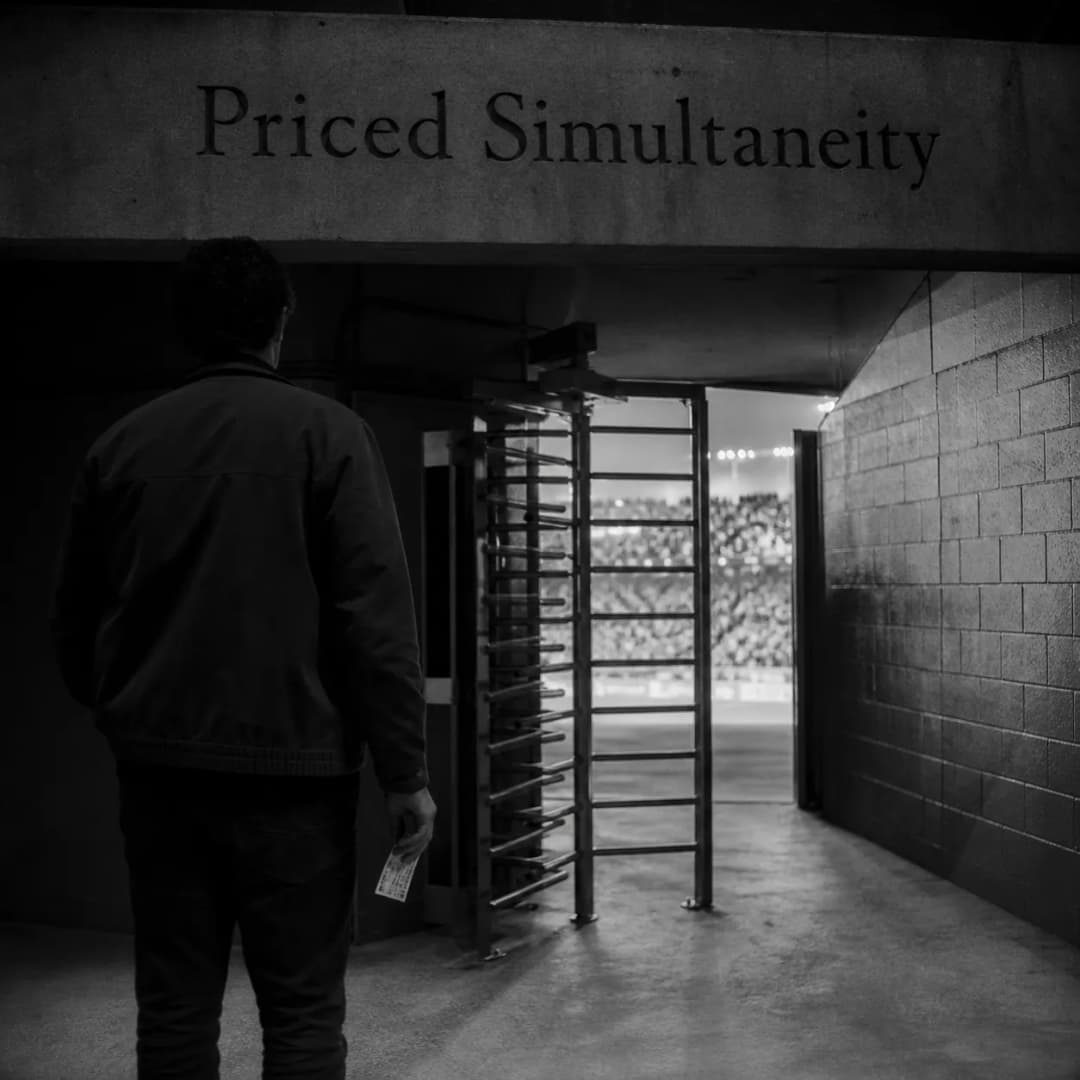
Priced simultaneity is mass simultaneous attention sold directly to the audience rather than given away and monetised on the advertiser side. It is this publication's own construct, not a research finding. The claim is narrow. The free, advertising-funded version of everyone watching at once declined, and the mechanism underneath it was made scarce on purpose and put behind a paywall. The supporting evidence is trade and company reporting, and the felt payoff being sold rests on a mechanism whose best objective test came back null.
What it is
Start with what the term is not doing. It is not a claim that the monoculture has returned, and it is not a psychological finding. It is a way of reading two sets of numbers that are usually read separately.
The first set is broadcast. On 8 February 2026, 137.8 million people in the United States were watching Super Bowl LX at the same moment late in the second quarter, reported as the highest peak audience in American television history. The average was 125.6 million, second only to Super Bowl LIX's 127.7 million the year before. The same broadcast drew a 39.7 combined household rating on an 80 share. On 19 January 1953, the I Love Lucy episode in which Lucy has her baby drew 71.7 per cent of American television households. Elvis Presley's first appearance on The Ed Sullivan Show, on 9 September 1956, drew 82.6. Eisenhower's inauguration, the morning after the Lucy episode, managed 67.7. The absolute audience for the largest event is at a record. The share of the country is roughly half what it was. Both readings are correct, and the gap between them is a large audience that stopped turning up for the free version.
The second set is what people pay to be somewhere at a fixed time. Pollstar's 2025 year-end analysis found grosses and ticket sales falling while averages rose: stadium tickets up 18.3 per cent to an average of $216.13, the average stadium show grossing $7.11 million, 19 per cent more than in 2024, and the top-tour average ticket at $132.62. Live Nation booked record revenue of $25.2 billion for 2025, concerts alone at $20.9 billion, up 10 per cent. Sphere in Las Vegas took $379 million from 1.7 million tickets, reported as the highest-grossing arena in the world, in a building whose entire proposition is that you had to be inside it. All three of those are trade analysis or company reporting about their own business. None of it is research, and the page treats it accordingly.
Set the two together and the shape is fewer people paying more for the events at the largest scale, over the same period in which the free mass audience for the largest scale kept thinning. Priced simultaneity is the name for that arrangement, and for the pricing logic inside it: what commands a premium is specifically the version of an experience that is simultaneous, unrepeatable and visible to other people. Which is why status signaling sits so close to it. A thing you can watch later at your convenience is a different product from the same thing watched at the only moment it exists.
There is a counterweight worth keeping in view, and it comes from the seller. Live Nation reports that get-in prices held flat against 2024, tracked below inflation, and that 75 per cent of its US tickets sold for under $100. A company describing its own pricing is not a disinterested source. The claim is also checkable and not trivial, and if it holds, the floor did not move and the ceiling did. That is the narrower and more interesting version of the argument: the premium attached to the visible, unrepeatable version, not to live events in general.
The last thing to say about the construct is where it is weakest. Everything above is economics. The explanation offered for why anyone pays the premium, that attending with other people at the same time produces something attending alone does not, is joint attention at broadcast scale, and the best objective test of that claim found nothing. If the mechanism fails, priced simultaneity survives as a description of a market and loses its account of why the market behaves that way.
In effect
Research: the mechanism, tested, and it did not appear
Noam Mairon, Mor Nahum, Arjen Stolk, Robert T. Knight and Anat Perry sat 42 University of California, Berkeley undergraduates down in pairs, at opposite sides of a table, each about 90 centimetres from a shared screen, silently counting images of flowers for around ten minutes a run. They measured attention and memory behaviourally and with EEG. They found no amplifying effect of shared attention on either, with Bayes factors between 0.13 and 0.64, which is positive evidence for the null rather than a failure to find anything.
The one solid social effect ran the other way. Accuracy was 94.35 per cent alone against 86.25 per cent shared, t(39) = 5.62, d = 1.04. A second person at the table made people worse, which is social facilitation and distraction, a different and much older effect. The authors mark their own limits: they never asked participants how anything felt, and the amplification findings they were testing against concern self-reported emotion under mediated co-presence. The door is open on feeling and closed on performance.
Everyday life: the thing you cannot watch later
The behaviour this concept describes is one most people already perform without a theory for it. A match watched live and a match watched on a delay are, on the picture, identical. On everything else they are not, which is why people go to some trouble to avoid knowing the result, and why a group will coordinate diaries around an hour that a recording would make unnecessary. The scarce good is not the footage. It is being inside the same moment as everybody else, and that is exactly the part a recording cannot deliver at any price.
Commerce: platinum, and what a label sells
When Oasis tickets went on sale in August 2024, the story that hardened was that Ticketmaster had used dynamic pricing to raise prices mid-sale. The Competition and Markets Authority investigated and found no evidence that dynamic pricing was used in that on-sale. What it found was a labelling problem: certain seated tickets were sold as "platinum" at nearly 2.5 times the price of equivalent standard tickets, without adequately explaining that platinum carried no additional benefit. Ticketmaster gave undertakings voluntarily and with no admission of liability, including 24 hours' notice when tiered pricing is in use and two years of reporting to the regulator.
The correction is worth more than the anecdote. The popular version blames an algorithm reacting to live demand. What the regulator described was an ordinary seat, a word attached to it, and a price supported by a buyer's belief that the moment was scarce and that a better version of it existed. No algorithm is required to sell that. A label will do, which is the clearest available demonstration that what is being priced is the perceived quality of the simultaneity rather than the seat.
What it does not say
It is not a research claim and does not become one by being applied carefully. The vault records it as not-a-research-claim, and the numbers underneath it are trade analysis (Pollstar) and company reporting on the company's own business (Live Nation, Sphere). Nobody has run a controlled test of anything on this page.
It does not establish that the decline of free mass attention caused the rise in live pricing. Two things moved over the same period. That is a correlation observed across trade figures, not an identified effect, and there are ordinary alternatives, including touring economics, supply constraints on large venues and general inflation in premium services, that this page has not ruled out.
It does not claim the premium applies broadly. Live Nation's own figures, if taken at face value, say the opposite: entry prices flat, 75 per cent of US tickets under $100. The claim is about the top of the market, and it should not be stretched into a claim that live experience in general has been priced out of reach.
It does not claim Ticketmaster used dynamic pricing. The regulator found no evidence of it, and repeating the popular version would be repeating something a regulator specifically declined to find.
It does not have a working psychological mechanism. The felt payoff it names is collective effervescence, a sociological thesis from 1912 that has never been tested at this scale, resting on joint attention, whose best objective test in adults returned a null. Two strangers at a table for ten minutes is the evidence. A stadium is the extrapolation.
Where we land, September 2026. Narrowcasting is the strongest case against this concept, and it is a good one: the audience genuinely fragmented, on purpose, and the documentary record for that is far better than anything assembled here. Our position is that the fragmentation account explains what happened to the version of mass attention that was given away, and does not explain what happened to the demand for it. That is a judgement about which of two true stories is doing more work, not a finding, and it should be revisited when someone produces a figure that separates them.
Who developed it
The term is this publication's, coined in Prime Time Never Died, It Started Charging Admission in September 2026. Nothing about it is borrowed from a source, which is precisely why it carries less authority than the material it assembles. The parts it is built from belong to other people: Emile Durkheim for collective effervescence in 1912, Michael Scaife and Jerome Bruner for joint attention in 1975, and Tim Wu for the history of prime time and its fragmentation in The Attention Merchants.
Sources
- Nielsen (2026). Super Bowl LX final viewership, Big Data + Panel measurement: 125.6 million average, 39.7 combined household rating, 80 household share. Broadcast 8 February 2026.
- NBC Sports / NFL (2026). Super Bowl LX peak audience of 137.8 million late in the second quarter, reported as the highest peak viewership in US television history. Super Bowl LIX (2025) remains the highest average at 127.7 million.
- "Lucy Goes to the Hospital", I Love Lucy, broadcast 19 January 1953: 71.7 rating. Elvis Presley's first appearance on The Ed Sullivan Show, 9 September 1956: 82.6. Eisenhower's inauguration, 20 January 1953: 67.7. Ratings are percentages of US television households and are not directly comparable to modern viewer counts.
- Pollstar (2025). Year-end business analysis: grosses and ticket sales fell while averages rose; stadium tickets up 18.3 per cent to an average of $216.13; average stadium gross $7.11 million a show, up 19 per cent on 2024; top-tour average ticket $132.62. Trade analysis, not research.
- Live Nation Entertainment (2026). Full-year 2025 results: record revenue of $25.2 billion, concerts $20.9 billion, up 10 per cent. Statements on get-in prices holding flat against 2024 and 75 per cent of US tickets under $100 are company claims about the company's own pricing.
- Sphere Entertainment Co. (2026). Full-year 2025 results: $379 million from 1.7 million tickets at Sphere Las Vegas, reported as the highest-grossing arena in the world. Company reporting.
- Competition and Markets Authority (2025). Ticketmaster undertakings following the Oasis on-sale investigation. No evidence that dynamic pricing was used; concerns about seats labelled "platinum" sold at nearly 2.5 times the price of equivalent standard tickets without adequate explanation that they carried no additional benefit. Undertakings are voluntary, include 24 hours' notice of tiered pricing and two years of reporting, and carry no admission of liability.
- Mairon, N., Nahum, M., Stolk, A., Knight, R. T. & Perry, A. (2020). "Behavioral and EEG Measures Show no Amplifying Effects of Shared Attention on Attention or Memory." Scientific Reports, 10, 8458.
- Wu, T. (2016). The Attention Merchants. Knopf. Prime time and serialisation, pp. 85-94; joint attention, p. 115; narrowcasting, pp. 170-180.
- Durkheim, E. (1912). The Elementary Forms of Religious Life.
- Where this came from
- No book in this library is the source of this concept. It entered the vault from Prime Time Never Died, It Started Charging Admission, built from primary sources rather than from a book.