Prime Time
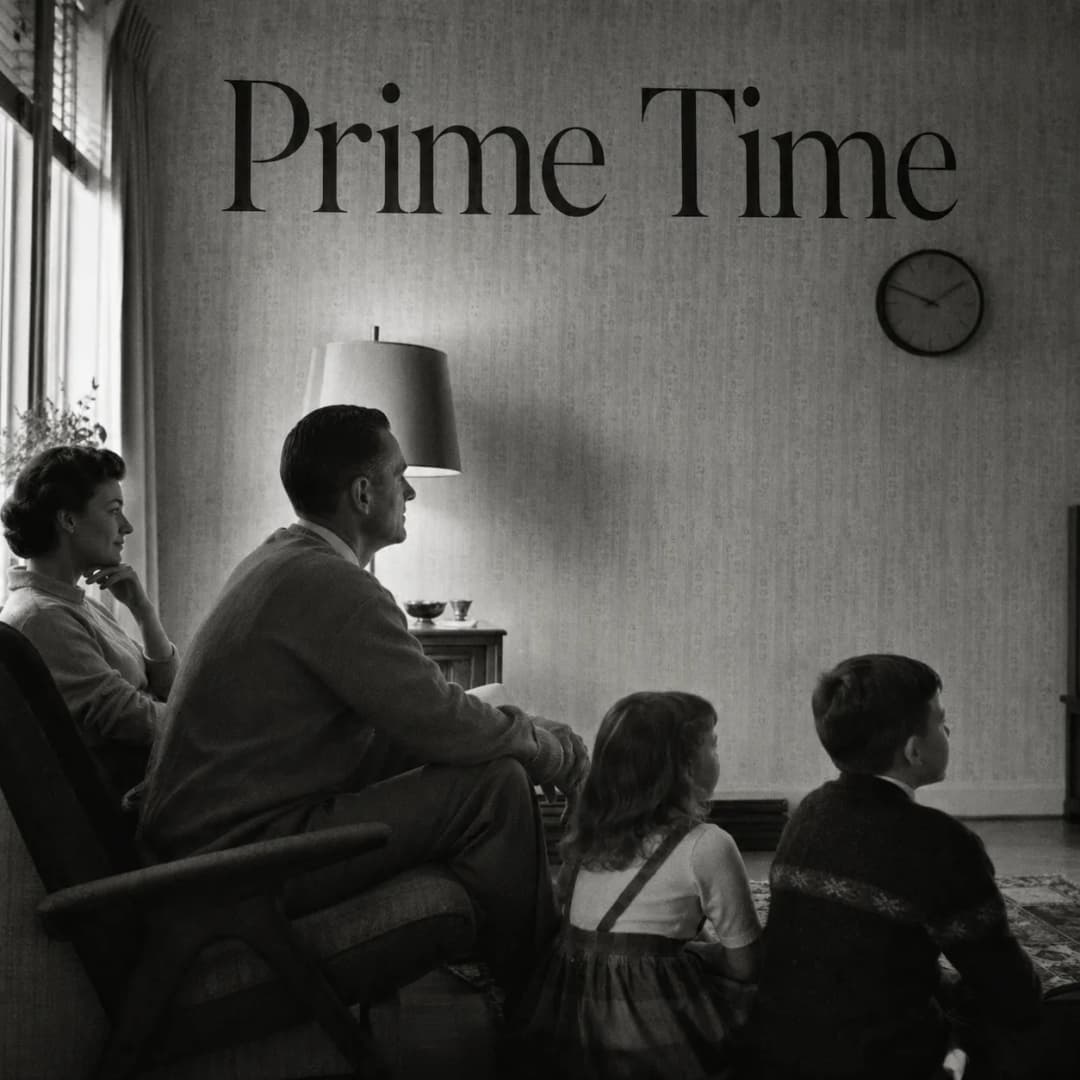
Prime time is ownership of a slice of the clock: the same hour, every night, claimed by one network until the audience arrives out of habit rather than decision. Tim Wu dates its invention to Amos 'n' Andy, national on NBC from 1929, and argues that the real innovation was not the comedy but serialisation, a story engineered to return the same people to the same hour tomorrow. Nobody coined the term. It is industry practice, not a person's construct.
What it is
Broadcasting began with a taboo. Entertainment and commerce were not supposed to mix, and the people setting the rules, Herbert Hoover at the American end and John Reith at the BBC, treated the airwaves as too public a thing to be turned into a sales pitch. That position did not survive contact with a hit. Amos 'n' Andy went national on NBC in 1929 after a local run in Chicago from the year before, and it broke the taboo by demonstrating what a nightly audience was worth.
The part worth attention is what the show actually invented, because it was not the comedy. It was serialisation: cliffhangers and continuing plotlines built so that the ending of tonight's episode is the reason to be in the same chair tomorrow. A hit show is a one-off. A serial is a repeatable capture mechanism, and that difference is what turned one evening slot into the most valuable real estate in the industry. The relationship to the habit loop is direct enough to be uncomfortable: a cue that arrives at a fixed time, a routine that costs nothing, and a reward deliberately withheld until the following night.
Once seven o'clock had been colonised, the industry went looking for other hours to claim the same way. Irna Phillips solved daytime with the identical trick, inventing the daytime serial to reach women at home during the day, which is where the soap opera comes from and why it is named after its sponsors. That the mechanism transferred cleanly from evening to morning is the evidence that it was a mechanism rather than a fluke of one show.
Wu's own reading of the result is the sentence most often quoted from this part of his book. He calls prime time "a massive ritual of collective attention", and he does not offer that as a figure of speech. His argument is that broadcasting achieved through pleasure and habit something that propaganda had previously needed coercion to achieve, and that the two are structurally the same act performed with different instruments. That is a thesis, not a measurement, and it should be attributed to him inside any sentence that uses it.
The commercial peak came later and under one man. William Paley built CBS into the ratings machine that dominated American television from 1955 to 1976, which is the window this site calls peak attention. Wu's verdict on Paley is that he built the system and the system ended up swallowing him, which is the kind of judgement worth recording as a judgement.
The reason a concept from 1929 has a page in 2026 is the argument in the article it supports: prime time did not end, it changed pricing model. The free, advertising-funded version of everybody-at-once declined, and the mechanism underneath it was made scarce and sold directly to the audience. See priced simultaneity for that argument and for the trade figures it rests on, which are weaker evidence than the history on this page.
In effect
Research: the claim underneath the phrase, tested once
"A massive ritual of collective attention" contains a testable assertion, that people attending to the same thing at the same time get a different result from the same number of people attending separately. Noam Mairon and colleagues tested it in 2020: 42 Berkeley undergraduates in pairs, at opposite sides of a table, about 90 centimetres from a shared screen, silently counting flower images for around ten minutes, measured behaviourally and by EEG. They found no amplifying effect of shared attention on attention or memory, with Bayes factors between 0.13 and 0.64, which is positive evidence for the null.
What did show up ran the other way. Accuracy was 94.35 per cent alone against 86.25 per cent shared, d = 1.04. Co-presence made people worse at the task. That is social facilitation, an old and well-replicated effect, and it is not what Wu's phrase claims. The full argument, including why the finding does not settle the question, is on joint attention.
Everyday life: 19 January 1953
The I Love Lucy episode in which Lucy has her baby drew 71.7 per cent of American television households. Eisenhower was inaugurated the following morning and drew 67.7. Two facts about a single week, and the second is the more revealing one, because it means a sitcom out-drew a presidential inauguration in a country where most homes with a television were tuned to one or the other.
Nothing about that was accidental. The hour was owned, the audience had been trained to arrive at it, and the programme had spent months making sure they would want to know what happened next.
Commerce: exporting the trick to another hour
Irna Phillips took serialisation to daytime and produced the soap opera, a form built around an audience presumed to be at home and doing something else at the same time. The commercial logic is exact: the value of an hour is the reliability with which a known audience can be delivered into it, so the way to create new inventory is to find an unclaimed hour and engineer a reason to return to it. This is the same move cable would later make across channels rather than hours, which is where narrowcasting starts, and the same move a streaming service makes when it abandons releasing a whole season at once and goes back to a weekly episode.
What it does not say
It does not have an originator, and the vault said otherwise until recently. Concepts/Prime Time.md carried originator: Tim Wu with no year and high confidence until 2 September 2026, when it was reset to unknown with confidence none. Wu dates the practice and describes it. He did not coin it, and the term is industry usage with no traceable author. That correction was one of five made the same day, out of 72 concept notes in this vault carrying the same signature.
The history is sourced. The thesis is not the same kind of thing. Amos 'n' Andy going national in 1929 and Irna Phillips inventing the daytime serial are standard broadcast history and can be followed to ground. "A massive ritual of collective attention" is an interpretation of that history. Both are useful and only one of them can be wrong about a fact.
It does not establish that scheduled simultaneity does anything to a viewer's mind. The claim that a nightly audience of millions is cognitively different from the same millions watching at staggered times is exactly the claim that has not survived its best test. Prime time as a commercial arrangement is solid. Prime time as a psychological event is unproven.
The ratings on this page are not viewer counts. A 71.7 rating is a percentage of American television households in 1953, when far fewer homes had a set. Setting it beside 137.8 million simultaneous viewers of Super Bowl LX in 2026 is a comparison of two different units, and the fact that both directions of that comparison are true at once is the reason this cluster of pages exists.
The vault records this note as unreviewed. Nobody here had assessed the evidence behind it when it was written. It rests on a single secondary source, and that source's own reliability audit in this vault advises treating every bare number in it as unchecked until someone opens the endnote.
Who developed it
No single person. Tim Wu supplies the dating and the framing in The Attention Merchants (2016), and the argument that serialisation rather than comedy was the invention is his. Irna Phillips proved the mechanism was not evening-only by building the daytime serial on it. William Paley built the commercial machine that made the hour the most valuable property in the industry. None of them named the thing.
Sources
- Wu, T. (2016). The Attention Merchants. Knopf. Amos 'n' Andy and serialisation, 1929, pp. 85-94; prime time as "a massive ritual of collective attention", pp. 91-94; Irna Phillips and daytime, p. 93; Paley and CBS ratings dominance 1955-1976, pp. 128-141.
- This vault's reliability audit of The Attention Merchants, 2026-09-01, which verifies Amos 'n' Andy as national on NBC from August 1929 after a Chicago local run from 1928, confirms Irna Phillips and the daytime serial as standard history, and records the general rule that Wu's numbers should be treated as unchecked until traced to his endnotes.
- "Lucy Goes to the Hospital", I Love Lucy, broadcast 19 January 1953: 71.7 rating. Eisenhower's inauguration, 20 January 1953: 67.7. Percentages of US television households.
- Mairon, N., Nahum, M., Stolk, A., Knight, R. T. & Perry, A. (2020). "Behavioral and EEG Measures Show no Amplifying Effects of Shared Attention on Attention or Memory." Scientific Reports, 10, 8458.
- Resources/Projects/Originator Sweep, 2026-09-02, for the attribution correction and the 72-note pattern behind it.
- Where this came from
- One book in this library carries this concept. A concept resting on a single popular retelling is roughly twice as likely to be contested, mixed or unverified as one two or more books carry, so treat it as unchecked until it has been taken to a primary source.