Process Losses and Process Gains
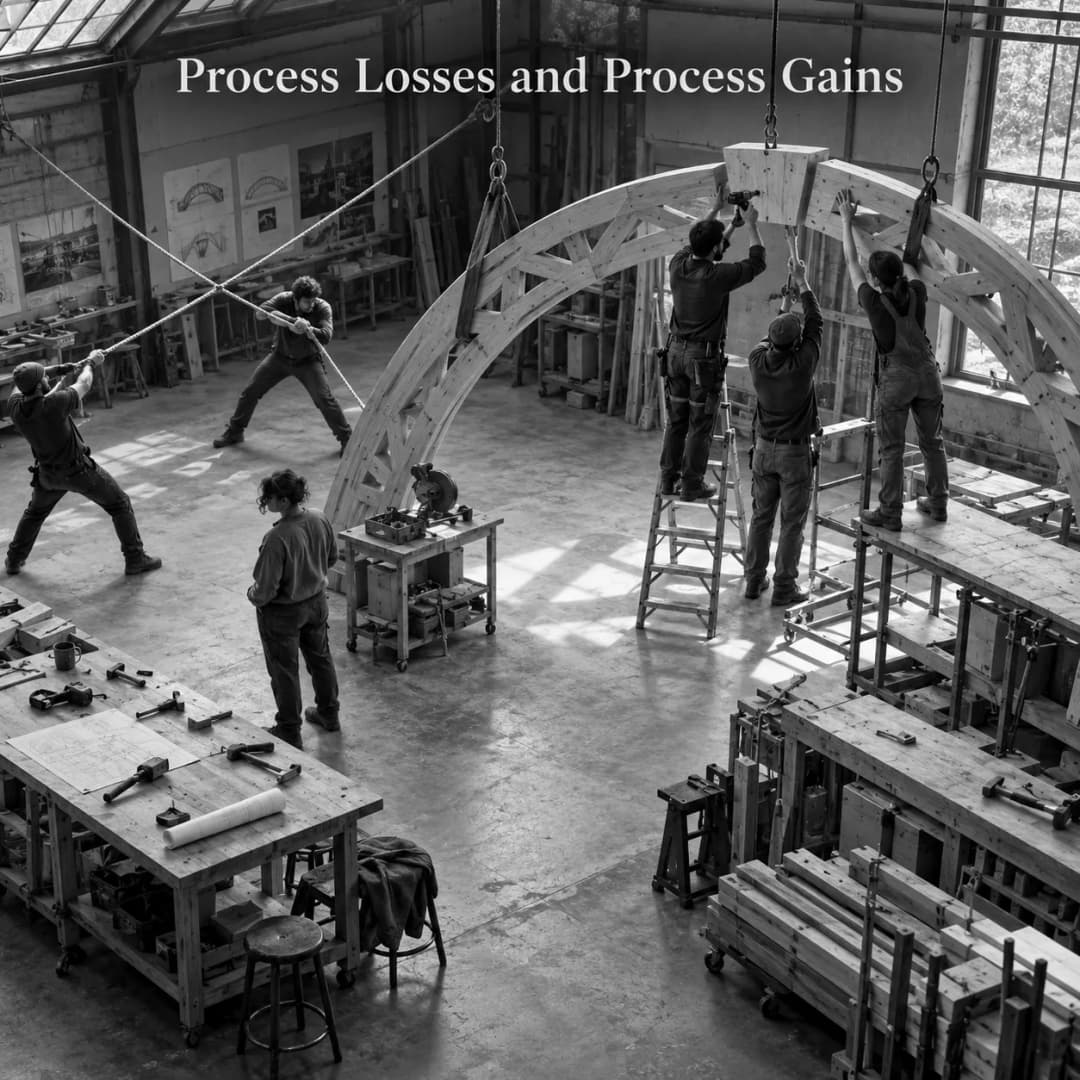
Process losses and process gains are the accounting vocabulary for why a group's output differs from the sum of what its members could have produced alone. Ivan Steiner's 1972 formula is a subtraction: actual productivity equals potential productivity minus losses due to faulty process. Richard Hackman added the other term, process gains, meaning the things a group can do that no member could. The vocabulary is a framework and is not in dispute. The empirical claims attached to it are uneven, which is why this page is marked mixed.
What it is
Steiner's losses come in two kinds. Coordination losses, where effort is spent on the mechanics of working together rather than on the work. And motivation losses, of which social loafing is the best-known case. His version is pessimistic by construction: on that formula a group can only ever fall short of its own potential, never exceed it.
Hackman's addition of gains is what turns the formula from an argument against groups into a question about conditions. A gain is genuine synergy, not merely the absence of loss, and admitting the term makes it possible to ask when a group does better than its parts rather than assuming it cannot.
Holding only half the pair produces a predictable error in either direction. A reader who has only losses concludes that groups are a tax on individuals, which is the conclusion the popular brainstorming literature reached and which is too strong. A reader who has only gains believes in synergy, which is rarer than it sounds.
The defensible statement is that synergy is real and rare and depends on task type: groups tend to beat individuals on complex knowledge work and to lose on simple additive tasks. Which category a task falls into is what Steiner's task taxonomy is for, and it is the half of Steiner that trade books consistently drop.