Progressive Difficulty
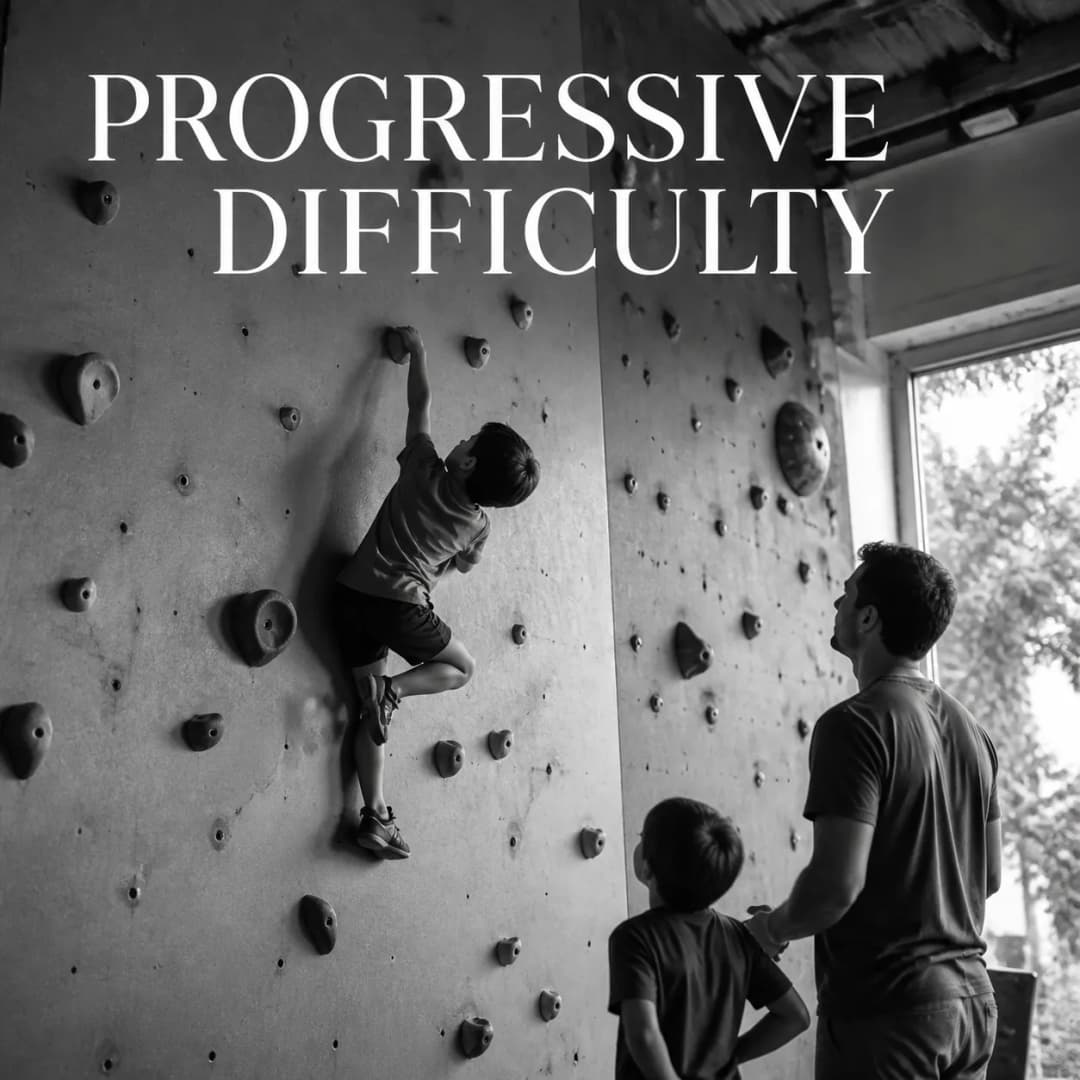
Progressive difficulty is Adam Alter's fourth ingredient of behavioural addiction: challenge has to keep rising or engagement dies. A game you always win stops being a game. The theory underneath is borrowed, Vygotsky's zone of proximal development paired with Csikszentmihalyi's flow channel, and it says to sit just past what a person can currently do, close enough to dodge boredom on one side and anxiety on the other. That is a description of good teaching and a specification for a slot machine.
What it is
Difficulty is a moving target. That is the whole idea, and it is why the concept belongs on a list of things that make products hard to put down rather than on a list of things that make them good. Skill rises with practice. The challenge that absorbed a person in week one bores them by week ten. Anything that wants to hold attention over months has to keep raising the bar, and anything that fails to raise it loses the person to boredom, which they will experience as having simply lost interest.
Alter names this as the fourth of six ingredients in Irresistible (2017), in the chapter called "Escalation". The theoretical parts are borrowed and he says so. Lev Vygotsky's zone of proximal development describes the band just beyond what a learner can do unaided, where instruction does its work. Mihaly Csikszentmihalyi's flow channel describes the same band from the inside, with boredom below it and anxiety above. Neither man was writing about engagement design. Both descriptions turn out to be implementable, which is the fact the chapter is built on.
The journalist Olivia Goldhill supplies the line Alter builds the argument around, that for most people a game you always win is boring. Set beside the flow channel it produces the design rule: a curve, not a level. And a curve has a property a level does not, which is that it has no natural stopping point. A well-tuned difficulty ramp never delivers the moment where the player has finished and can leave. It delivers the next rung.
This page carries unreviewed, and the honest reason is worth separating into two parts. The framework is a taxonomy, one author's six-part model of what makes a product compelling, and it has never been tested as a model. Underneath it sit two theories, Vygotsky's and Csikszentmihalyi's, which are themselves descriptions built substantially on observation and self-report rather than measured effects, and our own page on flow says so. Above it sit the illustrations, which are the part to watch. Our audit of Irresistible records the pattern in the book plainly: the mechanism chapters are the sturdiest engagement material in this vault, and the storytelling around them is unchecked. Alter is a careful researcher and a less careful anecdotalist.
The one place progressive difficulty is genuinely distinguishable from its neighbours is in what it does to failure. Incremental progress, Alter's third ingredient, is about the felt sensation of getting better. Progressive difficulty is about being made to fail again at a higher level, on purpose, and finding that the failure makes the next attempt more attractive rather than less. Tetris does not end when you are good at it. It speeds up until you lose.
In effect
Research: the bored participants, and a headline that overstates its own study
The nearest thing to an experiment in this chapter is Wilson and colleagues' 2014 paper in Science, eleven studies, in which participants left alone in a room with nothing to do chose to give themselves an electric shock rather than sit with their own thoughts. One man shocked himself 190 times in twenty minutes. It reads as the negative case for the whole concept, what happens when the difficulty curve is removed entirely and there is no challenge at any level.
It is also the clearest example on this page of a real finding retold too hard, and the caveat is not optional. A published commentary reanalysed the participants who had earlier said they would pay money to avoid the shock, and among that group a majority preferred just thinking. What the study supports is that people find unstructured solitude unpleasant. It does not support the line it is usually quoted for, which is that people would rather be electrocuted than think. Our own vault holds this one as contested, and the 190 figure should travel with the reanalysis attached or not travel.
Everyday life: the reset, and the game you have already beaten
Alexey Pajitnov's Tetris is the cleanest version of the mechanism anyone has built, and almost everyone has felt it. The pieces fall faster, you fail, it resets, and the whole game is that curve with nothing else attached, no story, no ending, no reward that is not another round. Nobody plays Tetris to finish it.
Then the opposite experience, which is more instructive because it is so ordinary. A game you have completely mastered goes quiet. The puzzle app you were doing every morning stops being interesting somewhere around the point where you stop getting them wrong. The difficulty did not change. Your skill did, and the same setting that held you in January is now underneath you. People almost never describe this accurately to themselves. They say they got bored of it, which is true, and which conceals the fact that boredom here is a measurement of the gap.
Commerce and product design: Miyamoto, Cavanagh, and the machines with no ceiling
Shigeru Miyamoto's design work on Mario is the benign end and worth stating in its own terms: hidden shortcuts that reward a veteran player without punishing a novice, so the same level can sit inside two different people's zones at once. That is a craft problem solved well, and it is the same problem a good teacher solves with a mixed-ability class.
Terry Cavanagh's Super Hexagon is the other end. It is deliberately brutal from the first level, with no ramp at all, and Cavanagh has said the difficulty is what hooked him while he was testing his own game. The commercial version with no ceiling is the gambling machine, described by Natasha Dow Schüll in Addiction by Design (Princeton, 2012) after fifteen years of fieldwork in Las Vegas, where players enter a state in which the aim is not to win but to stay in the cycle. Alter borrows the term "ludic loop" for that cycle and credits Schüll, and our audit could not confirm the coinage is hers, since her own central term is the machine zone. Attribute the mechanism to Schüll and leave the label alone.
None of these three is evidence. Pajitnov, Cavanagh and Miyamoto are designers describing their own games to a journalist, and Schüll's work is ethnography, which describes a mechanism rather than measuring an effect. They illustrate the concept very well and they establish nothing.
What it does not say
It does not say that rising difficulty causes addiction. It is one ingredient of a six-part model that has never been tested as a model, and behavioural addiction is a contested category in its own right, with gambling disorder the only behavioural addiction the DSM-5 recognises as a formal diagnosis. A hard game is a hard game.
It does not carry the evidence of the theories it borrows. Vygotsky's zone of proximal development and Csikszentmihalyi's flow channel are frameworks with long records in education and psychology, not measured constants, and this page's use of them is at one remove. No effect size attaches to any of it.
It does not license the shock study as usually told. See above. The finding is that unstructured solitude is aversive. The dramatic version does not survive the reanalysis.
It is not the same as incremental progress. Alter's third ingredient is the felt sense of improvement. This one is the deliberate reinstatement of failure at a higher level. Products usually ship both, and they pull in different directions, which is a design tension worth naming rather than a redundancy.
It does not tell you who the tuning is for. A physiotherapist raising the difficulty of an exercise programme and a studio raising the difficulty of a level are performing the same operation. The concept contains no way to tell them apart, and the answer, when there is one, comes from the business model rather than from the psychology.
Who developed it
Adam Alter named progressive difficulty as the fourth of six ingredients of behavioural addiction in Irresistible (2017), ch. 7, "Escalation", p. 167. The theory he builds it on is Lev Vygotsky's zone of proximal development and Mihaly Csikszentmihalyi's flow channel, neither written with engagement design in mind.
Our own note names Csikszentmihalyi as the originator, at medium confidence, with a year of 2014. That year matches neither Flow (1990) nor Irresistible (2017), and the field is left uncorrected rather than quietly overwritten, because the shape of it, a famous name in the originator field with a date that fits nothing, is the exact pattern that produced seven misattributions in this vault. The defensible position is the one on this page: the ingredient is Alter's, the theory is Csikszentmihalyi's and Vygotsky's, and the vault's originator field is wrong. Csikszentmihalyi and Vygotsky have no pages on this site yet.
Sources
- Alter, A. (2017). Irresistible: The Rise of Addictive Technology and the Business of Keeping Us Hooked. Penguin Press. Ch. 7, "Escalation", p. 167. Named as ingredient four of six. Full text read, 2026-09-01.
- Wilson, T. D., et al. (2014). Science. Eleven studies on unstructured solitude; participants choosing self-administered shocks, one man 190 times in twenty minutes. Contested. A published commentary reanalysing participants who had said they would pay to avoid the shock found a majority preferred just thinking. The aversion to unstructured solitude holds; the popular version goes further than the evidence.
- Schüll, N. D. (2012). Addiction by Design. Princeton University Press. Fifteen years of Las Vegas ethnography. Qualitative fieldwork describing a mechanism, not measuring an effect. The term "ludic loop" is credited to her by Alter and could not be confirmed as her coinage; her own central term is the machine zone.
- Vygotsky, L. The zone of proximal development, the learning-theory half of the model. Not read in the original here; it reaches this page through Alter.
- Csikszentmihalyi, M. (1990). Flow: The Psychology of Optimal Experience. The flow channel. See our page on Flow State for its own evidence position.
- Vault audit of Irresistible, 2026-09-01. Records Pajitnov's Tetris, Cavanagh's Super Hexagon and Miyamoto's Mario design as unchecked and, more importantly, as not research: designers describing their own games to a journalist. Excellent illustration, zero evidential weight.
- Where this came from
- 2 books in this library carry this concept, which is corroboration worth knowing about, though these authors read each other and often draw on the same experiments, so it is not independent confirmation.