Protective Frame
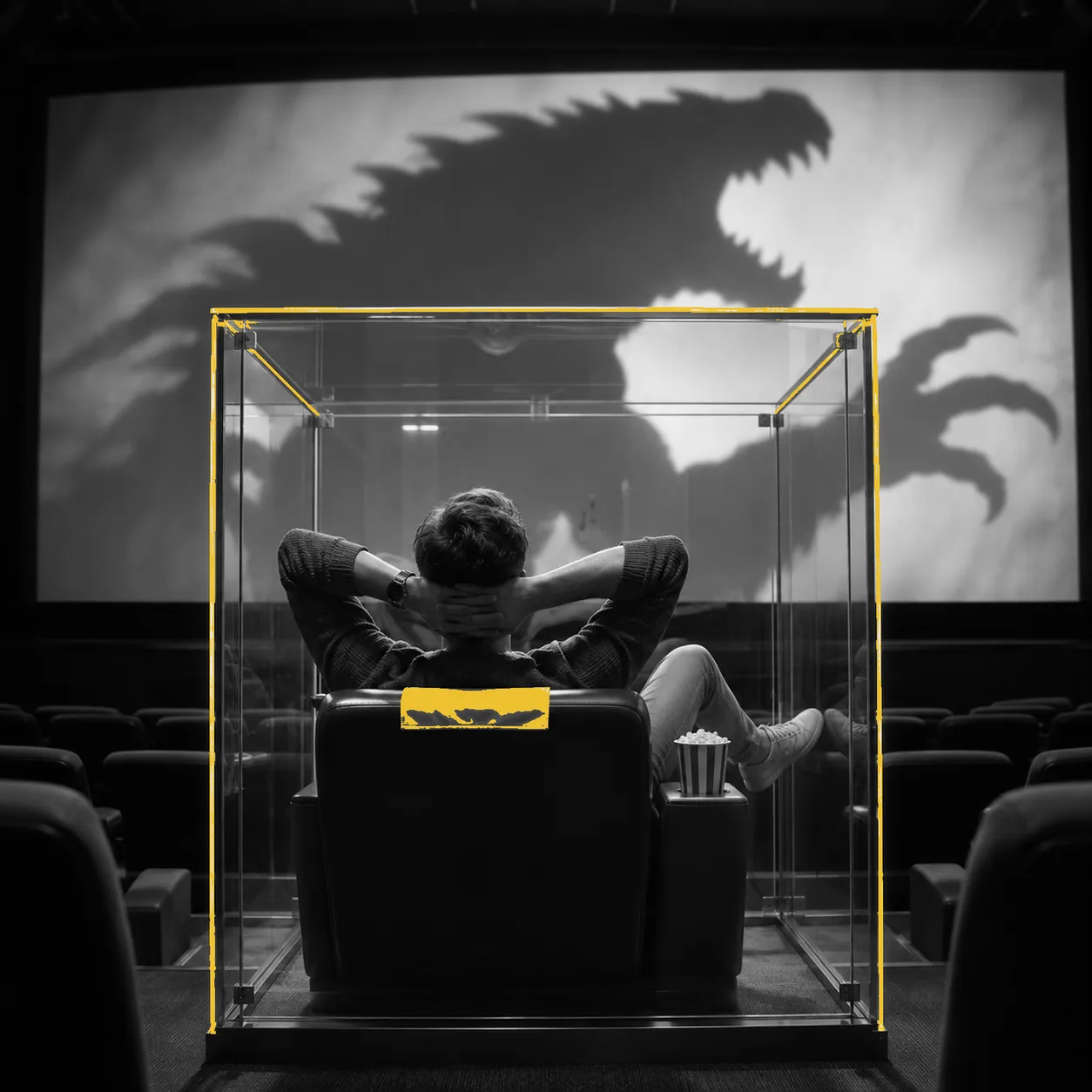
A protective frame is a sense of detachment that keeps a frightening experience from being treated as a real threat. Eduardo Andrade and Joel Cohen proposed it in 2007.
What it is
Andrade and Cohen ran four studies in which consumers with approach or avoidance tendencies toward horror movies reported their feelings before or after watching one. They argued that two things together give the most economical account of why people consume horror: positive and negative feelings can be active at the same time, and a protective frame, which is a feeling of detachment from the danger, lets the negative feelings be enjoyed rather than avoided.
The frame is psychological rather than physical. A viewer who knows the monster is a prop, the room is safe and the film will end is working inside a frame, and that knowledge is what turns a threat into an experience.
In effect
In the article on why we enjoy horror films, the protective frame is the condition under which negative feelings can be enjoyed. It also connects to the account of constructed emotion, in which the same bodily arousal can be read as fear or as excitement depending on context. That link is an interpretation, not a tested finding.
What it does not say
It does not say that the frame is always present or always sufficient. When detachment fails, the same scene may simply feel bad. The studies concern horror movie viewers, not other forms of fear.
Where it comes from
Eduardo B. Andrade and Joel B. Cohen proposed the protective frame in On the Consumption of Negative Feelings, Journal of Consumer Research, volume 34, issue 3, 2007. The paper is about why people choose experiences that make them feel bad, and horror films are its test case.
What the research found
The paper reports four studies. In each, consumers with an approach or avoidance tendency toward horror movies reported their feelings before or after watching one. The authors argue that two things together give the most economical account of why people consume horror. The first is coactivation: positive and negative feelings can be active at the same time. The second is the protective frame, a feeling of detachment from the danger that acts as a moderator, so that the negative feelings are enjoyed and not escaped.
The result is a comparison of explanations. Andrade and Cohen present coactivation with a protective frame as more parsimonious than rival accounts, meaning it explains the same pattern with fewer assumptions. It is a claim about which explanation fits best, not a measurement of how large the frame is.
A later field study in haunted attractions, by Andersen and colleagues in 2020, found that enjoyment followed an inverted U against fear. That study does not test the frame directly, but it fits the idea that enjoyment survives only while fear stays inside limits that the visitor can hold at a distance.
The reading depth is the abstract of the 2007 paper, so the account of the studies is limited to what the authors state there.
Where opinion differs
One reading is that the frame is the key to enjoying frightening fiction: without detachment, fear is just fear. A second reading stresses that frames are fragile, since a scare can break through the detachment and tip enjoyment into distress, which is what the falling side of the inverted U suggests. A third, drawing on constructed emotion, holds that the same bodily arousal is read as fear or excitement depending on context, so the frame is part of how the feeling is labelled. The 2007 paper supports the first. The other two are interpretations made on this site and are not tested by it. All three accept that context decides whether a scare is enjoyed.
How this site uses it
The Why We Project uses the protective frame in its piece on why we enjoy horror films, as the condition under which negative feelings become an experience. It is paired with coactivation of feelings and the inverted U of fear and enjoyment.
Sources
- Andrade, E. B. and Cohen, J. B. (2007), Journal of Consumer Research 34(3), 283-300.