Psychological Moonshot
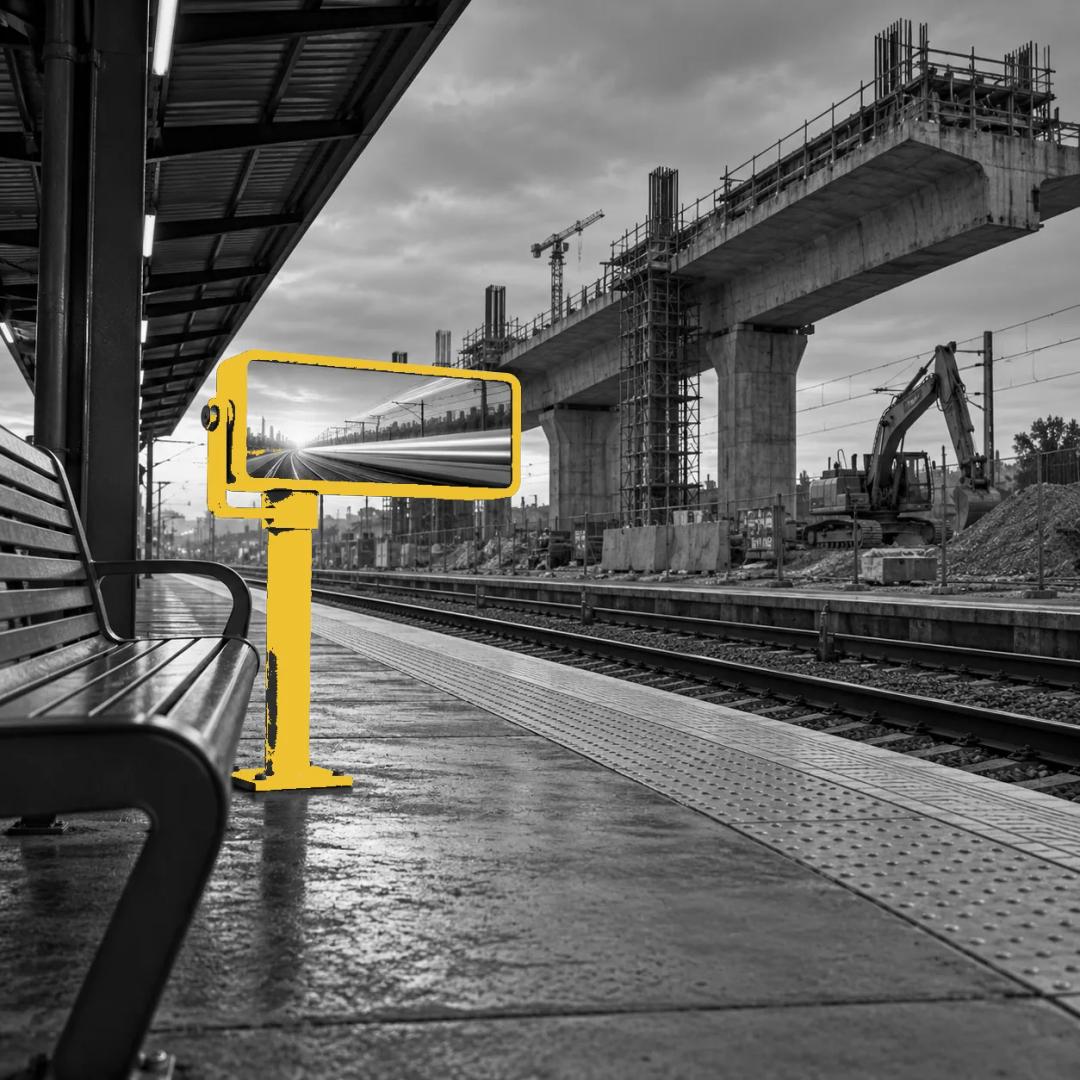
A psychological moonshot is the purchase of a large improvement in how something is perceived at a small fraction of what an equivalent improvement in reality would cost. The phrase is Rory Sutherland's, from his 2019 book Alchemy. It is a practitioner's argument about where to look for cheap gains and is not a research finding. Its best-known illustration comes from a conference talk, the scheme used as its foil was audited, and the strongest part of the underlying point, that journey quality has a measured price, is better supported by transport research than by the anecdotes.
What it is
The claim is an asymmetry. Engineering effort is bounded by physics, so speeding a rail journey up by a fifth can cost hundreds of millions of pounds. Perception is bounded by psychology, and Sutherland argues that we understand psychology far less well than physics, so there is more unexplored room on that side. Making the same journey a fifth more enjoyable might cost very little. A moonshot, in his usage, is a perceptual change that delivers most of the benefit of a physical one for about one per cent of the cost.
The justification is a statement about where to search and not a measurement. He describes the book as a provocation, acknowledges that parts of it are likely to be mistaken, and says his point is that proposed solutions of this kind should keep being tested. This page holds the idea to that standard.
In effect
Four points came out of reading the argument against its sources.
First, the scheme behind the comparison is High Speed 1. The National Audit Office reported construction at 6,163 million pounds in outturn terms and valued journey time savings at 7,000 million pounds in present value to 2070, within a range of 6,100 to 7,700 million. In the auditor's accounts the minutes were not the weak part. Passenger demand was: actual numbers between 2007 and 2011 averaged about a third of the level forecast in the 1995 bid.
Second, the method does not always build the comparison it asks others to build. Sixty million pounds of wireless internet is costed against nothing: not against capacity for twenty trains an hour in each direction, not against a domestic service into Kent, not against the regeneration case at three stations. This is the point of the counterfactual page on this site, and the auditor made the same complaint of the railway.
Third, journey quality already has a price. Abrantes and Wardman pooled 226 studies in 2011, and Wardman and Whelan priced crowding as a multiplier on time. Lyons, Jain and Holley surveyed 26,221 rail passengers in 2004 and reported positive utility of travel time. Comfort and speed are measured in the same currency.
Fourth, the sharper form of the claim survives. Appraisal prices comfort inside a framework whose benefit side is still dominated by time, and a cheap option often has no promoter to build its case.
What it does not say
It does not say that perception is cheap in general. Nothing in the record measures the cost of a perceptual improvement against its effect.
It does not say that appraisal ignores comfort. Appraisal prices comfort as a reduction in a time multiplier.
It is not evidence that cheap interventions outperform expensive ones. That dispute runs through publication bias and through the contrast between individual-level and system-level solutions, and it is not settled.
The page also declines to carry several figures that appear in the book because no measurement stands behind them: the reduction in frustration claimed for a ride-hailing map, the superlative given to a set of platform displays, and the 250,000 pounds named for a national ticketing app.
Where it comes from
Alchemy was published by WH Allen in 2019, with a paperback edition in 2020. The operative claim sits in its discussion of psychological moonshots.
The Eurostar illustration that is attached to the idea in most retellings is not in the book. It comes from one of Sutherland's conference talks, in which the engineering option is six billion pounds of new track to take about forty minutes off the journey from London to the coast, set against hiring supermodels to serve wine, which he offers as a joke. The text reached this publication through the verbatim transcript of a TED Radio Hour segment. In a 2014 interview about the talk he said the more serious suggestion had been wireless internet at not quite one per cent of the money. The book's own rail case is a counter-proposal to High Speed 2, with different numbers.
Where opinion differs
Supporters read the idea as a cost-effectiveness claim and note that a letter or a message costing pennies per household is a different proposition from a programme costing millions. Shlomo Benartzi, John Beshears, Katherine Milkman, Richard Thaler and colleagues reported impact-to-cost ratios in which behavioural interventions often compared favourably with traditional tools, while saying that more calculations were needed. Avishalom Tor and Jonathan Klick re-examined those calculations and argued that cost elements had been treated unevenly, and that nudges do not consistently outperform traditional interventions once costs and benefits are set out in full.
A second view, from Nick Chater and George Loewenstein, concerns the frame of the question. They argue that system-level measures are larger than individual-level ones and that cheap individual-level options can draw attention away from them. Sutherland names Chater as a friend in the same transcript, and the disagreement is one between serious people who know each other's work.
How this site uses it
The Why We Project treats the moonshot as a prompt to ask the cheaper question first and to measure the answer. Where an article proposes a perceptual fix, the check is whether a comparison was built, what the effect was, and what the cheaper option displaced.
Sources
- Sutherland, R. (2019). Alchemy. WH Allen. 2020 paperback, read in full from photographed spreads.
- Sutherland, R. (2009). TEDGlobal 2009 talk, read through the verbatim transcript of a TED Radio Hour segment.
- National Audit Office (2012). The completion and sale of High Speed 1. HC 1834. Executive summary read in full.
- Abrantes, P. A. L., & Wardman, M. R. (2011). Meta-analysis of UK values of travel time: An update. Transportation Research Part A, 45(1), 1-17.
- Lyons, G., Jain, J., & Holley, D. (2007). The use of travel time by rail passengers in Great Britain. Transportation Research Part A, 41(1), 107-120.
- Benartzi, S., Beshears, J., Milkman, K., Thaler, R. and colleagues; and Tor, A., & Klick, J.: two papers on impact-to-cost ratios of behavioural interventions. Abstracts and bibliographic records read, not the full texts.