Queue Psychology
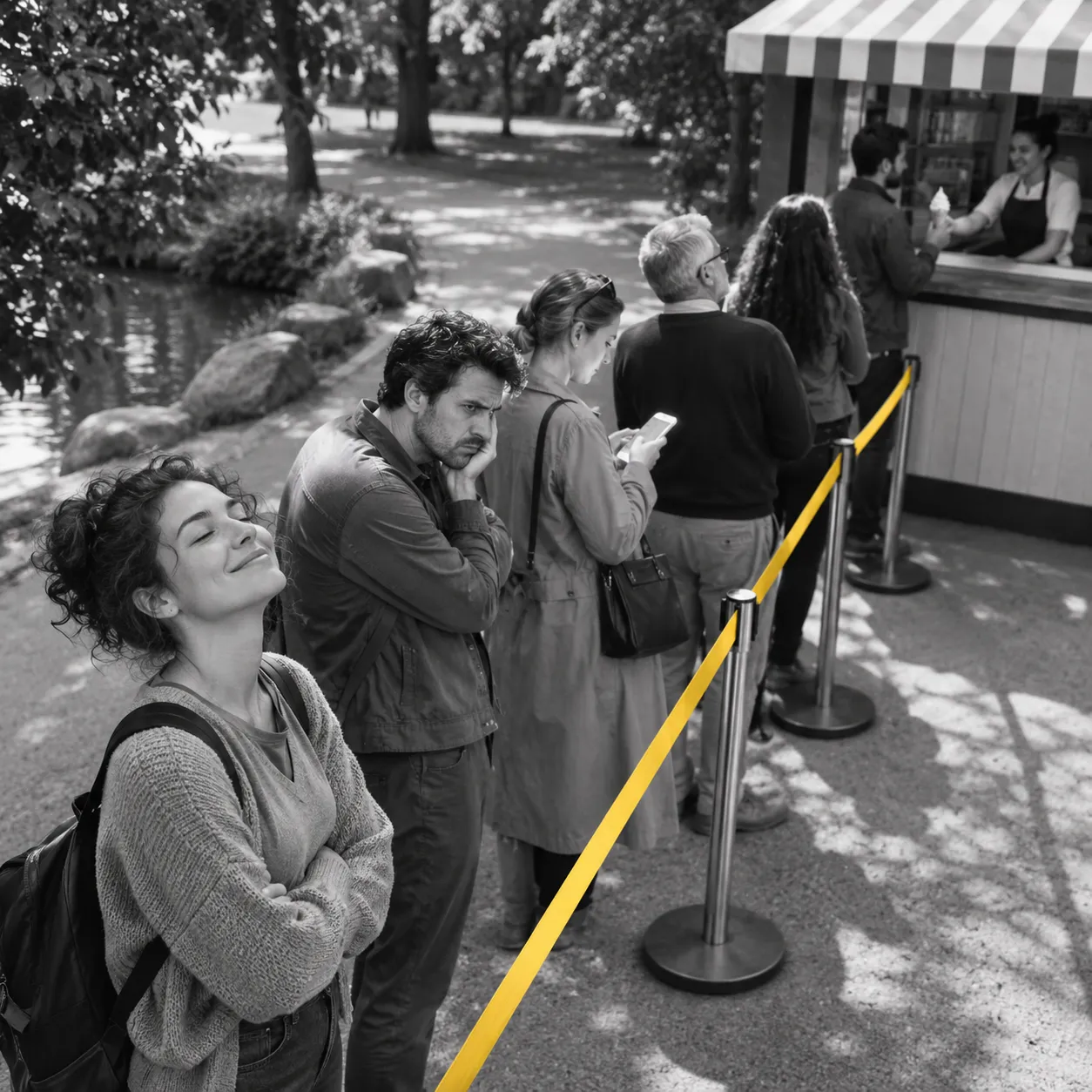
Queue psychology is the study of how waits are felt and judged, as distinct from how long they last. This site draws on work about how time is valued, how fair a line seems and what a lane sells.
What it is
France Leclerc, Bernd Schmitt and Laurette Dubé tested in 1995 whether people treat waiting time as they treat money. With certain outcomes, time losses were handled consistently with a convex loss function, as with money. With risky outcomes, people were risk-averse for time losses, unlike the risk seeking usually found for money losses. The authors attribute the gap to time not being fungible with money.
In effect
Waits are judged by uncertainty and by fairness as well as by length. Paid priority may sell a short and predictable wait, which could suit people who dislike gambling with their time. Others in the line judge a paid lane by whether it costs them anything, as the line-sitting experiments show, and Felix Oberholzer-Gee found that a majority was willing to wait longer, but only a small minority accepted money to let a stranger cut in.
What it does not say
The research cited here covers laboratory and field experiments on specific designs. It does not give a single rule for how long waits feel. The page makes no claim about pricing or service design advice.
Sources
- Leclerc, F., Schmitt, B. H., & Dubé, L. (1995). Waiting time and decision making: Is time like money? Journal of Consumer Research, 22(1), 110-119. https://doi.org/10.1086/209439
- Oberholzer-Gee, F. (2006). A market for time: Fairness and efficiency in waiting lines. Kyklos, 59(3), 427-440. https://doi.org/10.1111/j.1467-6435.2006.00340.x
- Althenayyan, A., Ülkü, S., Yang, L., & Cui, S. (2025). Not all lines are skipped equally: An experimental investigation of line-sitting and express lines. Manufacturing & Service Operations Management, 27(1), 287-304. https://doi.org/10.1287/msom.2022.0338