Repetitive Negative Thinking
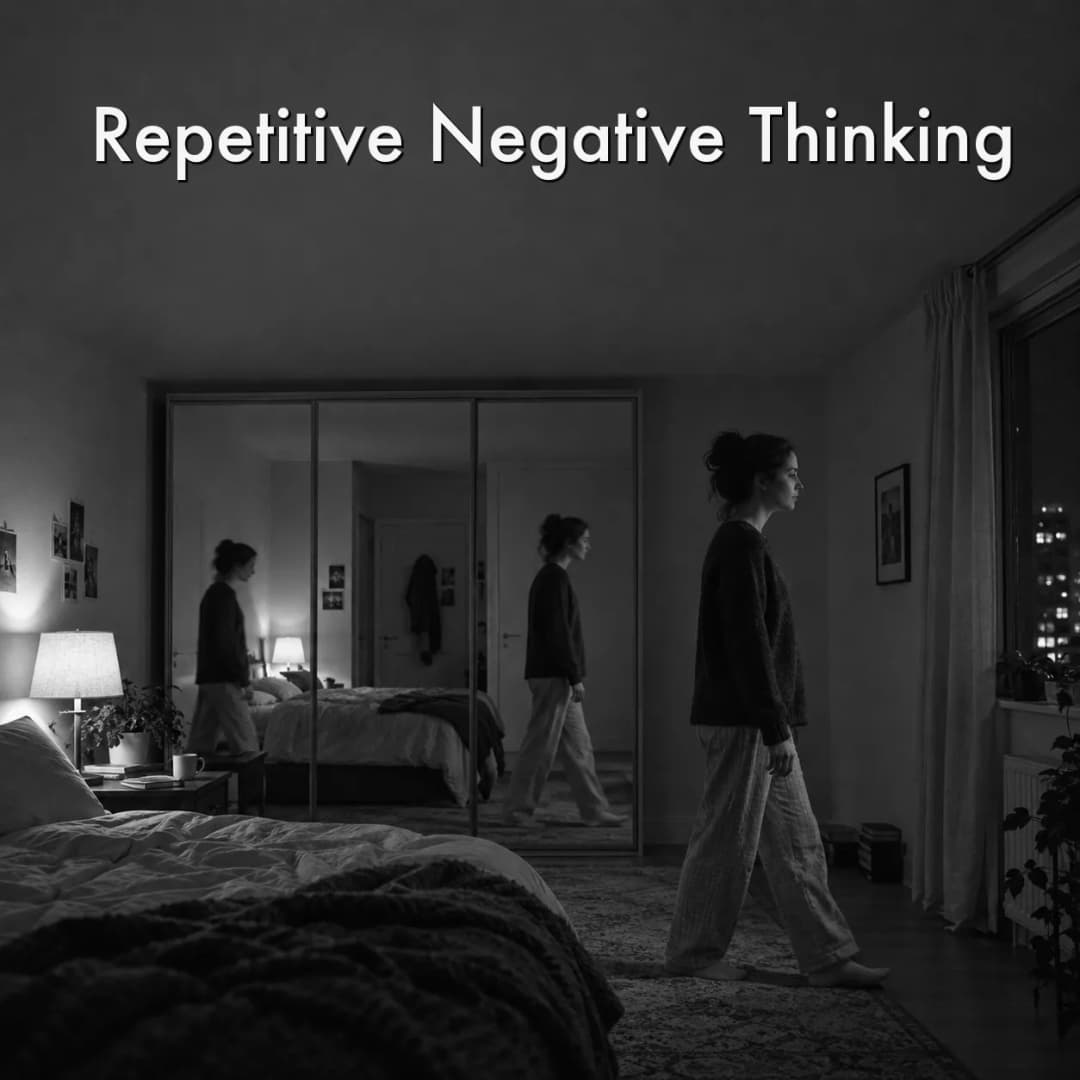
Repetitive negative thinking is one name for the thinking that will not stop, whichever direction it faces. Worry points forward, at what might happen. Rumination points back, at what already did. Thomas Ehring and Edward Watkins argued in 2008 that these are the same process running on different content, and that the process turns up across many different conditions rather than belonging to any one of them. The ordinary word for it is overthinking.
What it is
It is worth saying plainly what that ordinary word is not. Overthinking is not a diagnosis, and it is not a listed symptom of anything. A reader who lies awake replaying a conversation has a process running, not a condition.
Transdiagnostic is the term of art, and it means exactly what it sounds like: a feature that shows up across diagnoses instead of marking out one of them. The same repetitive thinking appears in depression, in generalised anxiety disorder, in obsessive compulsive disorder, in post-traumatic stress disorder and in psychosis, and it also appears in people with no diagnosis at all. What changes between them is the subject matter, not the shape of the loop.
That framing is useful in two directions at once. For clinicians it suggests treating the process rather than chasing the content, which is what rumination-focused CBT does. For a reader it is the kinder reading: having it does not mean you have something.
In effect
Research: where the framing comes from
Ehring, T., & Watkins, E. R. (2008), "Repetitive Negative Thinking as a Transdiagnostic Process", in the International Journal of Cognitive Therapy, set out the case. It has held up. Direct comparisons of repetitive thinking across different disorders find more similarities than differences, which is the finding that supports treating it as one process wearing different clothes.
Everyday life: the belief this corrects
"Overthinking is a symptom of anxiety" is not established as stated, and it is wrong twice over. It is wrong because overthinking is a lay word covering two distinct clinical constructs, worry and rumination, which have separate literatures. And it is wrong because the process is not specific to anxiety. Sleeplessness plus worry is not a diagnosis, and it is worth knowing that the criteria for generalised anxiety disorder already include disturbed sleep among the associated symptoms, which is a further reason not to read the combination as a verdict on yourself. See insomnia disorder for where the clinical lines actually sit.
The other side, held honestly
A transdiagnostic label can flatten real differences between conditions, and it is a construct defined by questionnaire rather than by a mechanism anyone has observed directly. It earns its place because it predicts across diagnoses, not because it has been shown to be one thing in the brain. Both of those sentences are true at the same time, and this page keeps them together rather than picking the flattering one.
What it does not say
It does not say worry and rumination are interchangeable. They differ in what they point at, and the evidence bases for the two are not identical.
It does not say overthinking is a disorder. It is a process that appears in people with diagnoses and in people without them.
It does not identify a mechanism. This is a description of a pattern measured by questionnaire, not an account of what the brain is doing.
It does not tell a reader what to do about it. The treatment that targets the process is clinician-delivered. Describing it is not advising it. See YMYL.
Sources
- Ehring, T., & Watkins, E. R. (2008). "Repetitive Negative Thinking as a Transdiagnostic Process", International Journal of Cognitive Therapy, 1(3), 192 to 205. The founding statement of the framing.
- DSM-5 criteria for generalised anxiety disorder, which include sleep disturbance among the associated symptoms.
- Vault verification record, 2026-09-11. Evidence status primary-cited. Thomas Ehring is credited first, as first author.
- Where this came from
- No book in this library is the source of this concept. It entered the vault from Why You Lie Awake at 3am, built from primary sources rather than from a book.