Resource Exchange
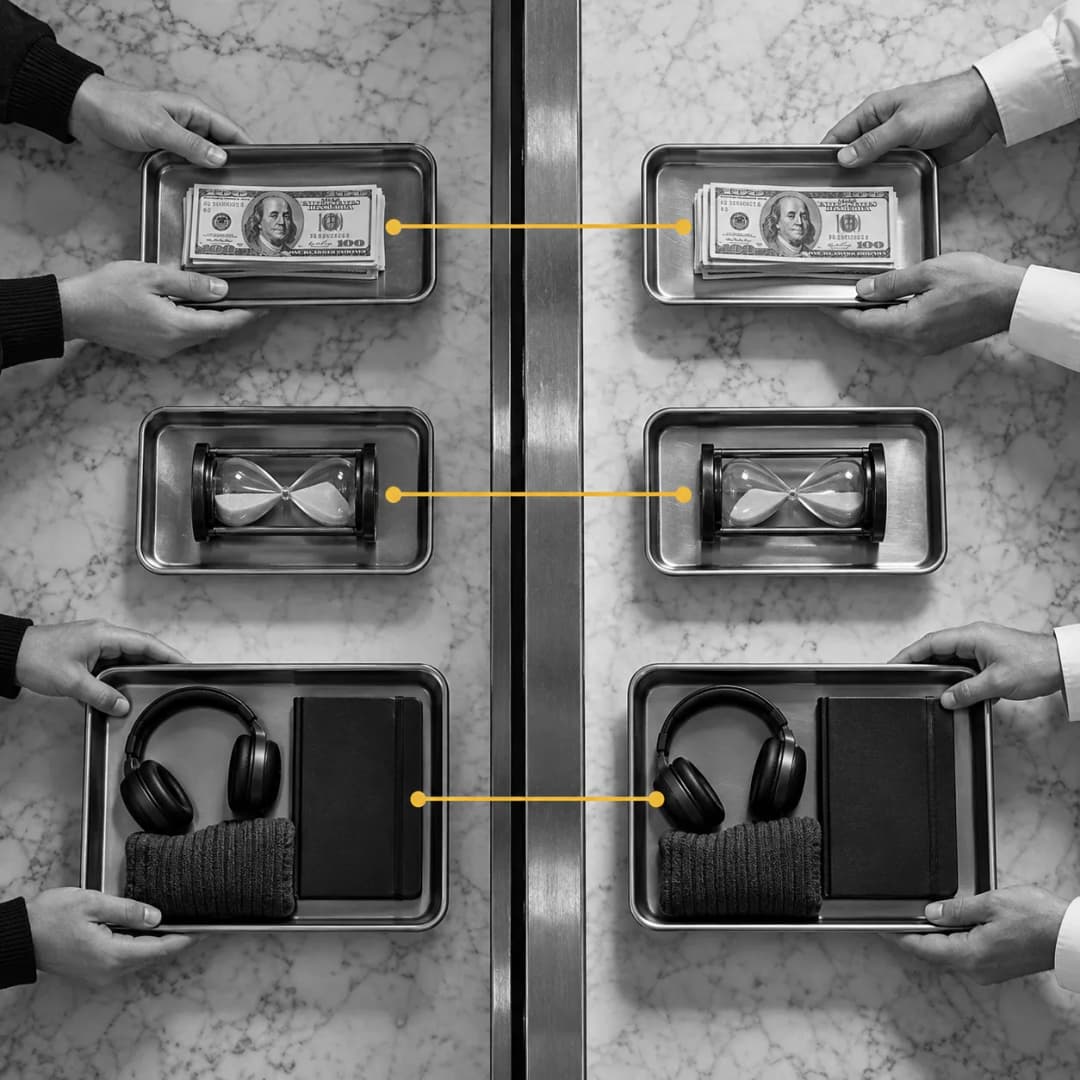
Resource exchange treats a service failure as the loss of a resource, money, time, goods, status or attention, and the recovery as a return of resources. Its practical claim is simple and well supported: compensation works best when it is paid in the same currency as the loss, and in an amount in proportion to it.
What it is
The idea descends from Uriel and Edna Foa's resource theory of social exchange, set out in Societal Structures of the Mind (1974), which sorts what people exchange into classes, love, status, information, money, goods and services, and holds that exchanges within a class feel more appropriate than exchanges across classes. A dinner returned with cash, on this account, is an awkward trade even when the sums are right.
Amy Smith, Ruth Bolton and Janet Wagner brought it into service recovery in the Journal of Marketing Research in 1999. Their model of satisfaction with failure and recovery integrated the consumer satisfaction and social justice literatures using principles of resource exchange, mental accounting and prospect theory. A failure takes something from the customer, a recovery gives something back, and the customer keeps a mental account of whether the exchange balanced.
In effect
Smith and colleagues ran a mixed-design experiment, delivered as a survey, in which customers evaluated failure and recovery scenarios for a restaurant or hotel they had recently used. Customers preferred to receive recovery resources that matched the type of failure they experienced, in amounts commensurate with the magnitude of the failure. The authors offered that as a managerial guide to the fit between a failure and its recovery.
Holger Roschk and Katja Gelbrich tested the matching claim fifteen years later, in a 2014 meta-analysis and experiment in the Journal of Service Research. They proposed resource-based classifications of both failures and compensation and found three things. The recovery effect was generally strongest when compensation was a resource similar to the failure: immediate money for a monetary failure, an exchange for a flawed product, reperformance for a failed service, and psychological compensation for a lack of attention. A lack of attention, unusually, could also be put right by the other kinds of compensation. Immediate money generally did more than delayed money, with the size of that advantage varying by failure. And the resource-based classifications explained the recovery effect better than the older ones, which the authors suggest accounts for the fluctuating effect sizes in earlier research.
The amount has its own curve. Gelbrich, Jana Gäthke and Yany Grégoire tested eleven compensation levels in 2015 and found that where customers had rejected the flawed service, satisfaction climbed fastest between about 60 and 120 per cent of the loss; where they had accepted it, the first money offered did the most. Paying in kind and paying in proportion are two halves of the same exchange.
What it does not say
It does not say money is always the wrong currency. For a monetary loss, money paid at once was the best match in the 2014 work.
It does not say matching is all a recovery needs. Resource exchange describes the outcome side of a recovery. The treatment side, apology, explanation and attention, is covered by interactional justice, and in the 2011 meta-analysis by Gelbrich and Roschk it carried slightly more weight for loyalty.
And the attention exception cuts in a particular direction. A customer who was ignored can be won back by other resources, which is the one case where a mismatched gift still works.
Reading the matching result
The two halves of the idea, paying in kind and paying in proportion, are tested by different studies and should not be merged. Roschk and Gelbrich's 2014 work concerns the kind of resource, and Gelbrich, Gäthke and Grégoire's 2015 experiments concern the amount. A firm that reads only the first can overpay in the right currency, and a firm that reads only the second can pay a fair sum in the wrong one. The sizes found in the experiments, satisfaction climbing fastest between about 60 and 120 per cent of the loss for customers who had rejected the flawed service, belong to those experiments and are not forecasts for any one firm. Most of the evidence also rests on customers responding to described or staged failures, which cannot carry the anger of a real one. The article on what a customer apology must contain takes the practical point that a recovery should stop near the full amount of the loss, since each further step bought less.
Sources
- Foa, U. G., & Foa, E. B. (1974). Societal Structures of the Mind. Springfield, IL: Charles C. Thomas.
- Smith, A. K., Bolton, R. N., & Wagner, J. (1999). 'A Model of Customer Satisfaction with Service Encounters Involving Failure and Recovery.' Journal of Marketing Research, 36(3), 356-372. doi:10.1177/002224379903600305
- Roschk, H., & Gelbrich, K. (2014). 'Identifying Appropriate Compensation Types for Service Failures: A Meta-Analytic and Experimental Analysis.' Journal of Service Research, 17(2), 195-211. doi:10.1177/1094670513507486
- Gelbrich, K., Gäthke, J., & Grégoire, Y. (2015). 'How Much Compensation Should a Firm Offer for a Flawed Service? An Examination of the Nonlinear Effects of Compensation on Satisfaction.' Journal of Service Research, 18(1), 107-123. doi:10.1177/1094670514543149
- Gelbrich, K., & Roschk, H. (2011). 'A Meta-Analysis of Organizational Complaint Handling and Customer Responses.' Journal of Service Research, 14(1), 24-43. doi:10.1177/1094670510387914