Response Styles Theory
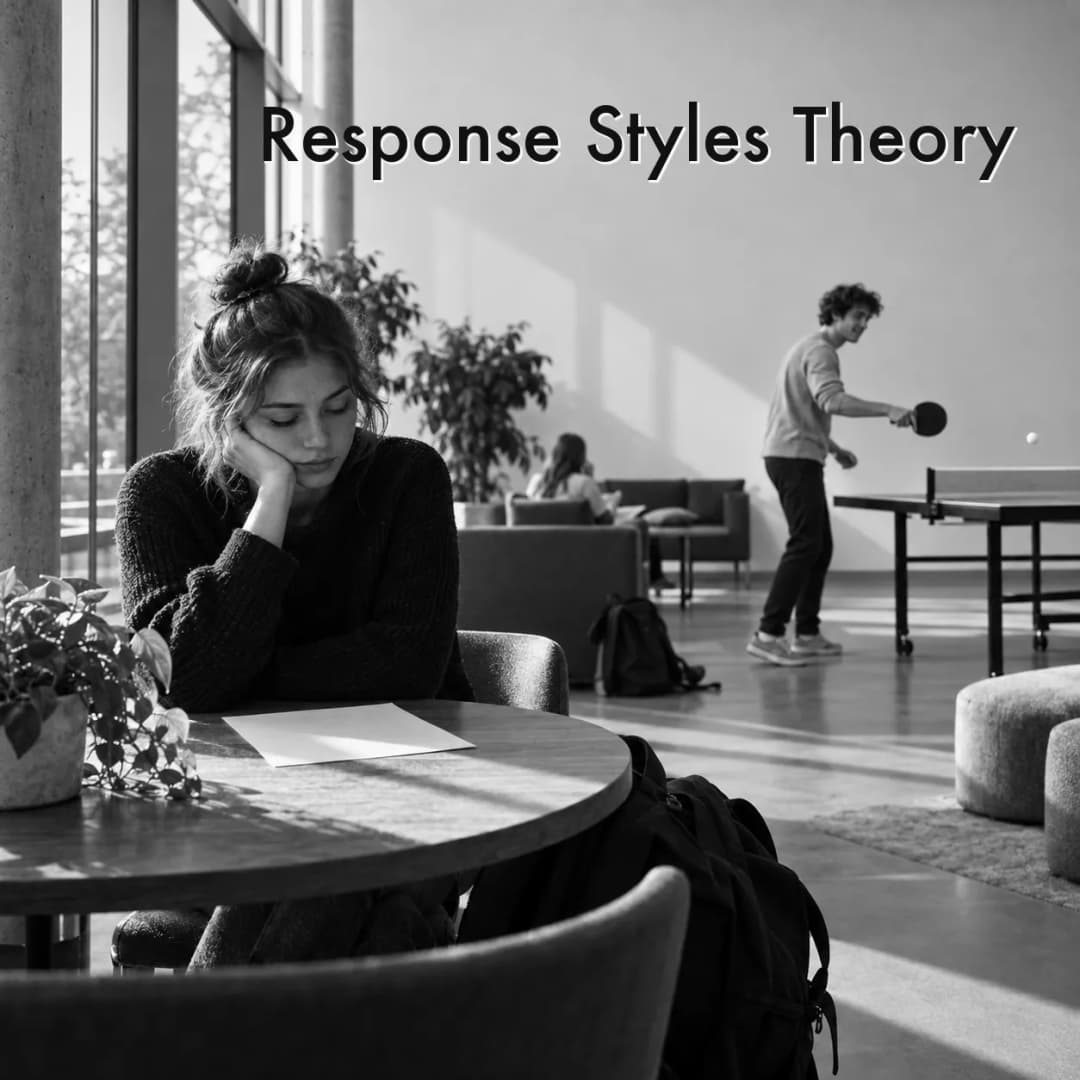
Response styles theory says that what decides how long a low mood lasts is not the mood itself but what you do once it arrives. Sit with it and turn it over, and it lasts longer. Do something absorbing instead, and it lifts sooner. Susan Nolen-Hoeksema set this out in 1991, and it is the founding citation for rumination as a research construct rather than as a word people use about themselves.
What it is
A response style is the habitual thing a person does when they notice they feel low. The theory's claim is that this response, rather than the size of the original knock, does most of the work in deciding whether the mood passes in an hour or runs for weeks.
Two responses are contrasted. The ruminative one keeps attention on the feeling and its causes and meanings. The distracting one moves attention onto something absorbing and neutral. The theory does not say that distraction is a virtue and reflection is a vice; it says that attention aimed at a low mood tends to sustain it.
This is the older and narrower account inside the family described at repetitive negative thinking. Its measure was refined in 2003 into the brooding and reflective pondering split, and that refinement happened for a reason worth knowing: the original questionnaire contained items that were near-duplicates of depression symptoms, so part of what it was measuring was the thing it was supposed to predict.
In effect
Research: the experiment, not the survey
The cleanest demonstration is experimental. Morrow, J., & Nolen-Hoeksema, S. (1990), in the Journal of Personality and Social Psychology, put people into a low mood and then randomly assigned them either a passive task that kept their attention on how they felt or an absorbing task that did not. The distraction group's sadness fell. The rumination group's did not. Same starting mood, different instruction, different ending. Because the response was assigned rather than observed, this licenses causal language about the next few minutes in a way the long-term literature does not.
Research: the long-run association
The association between a ruminative response style and worse, longer depressive episodes is one of the better-replicated findings in clinical psychology. The authoritative review is Nolen-Hoeksema, S., Wisco, B. E., & Lyubomirsky, S. (2008), "Rethinking Rumination", in Perspectives on Psychological Science.
Both sides, then the line
For the strong version: this is a well-supported account of why some low moods pass in an hour and others run for weeks, and it is the reason behavioural activation works on the same insight from the other end. Against it: the long-term causal claim is weaker than the popular framing, because most of that work measures the thinking and the mood by asking the same person at the same time, because rumination overlaps heavily with the general tendency to experience negative emotion, and because of the near-duplicate items just described.
Where we land. Ruminating reliably prolongs a low mood in the hours after it starts, and it predicts worse and longer depressive episodes. Whether it causes depression from a standing start is not settled, and nothing on this site says that it does.
What it does not say
It does not say rumination causes depression. It says it prolongs low mood in the short run and predicts worse episodes in the long run, which is a narrower claim.
It does not say distraction is a treatment. A laboratory task that lifts an induced sadness in minutes is not a plan for a depressive episode.
It does not escape the measurement problem. Most of the long-run evidence asks one person about both variables at once. See the self-report problem.
It does not stand on the 1991 questionnaire. That instrument was rebuilt in 2003 precisely because of overlap with depression symptoms, and the split it produced carries its own separate evidence.
Sources
- Nolen-Hoeksema, S. (1991). "Responses to depression and their effects on the duration of depressive episodes", Journal of Abnormal Psychology, 100(4), 569 to 582. The founding citation.
- Morrow, J., & Nolen-Hoeksema, S. (1990). Journal of Personality and Social Psychology. Mood induction followed by random assignment to a ruminative or a distracting task.
- Nolen-Hoeksema, S., Wisco, B. E., & Lyubomirsky, S. (2008). "Rethinking Rumination", Perspectives on Psychological Science, 3(5), 400 to 424. The authoritative review.
- Mor, N., & Winquist, J. (2002). Psychological Bulletin, 128(4), 638 to 662. Cited for its general conclusion only; no figure is quoted from it, because none could be confirmed in this pass.
- Vault verification record, 2026-09-11. Evidence status primary-cited.
- Where this came from
- No book in this library is the source of this concept. It entered the vault from Why You Lie Awake at 3am, built from primary sources rather than from a book.