Retronasal Smell
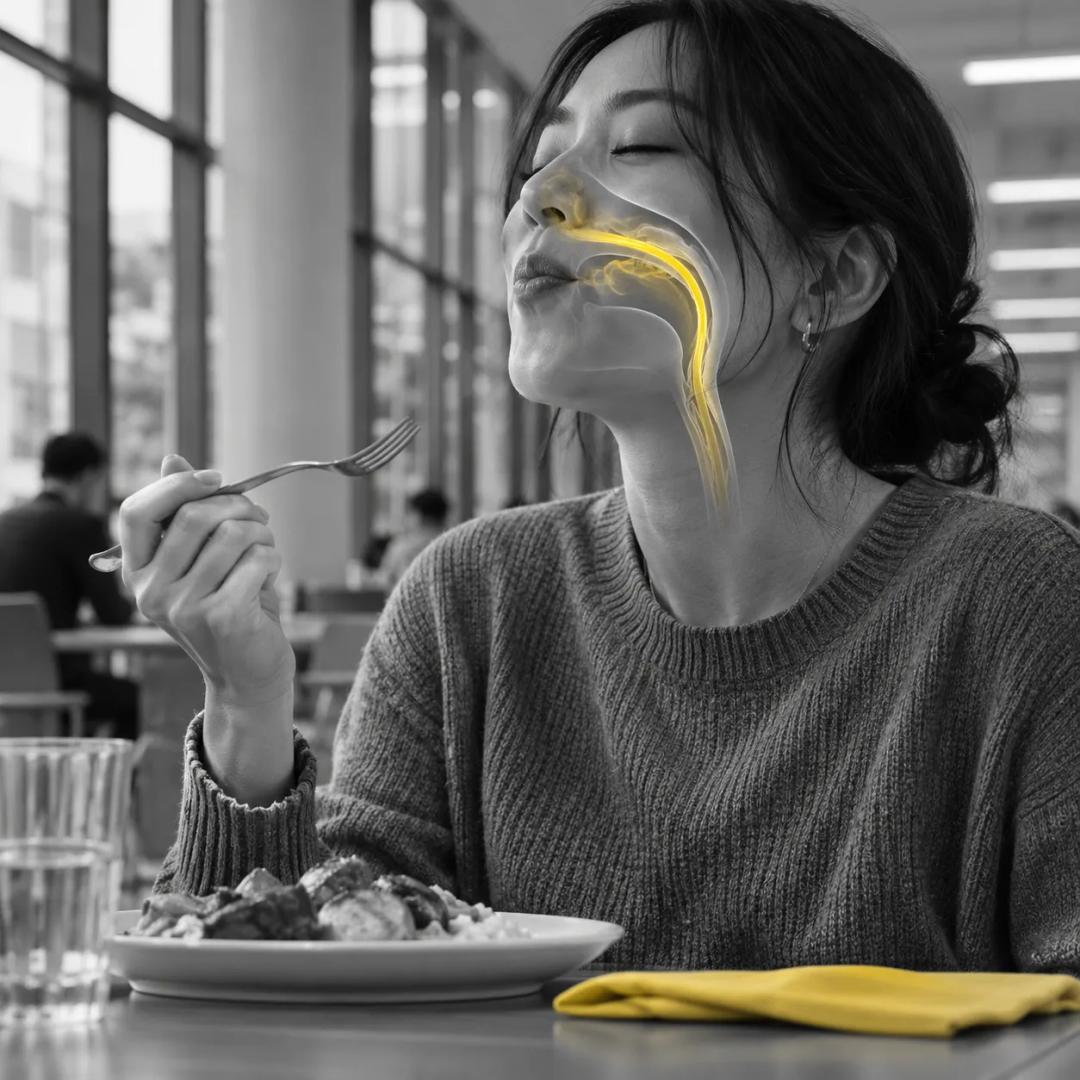
Retronasal smell is the smell of food from inside the mouth. Aroma released as food is chewed and swallowed rises behind the palate to the nose, and the brain files the result under taste.
What it is
Smell reaches the receptors in the nose by two routes. Sniffing draws air in through the nostrils. Chewing and swallowing push air the other way, from the back of the mouth up behind the palate, carrying the aroma released as food is broken down. That second route is retronasal smell. It supplies the fruit in a strawberry, the roast in coffee and the herbs in a sauce.
Charles Spence, in a 2015 review in Flavour, treats retronasal smell as constitutive of flavour and orthonasal smell as modulatory. Gordon M. Shepherd builds Neurogastronomy around the route, arguing that food holds molecules and that the brain makes flavour from them.
In effect
Dana Small and colleagues delivered the same odours to volunteers through the nostrils or through a tube to the back of the mouth while scanning their brains. Mouth delivery activated the part of the sensory cortex that represents the mouth, and for a chocolate odour it produced more activity in the medial orbitofrontal cortex and part of the cingulate. The brain treats an aroma arriving from the mouth as part of eating.
A cold works on the shared nasal passage. In a 1998 study of 36 people with a common cold, smell thresholds rose and odours were rated as weaker while symptoms lasted, and both recovered afterwards. This is one reason food seems bland with a cold while sweetness, saltiness and sourness largely remain.
What it does not say
The concept names a route, not a percentage. The popular claim that most of taste is smell is not fixed by it, and Spence found no single figure that holds across foods and definitions. The imaging result for the mouth route held for a chocolate odour and not for three non-food odours, lavender among them, so the route effect depends partly on the odour. The page makes no claim about diet or health.
Sources
- Small, D. M., Gerber, J. C., Mak, Y. E., & Hummel, T. (2005). Differential neural responses evoked by orthonasal versus retronasal odorant perception in humans. Neuron, 47(4), 593-605. https://doi.org/10.1016/j.neuron.2005.07.022
- Spence, C. (2015). Just how much of what we taste derives from the sense of smell? Flavour, 4(1), 30. https://doi.org/10.1186/s13411-015-0040-2
- Hummel, T., Rothbauer, C., Barz, S., Grosser, K., Pauli, E., & Kobal, G. (1998). Olfactory function in acute rhinitis. Annals of the New York Academy of Sciences, 855(1), 616-624. https://doi.org/10.1111/j.1749-6632.1998.tb10632.x
- Shepherd, G. M. (2012). Neurogastronomy: How the Brain Creates Flavor and Why It Matters. Columbia University Press.