Retrospective Endorsement
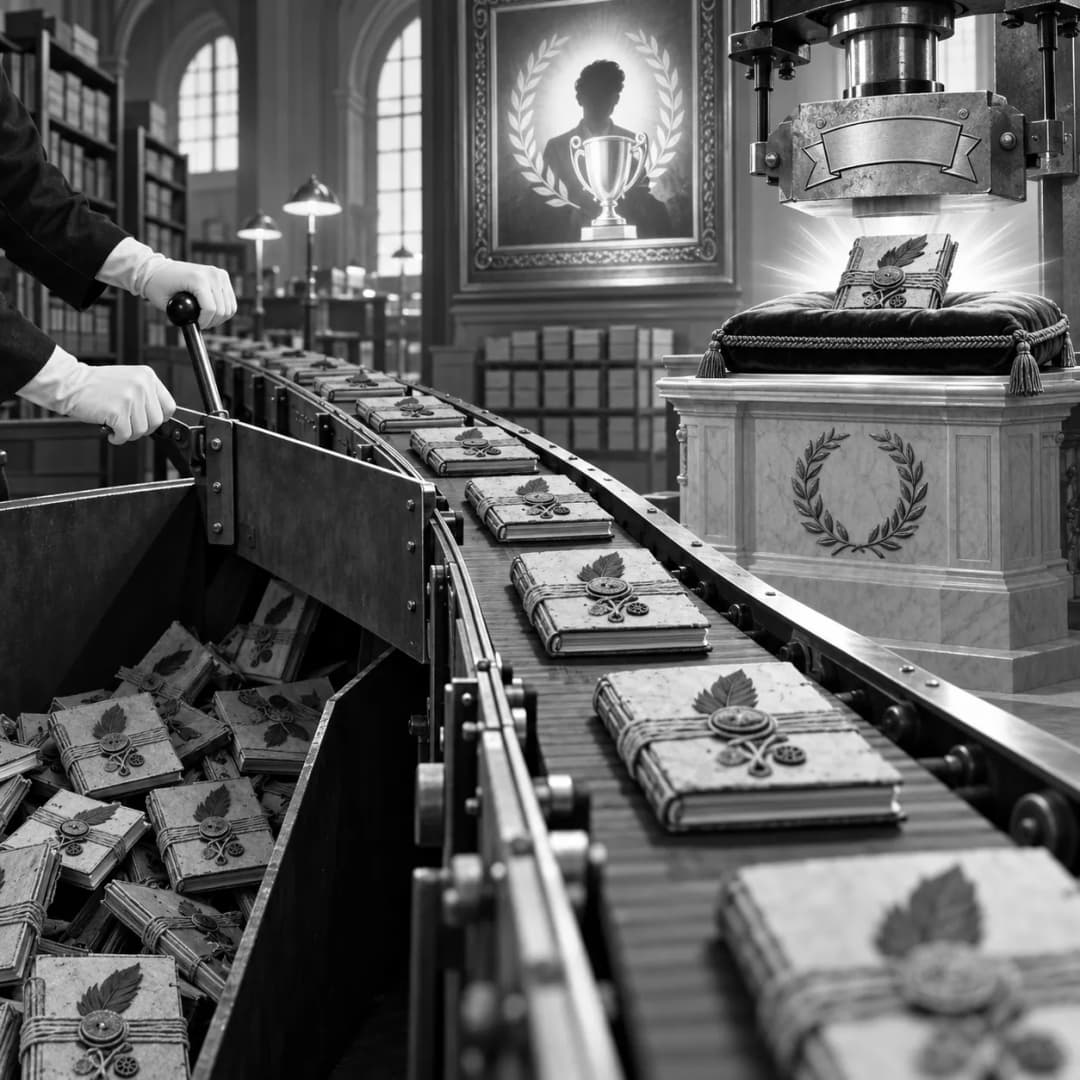
Retrospective endorsement is a practice becoming advice only after its practitioner becomes eminent, and never before. The habit is unchanged throughout. What changes is the outcome attached to the person doing it, and the outcome is what licenses the instruction. It is the exact mirror image of the evaluation literature, which shows judges marking novelty down while the verdict is still open, where the advice shelf prints the same novelty as an instruction once the verdict is in.
What it is
This is a naming rather than a finding, which is what the evidence status records. The underlying selection problem is survivorship bias and is well established, and the name here is this vault's own label for the publishing form it takes. The cleanest book-length specimen is a 2018 gift book of 56 one-spread profiles of creative figures, in which every text page carries a monospace running head that is an imperative rather than a name, among them PURSUE THE NEW, EMBRACE CHAOS and GO TO THE PUB. The subject illustrates the habit rather than the other way round, and the inference from this person did it and was great to do it is nowhere argued. It is typeset.
In effect
Two internal contradictions the book never notices make the point without any need for external evidence. One subject declares that creative block does not exist while another is praised for rarely suffering it. One says five days is enough for a screenplay and that more than two weeks means something is wrong, while another is celebrated for taking thirteen years. Both pairs are presented as method, and nothing in the volume could adjudicate between them, because the selection rule for entry was fame. Nobody prints a running head over a failure.
What it does not say
It does not say the practices are worthless, since a habit that appears only among successful people may still be a good habit and the selection problem cannot tell you either way. It does not establish anything about how new work is received, because the book contains no gatekeeper, no editor, no commissioning panel and no audience anywhere in its 125 pages, and that absence is the finding rather than an oversight to be filled in. And nothing on this page may be used as authority for a fact about any person, since the seed book is cited for its own framing only and its named citations were found in worse shape than its unsourced claims.
Sources
- Gosling, E. (2018). Great Minds Don't Think Alike: Discover the method and madness of 56 creative geniuses. ILEX, Octopus Publishing Group. ISBN 978-1-78157-537-6. Cited for the book's own framing and never as authority for a fact about any person. Fifty-six profiles, running heads from p. 13 to p. 125, the Introduction at pp. 8 to 11, and the contradictions noted at pp. 79, 97, 113 and 117. No notes, no bibliography and no index; the whole apparatus is nine sources named in the running prose.
- Mueller, J. S., Melwani, S., & Goncalo, J. A. (2012). "The Bias Against Creativity: Why People Desire but Reject Creative Ideas." Psychological Science, 23(1), 13-17. doi:10.1177/0956797611421018. The literature this is the mirror of.
- The vault's external verification pass of 20 September 2026, which found four of the book's most memorable stories descending from nineteenth-century fabricators and concluded that a citation is not a verification.