Ritual-Based Redesign of Routines
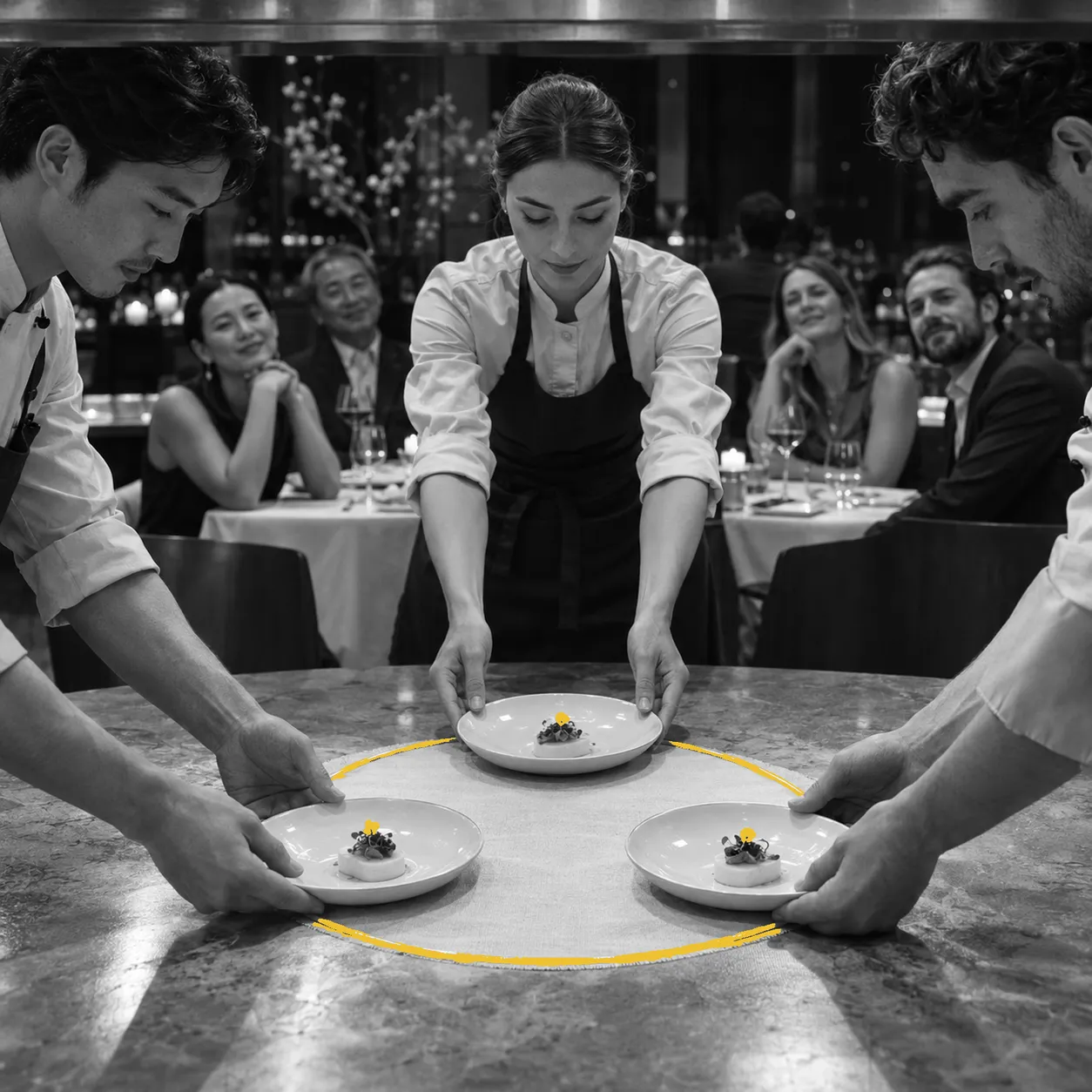
Ritual-based redesign of routines is redesigning an existing work routine as a ritual. In a field experiment in a working restaurant, a welcome entree routine was redesigned as a ritual, and the authors report greater shared purpose and cohesion among staff and higher enjoyment among diners.
What it is
Claudia Cozzio and Andrea Furlan ran a mixed methods field experiment centred on a restaurant's welcome entree routine. The routine was first observed and then redesigned as a ritual. The study reports that the redesign increased employee sharing of the routine's purpose, reduced variability in execution time, increased group cohesion among staff and increased the enjoyment of end consumers.
The design is notable because it moves ritual research out of the laboratory and into a place where people work and eat.
In effect
In the article on whether rituals make food taste better, the study is the field counterpart to the chocolate experiments. The staff performed the ritual and the diners received it, so the benefit ran in two directions.
What it does not say
It does not say that every routine gains from being made a ritual. It is one field experiment in one setting, and the evidence is preliminary.
Where it comes from
Claudia Cozzio and Andrea Furlan published the study in the International Journal of Contemporary Hospitality Management in 2022 under the title Ritual-based redesign of routines: An experimental approach in the restaurant industry. It extends laboratory work on rituals, such as the 2013 chocolate and lemonade experiments, into a working restaurant. The vault records the originators with medium confidence and the evidence status as primary-cited.
How it shows up
The researchers observed the restaurant's welcome entree routine as it happened, then redesigned it as a ritual. The authors report that the redesign helped staff share the purpose of the routine, made the time each performance took vary less, and raised group cohesion among staff. They also report that it increased the enjoyment of diners.
The roles differ from the laboratory tasks. In the chocolate experiment the person who ate performed the ritual, and watching did less. In the restaurant the staff performed the ritual and the diners received it. The lab result points to personal involvement and the field result points to a benefit for guests, so the setting decides who gains.
The finding also shows a second use of ritual, as a design tool for teams. A routine that is performed the same way, with a shared meaning, can coordinate people as well as enhance the experience of those it serves.
Where opinion differs
Field studies in a single setting are informative about that setting. Whether a redesigned welcome would work in other kitchens, cultures or price ranges is a separate question, and the study does not answer it. Hospitality practitioners often use set-piece service moments already, and may see the result as support for a familiar practice. Researchers will want more settings, comparison with other changes to the routine, and diner outcomes that do not depend on self-report. This page reports only what the authors report and does not add figures beyond that.
How this site uses it
The Why We Project uses the study as the field counterpart to the chocolate experiments in Do rituals make food taste better?, to show that ritual is a design variable for hospitality businesses as well as a laboratory phenomenon.
Reading the evidence
The study is useful because it moves a laboratory idea into a working setting, and the setting brings both strengths and limits. Strengths include real staff, real diners and a routine that already existed. The limits are that one restaurant cannot stand for the sector, that diners' enjoyment is a report and not a measurement of taste, and that a redesign changes several things at once, including attention, timing and team spirit.
For a hospitality manager the practical reading is modest. A welcome routine can be treated as something that is designed, performed consistently and given a shared purpose. Whether that raises enjoyment in another venue is a question that venue can answer by changing one routine and comparing it with an unchanged one. The same logic applies to any team routine, such as a shift handover or an opening checklist, where the shared purpose is easier to state than the sequence of steps.
Sources
- Vohs, K. D., Wang, Y., Gino, F., & Norton, M. I. (2013). Rituals enhance consumption. Psychological Science, 24(9), 1714-1721. doi:10.1177/0956797613478949. Four experiments; bibliographic record verified at OpenAlex and the study read through its published description.
- Cozzio, C., & Furlan, A. (2022). Ritual-based redesign of routines: An experimental approach in the restaurant industry. International Journal of Contemporary Hospitality Management, 35(6), 2113-2135. doi:10.1108/ijchm-01-2022-0056.
- Hobson, N. M., Schroeder, J., Risen, J. L., Xygalatas, D., & Inzlicht, M. (2017). The psychology of rituals: An integrative review and process-based framework. Personality and Social Psychology Review, 22(3), 260-284. doi:10.1177/1088868317734944.
- Sutherland, R. (2019). Alchemy. WH Allen. Source of the argument that meaning, and not only physical properties, shapes how people respond to a product.
In these themes
- Culture and Ritual
How customs, seasons and ceremonies shape what we do and buy.