Salient Distractor Suppression
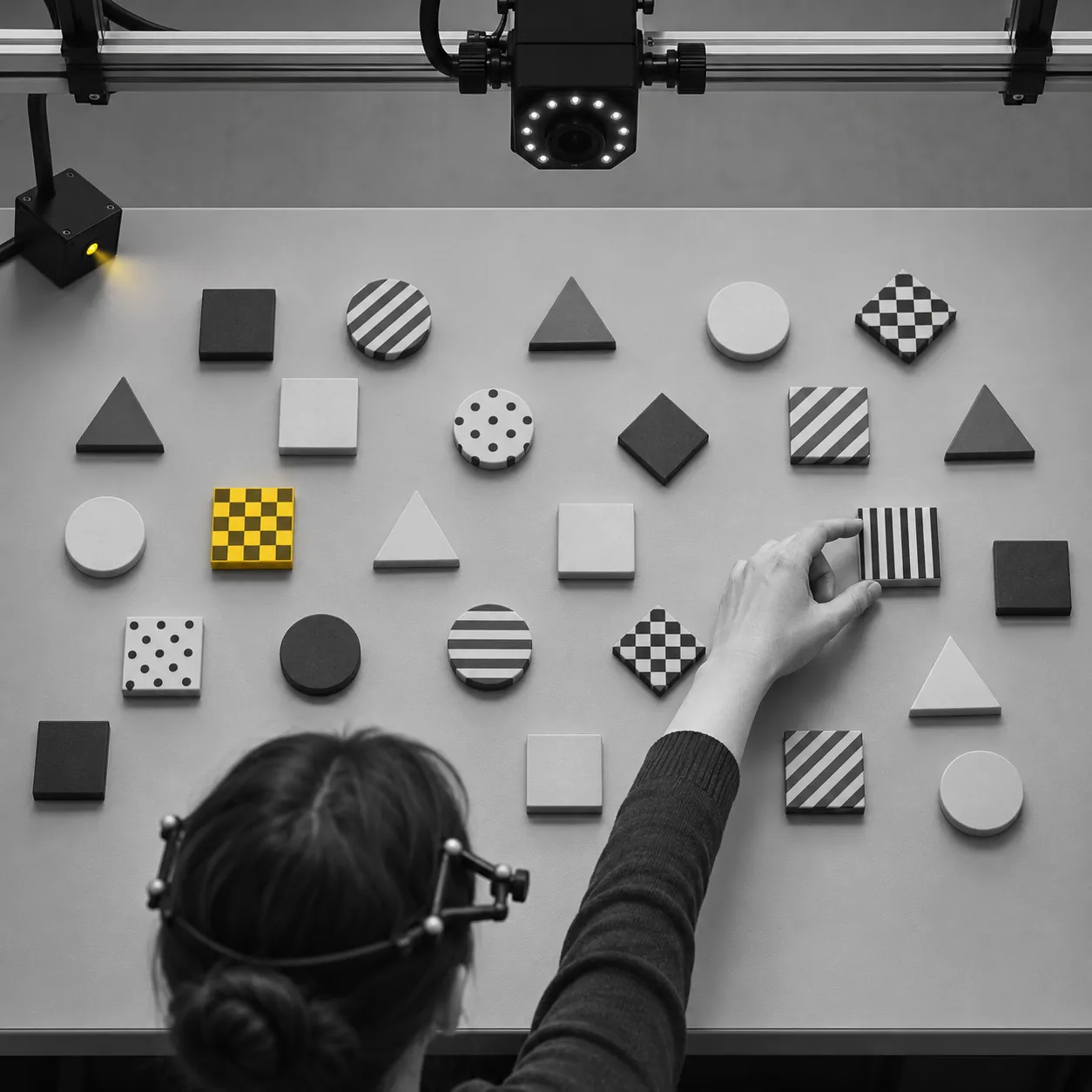
Salient distractor suppression is the ability of the attention system to ignore an odd, eye-catching item in a display. In a 2025 study by Brandi Lee Drisdelle, Alon Zivony and Martin Eimer, the odd item was ignored when its colours were fixed, but not when target and odd-item colours were swapped, and the effect reappeared when the target colour could take one of eight random values.
What it is
In visual search experiments, one item in a display is made different from the rest, often in colour. Such an item can draw attention. The question behind this concept is whether the system can learn to ignore it, and under what conditions. The authors note that earlier work suggested suppression of salient distractors was possible only when their features were constant and predictable.
In effect
Drisdelle, Zivony and Eimer used a multiframe letter-probe paradigm. They report suppression when singleton colours were fixed and no suppression when target and singleton colours were swapped. When the target colour could be any of eight random colours, the suppression effect reappeared. They conclude that first-order suppression is not universal, and that suppression effects appear even without targets, which they attribute to competition between target and singleton.
For a brand, the laboratory result offers a way to think about colour choice: an odd-coloured item can draw the eye, and it can be ignored more readily once its colour is predictable. In a category where most packs share one colour, that colour is no longer the odd one out.
What it does not say
The task used letters on a screen, and the result concerns colour in general. It says nothing specific to yellow, and it was not run on shelves, packs or advertisements. Moving from a display to a shelf is an extrapolation that would need its own test.
Sources
- Drisdelle, B. L., Zivony, A., & Eimer, M. (2025). Unpredictable singleton distractors in visual search can be subject to second-order suppression. Attention, Perception, & Psychophysics, 87(3). https://doi.org/10.3758/s13414-025-03028-3