Scriptura Continua
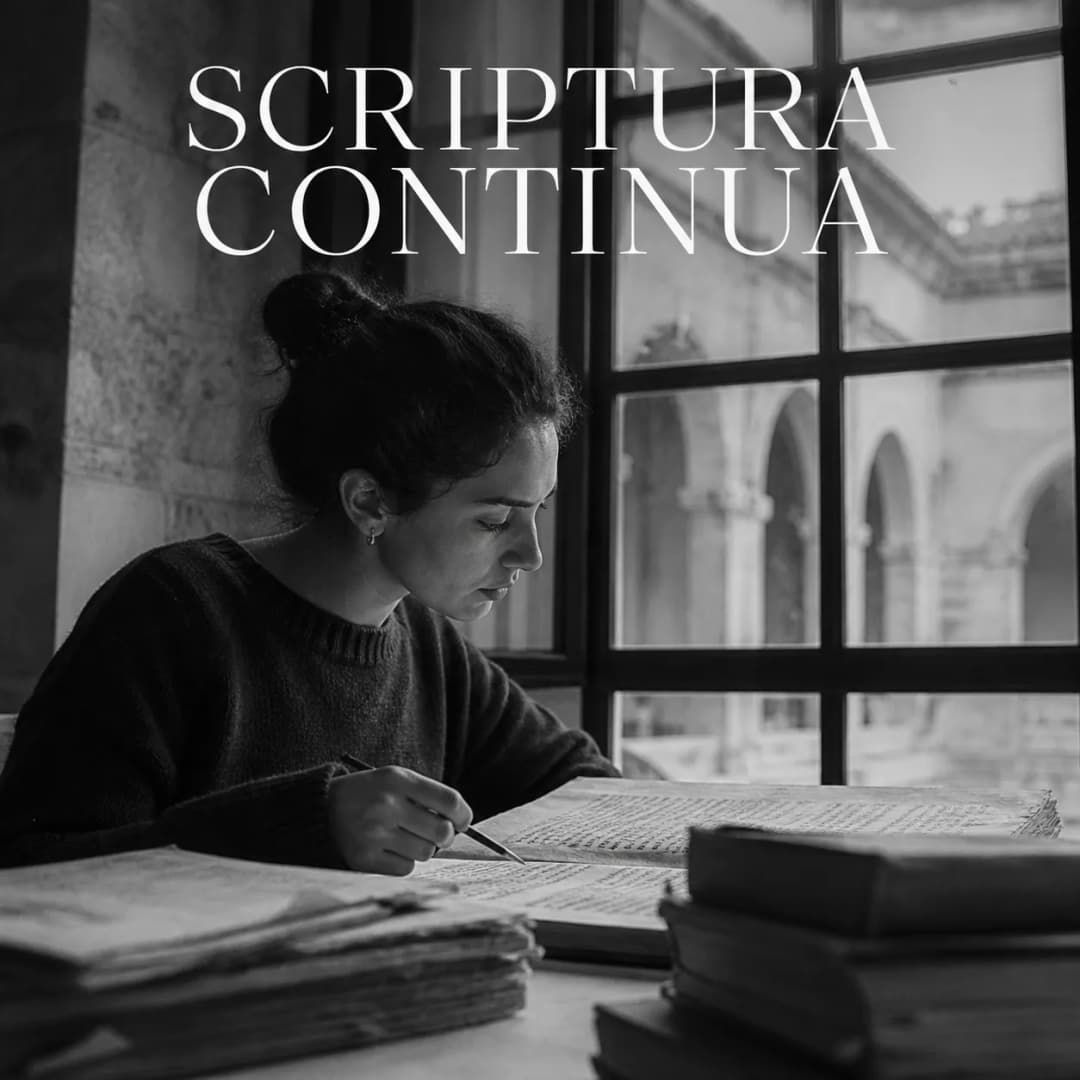
Scriptura continua is writing without spaces between words, the norm in Greek and Latin antiquity. Reading it was a decoding task rather than a fluent one, which is why reading aloud was standard and silent reading rare enough to be remarked upon. Word separation spread through the early medieval period and was established by the thirteenth century, and fluency followed. The idea matters because it makes fluent, silent, absorbed reading a historical achievement rather than a human default, and therefore something that can be lost.
What it is
Amodernreaderencounteringapageofancientgreekwouldbedoingtwojobsatonce. Where does one word end and the next begin, and what does the resulting sentence mean. The first job is invisible to us because it has been automated, and the second is the only one we notice. In antiquity both were conscious work, and the first consumed a good deal of the capacity available for the second.
That is the whole argument in one sentence, and it belongs to Paul Saenger, whose Space Between Words: The Origins of Silent Reading (Stanford University Press, 1997) is the standard account. Unspaced text, Saenger argues, combined with the flexible word order that classical languages permit, imposed a burden that kept reading slow, effortful and largely oral. You read aloud because hearing the sounds was part of how you worked out where the words were. Reading was closer to sight-reading a score than to what a person does with a novel on a train.
Word separation arrived gradually, spread through the early medieval period, and was established by the thirteenth century. What followed was fluency, and what fluency bought was capacity. Once decoding stopped consuming the reader's attention, that attention could be spent on the argument instead of on the letters. On Nicholas Carr's account in The Shallows, this is the precondition for deep reading, the sustained immersive mode in which a reader holds a long argument in mind long enough to form their own inferences, and therefore the precondition for the contemplative reader, who is on his reckoning roughly 550 years old.
The reason a publication about consumer psychology carries a page on a scribal practice is that this is the load-bearing half of a much-repeated modern argument. If deep reading is a built capacity rather than a natural one, then it is a cultural achievement that can be lost rather than a default that can be damaged, and the question of whether a medium is eroding it becomes a sensible question rather than a rhetorical one. That framing is doing real work in every screen-time argument written since.
It is also the half of Carr's argument that survives intact. Our reliability audit of The Shallows found that most of the neuroscience it rests on has failed to replicate. The historical chapters, on writing systems, the codex, silent reading, the map and the clock, are careful cultural history and hold up. That asymmetry is worth stating plainly, because the book is usually treated as a single claim to be accepted or rejected whole.
One overreach should travel with the idea rather than behind it. Carr asserts that an ancient reader's entire cortex "would have been buzzing with neural activity". That is an inference drawn from a historian's textual argument, not a measurement, and nobody has measured the cortex of a fourth-century reader. Saenger's case is documentary. It should be cited as documentary.
In effect
Erping Zhu, and the cost of a decision in the middle of a sentence
The closest thing to a controlled test of Saenger's mechanism is not about ancient text at all. Erping Zhu varied only the number of links inside otherwise identical passages, published in the Journal of Educational Multimedia and Hypermedia in 1999. As link count rose, comprehension scores fell, and so did readers' confidence in their own understanding. Every link is a decision, and a decision taken mid-sentence is extraneous load in John Sweller's sense: capacity spent on navigation rather than on the argument.
That is Saenger's burden with a different cause. The reader of scriptura continua spent capacity on locating word boundaries; the reader of a densely linked page spends it on evaluating exits. Neither is evidence for the other, and it would be a mistake to present the Zhu result as confirming a claim about antiquity. What it does establish is that the general shape of the argument, that a formatting decision can consume the attention meant for the meaning, is measurable rather than merely plausible.
Augustine watching Ambrose
The vivid case is a single passage in the Confessions, in which Augustine records his astonishment at watching Ambrose, Bishop of Milan, read without moving his lips. It is the standard illustration that reading practices are learned and changeable, and it is how most readers first meet the idea.
Handle it with more care than it usually receives. Historians of reading have argued for decades about how much weight the passage can bear. Augustine's surprise may have been at the particular circumstance rather than at silent reading as such, and there is evidence of silent reading well before him. Use it as a demonstration that the practice of reading has a history, never as proof that silent reading was invented in the fourth century.
The format a product would choose
The commercial descendant of this argument is a live design decision, and the research on it produces a result that ought to make anyone building a reading product uncomfortable. DeStefano and LeFevre's 2007 review in Computers in Human Behavior examined 38 studies and concluded that the disorientation and load of continually evaluating links interfere with comprehension, and that hypertext did not consistently beat linear presentation. In one comparison of a linear page with a hypertext version of the same lecture, the linear group comprehended more while the hypertext group found the material more interesting.
That divergence is the point. Engagement and understanding came apart, and a product optimising for time on page will take the format that lost. The bounded modern version of the same finding is screen inferiority: Delgado and colleagues' 2018 meta-analysis of 54 studies and over 170,000 participants found g = -0.21 for screen reading against print, with the effect appearing for expository text under time pressure and not for narrative text. Spacing words was a design decision that bought comprehension at no cost to anyone's revenue. Most subsequent design decisions about how text is presented have not had that shape.
What it does not say
It does not say the ancients could not read well, or that oral reading is inferior reading. Cultures built on recitation developed capacities that literate cultures largely lost, and Carr concedes as much. The claim is about the cost of decoding, not about the intelligence of the decoder.
It does not say silent reading was unknown before word separation, and the Augustine passage cannot carry that. The historical record is contested at exactly this point.
It does not say the internet is destroying deep reading. That is a separate claim, and it is the one that does not hold up. Our audit of The Shallows found that its neuroscientific supports have variously failed to replicate or were never independently replicated: the Google effect study, the phone-presence "brain drain" result, the fMRI search study, and the nature-walk attention finding. What survives as measured evidence is the modest, bounded screen-inferiority effect, which is a finding about expository text under time pressure rather than about brains.
It is not a research claim at all, and is tagged accordingly. Scriptura continua is a documented historical practice and Saenger's account of its cognitive cost is a historian's argument from texts. Replication does not apply to it, and neither does the language of effect sizes. Anyone citing it should cite it as history.
Who developed it
Nobody developed it. Scriptura continua is a scribal convention of Greek and Latin antiquity with no identifiable author, which is why this page records no originator. Our vault note listed Paul Saenger with the year 1997 in that field, and that is not right in the sense the field means: Saenger is the historian who established what unspaced writing cost its readers, in Space Between Words (1997), not the person who developed the practice. Nicholas Carr is the writer who carried the argument into the modern screen-time debate, in The Shallows (2010), borrowing the reading history from Saenger and the account of reading as a built capacity from Maryanne Wolf's Proust and the Squid (2007). Saenger has no page on this site yet.
Sources
- Saenger, P. (1997). Space Between Words: The Origins of Silent Reading. Stanford University Press. The standard account, reached here through Carr's chapter 4 rather than read directly.
- Carr, N. (2010). The Shallows: How the Internet Is Changing the Way We Think, Read and Remember. Atlantic Books. Chapter 4 for the reading history, chapter 7 for the alarm. Updated edition 2020 with an afterword.
- Wolf, M. (2007). Proust and the Squid. The underlying source for reading as a built rather than natural capacity.
- Augustine. Confessions. The passage on watching Ambrose read silently.
- Zhu, E. (1999). Journal of Educational Multimedia and Hypermedia, 8(3), 331-358. Link density against comprehension and confidence.
- DeStefano, D., & LeFevre, J.-A. (2007). Computers in Human Behavior, 23(3), 1616-1641. Review of 38 studies on hypertext and comprehension.
- Delgado, P., et al. (2018). Meta-analysis of 54 studies, over 170,000 participants, g = -0.21 for screen against print. Clinton (2019) gives g = -0.25. See Screen Inferiority.
- Where this came from
- 2 books in this library carry this concept, which is corroboration worth knowing about, though these authors read each other and often draw on the same experiments, so it is not independent confirmation.